How I Use Cycling to Become a Better Runner
A short cross-training framework.
Believe it or not, one of the most frequently asked questions I get about running isn’t even about running. It’s about how I use cycling to run better.
Indeed, cycling has become a huge part of my overall training in recent years, partly out of necessity and partly out of utility. I wanted to find a way to train more without putting myself at risk of injury. I’ve had several bone stress injuries in the last 5 years as a result of trying to aggressively increase volume, intensity, or both. So I had to problem solve, and that’s where I found (indoor) cycling.
The more I started cycling, the more I found it to be enjoyable and highly beneficial to my fitness and running performance. I wish I’d discovered it sooner.
For me—and most runners interested in cross-training—the looming question is how well cycling translates to running.
I was thinking about this recently because I came across a new systematic review and meta-analysis that looked at whether cycling can improve or maintain running-related fitness and performance compared with running itself. The review included seven randomized controlled trials lasting at least four weeks, comparing running-only, cycling-only, and combined run-bike training. The outcomes included VO2 max measured on a treadmill, VO2 max measured on a bike, and running performance over distances like 1 mile, 3,000 meters, and 5,000 meters.
The interesting part: there were no statistically significant differences between running-only and cycling-only training for treadmill VO2 max, cycling VO2 max, or running performance.
Now, that does not mean cycling is magically the same as running. Run-only training still tended to favor treadmill VO2 max. Cycling-only training favored cycling VO2 max. And the evidence base was small, with some limitations in the included studies. But for a lot of the aerobic work runners are trying to get, cycling may be a pretty good substitute.
That’s basically how I use it. And I thought I’d use this post to outline my framework. I hope you find it useful.
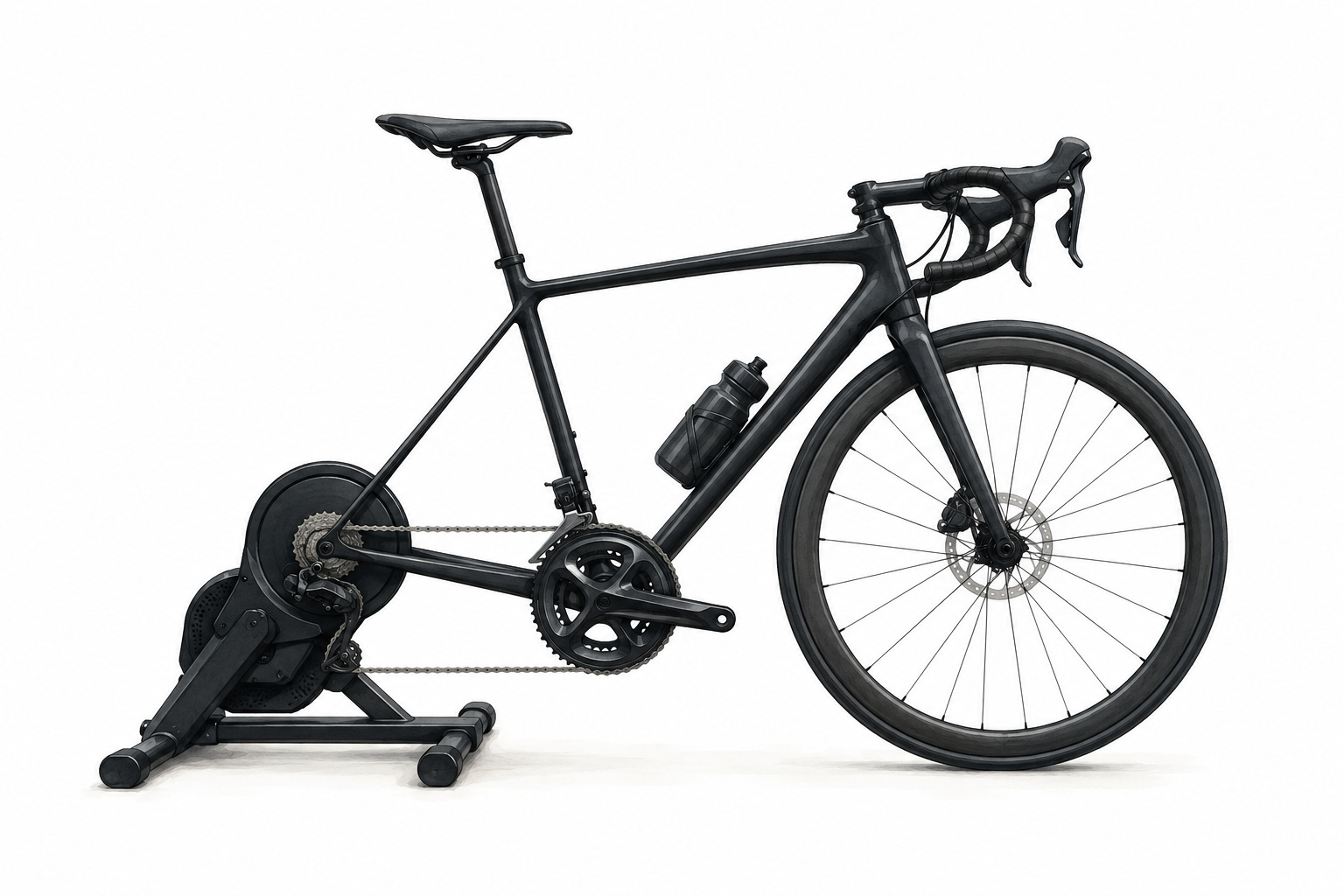
(For what it’s worth, all of my training is done indoors on the Zwift Ride Smart Trainer, which I have paired with a Wahoo Kickr Core. It’s so much fun).
More volume without adding pounding
The biggest role cycling plays in my training is that it lets me do more aerobic work than I could probably tolerate if all of that work came from running.
Most weeks, I run five days and leave two days as bike-only days. Those are not complete rest days. They are more like no-impact aerobic days. I’m still training and getting a cardiovascular stimulus and a lot of time in a lower-intensity aerobic domain without thousands of extra footstrikes. That tradeoff is huge.
On those bike days, I might ride two to three hours at once.
Or I might split it into two shorter rides—something like 60 to 90 minutes each.
The exact structure depends on the day, but the general idea is to get a lot of aerobic work in without making my legs absorb the kind of mechanical stress they would from another easy run. In my head, the very rough back-of-the-envelope version is that I’m trying to add the aerobic stimulus of maybe an extra 20 to 30 miles per week without literally running 20 to 30 more miles per week.
That’s obviously not a perfect conversion. I’m not pretending that three hours on the bike is exactly the same as [X] number of running miles. Running is still running. But from an aerobic standpoint, the bike lets me add meaningful work around the edges. And from an injury-risk standpoint, it’s just a completely different proposition than adding more mileage on my feet. It’s not “free fitness” and still comes with fatigue that needs to be managed… but it’s the closest thing to a training “cheat code” I’ve found.
As a deload day after hard workouts or long runs
The other big use case is “recovery.”
I’m not as young as I used to be (33 next week), and I can feel that after certain sessions. A hard interval workout takes something out of me. So does a long run.
The day after those sessions, I need blood flow and movement, but I don’t necessarily want or need another run, even if that run is technically “easy.” An easy run can be “easy” metabolically but still costly from a structural/mechanical perspective. For me, that matters because bone stress has been an issue in the past. So I’m always thinking about how to get the training effect I want without being careless about the cost. And cycling fits perfectly here.
After most hard workout days, I bike the next day.
Same thing after most long runs (usually 18+ miles).
It gives me a day where my body gets a real deload from running mechanics, but I’m not just sitting around doing nothing, and often, I’m working out at an intensity slightly higher than the easy run I’d be doing. And I usually feel better for it. I get some circulation, I keep the rhythm of the week going, and I’m not digging the same hole I might dig by adding another run.
Make the second daily run a ride (double workouts)
I like training twice per day a few times per week. So a lot of the time, the second session of the day becomes a ride.
Double runs can be great for building volume, improving aerobic fitness, and getting used to training on tired legs. But double runs are also more impact. And depending on where I am in a training block, I don’t always want that. So I swap a second run for an easy (or sometimes hard) bike ride.
For example, if I do a hard running workout in the morning, instead of coming back later for an easy 4- to 6-mile jog (a staple double run for me), I might do 60 to 75 minutes easy on the bike.
That still gives me the feeling and aerobic benefit of a double. I get a second session, but I usually feel much better the next day than I would if that second session had been another run.
Sometimes I’ll use the bike for a harder second session, almost like a modified double-threshold day.
Instead of doing two quality runs in one day, I might run one workout in the morning and then do the second aerobic or threshold-type session on the bike in the afternoon. That way, I still get another real training stimulus, but I’m not taking the same injury risk I would from a second hard run that might be what tips me over the edge.
This is actually one of the places where I think cycling is underrated for runners. We often think of cross-training as something to do when we’re hurt. And it can be that. But it can also be something to use proactively, while healthy, to get more work in. This has probably been the biggest mindset shift for me lately.
Let me be clear. A hard bike session is not free… it still creates fatigue. But the orthopedic cost is much lower. So if I want another strong cardiovascular stimulus, the bike gives me a way to get it with a much bigger margin of safety.
The simplest way I think about cycling for running is this: sometimes your engine can handle more than your chassis can.
My aerobic system might be capable of absorbing more work, but my bones, tendons, muscles, and connective tissue might not be ready for more running (or especially more fast running).
Cycling helps train the engine without constantly stress-testing the chassis.
This also presents somewhat of a conundrum in the opposite direction.
If I want to race well, especially over a distance like the marathon, I need enough running to prepare my body for the specific demands of running. Long runs, workouts, race-pace work, and enough weekly mileage to make running feel natural and efficient are still indispensable. So I do not replace those pieces with cycling! But I am very willing to replace some easy mileage, some recovery runs, and some second sessions with cycling if it lets me do more total aerobic work while staying healthier.
The bike supports running; it doesn’t fully replace it.
What does this look like in practice?
In a typical week, my schedule consists of five days of running and two bike-only days (though I might run more than 5 times or bike more than 2 times if I’m doing a couple of twice-per-day training days).
The bike-only days usually come after the hardest run sessions of the week. If I do intervals, the next day is probably a ride. If I do a long run, the next day is probably a ride. If I want a second session later in the day but don’t want more impact, I’ll ride instead of running again.
Sometimes that ride is very easy. Sometimes it’s longer and steady. Occasionally, it becomes a real workout. Admittedly, I don’t have a formal structure for this. I sort of just go on vibes, what I’m training for, and what the rest of the week looks like.
But the purpose is always the same—add aerobic work while mitigating risk.
That is the whole game for me, because running improvement is not just about how much work I can do. It’s about how much work I can absorb, consistently, over time (something that being injured is not very conducive to).
For me, cycling is not a compromise. I see it as a pressure-release valve in a way. It lets me train more without pretending my body has unlimited tolerance to pound out running miles (I don’t). And it’s become something I actually look forward to doing, which I never thought I’d say about cross-training!
Thanks for reading.
~Brady~


Nice text! I do triathlon and in the last years I increased my volume of swimming because it’s a way to keep my level of aerobic activity without impact!