

Greetings!
Welcome to the Physiology Friday newsletter.
Details about the sponsors of this newsletter and deals on products I love, including Ketone-IQ, Create creatine, Equip Foods, and ProBio Nutrition can be found at the end of the post.
I don’t claim to have all the answers when it comes to health and fitness. And I don’t pride myself on being one of those people who tries to “debunk” everything. But when I see some science that I know is clearly being misrepresented, I can’t help but call it out.
That’s what happened this week with a viral post claiming that regular exercise is linked to slower biological aging, but only in people sleeping 7+ hours per night—and that people sleeping under 6 hours who exercise “actually age faster.”
It made for a great (and sadly viral) social-media claim. It’s also not what the study, nor the broader literature, shows.
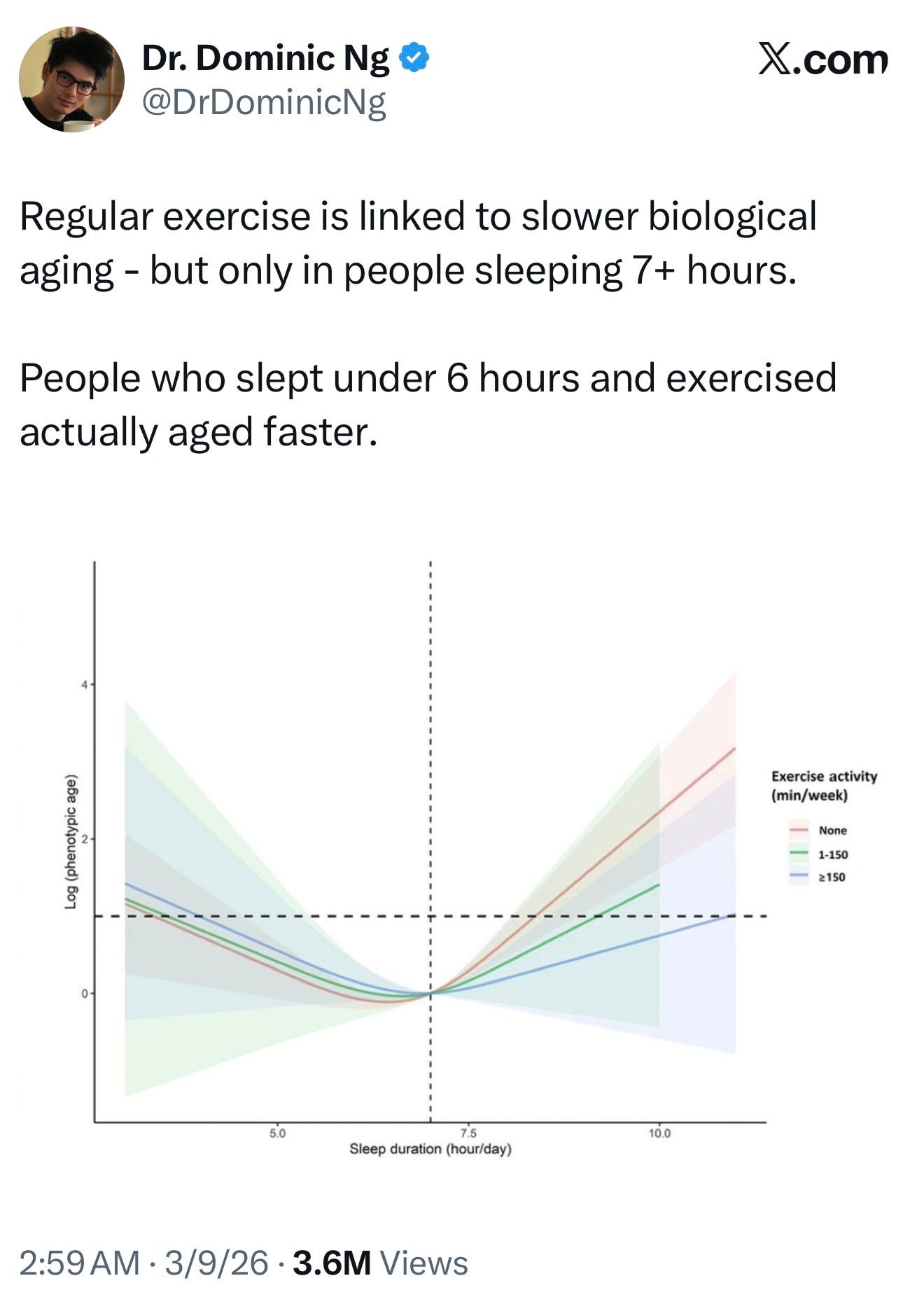
The post (and paper) in question was a cross-sectional NHANES analysis looking at sleep duration, phenotypic age, and exercise activity in 13,569 U.S. adults. Sleep was self-reported. The paper’s goal was to look at associations between sleep duration and a biomarker-based estimate of biological aging called phenotypic age, and then examine whether exercise participation might modify that relationship. That’s an interesting question. But right away, there are limitations. This was observational, cross-sectional, and based on self-reported sleep. So it cannot tell us that exercise causes faster aging in short sleepers. It cannot even really tell us the direction of the relationship.
And then there’s the bigger problem that the subgroup results that went viral were read backwards.
In the paper’s Figure 4a, the no-exercise group showed positive associations between short sleep, extreme short sleep, and long sleep and phenotypic age (higher phenotypic age is not a good thing in this context). But in the group doing more than 150 minutes per week of exercise activity, short sleep, extreme short sleep, and long sleep actually had a lowerphenotypic age relative to normal sleep in that same activity group!
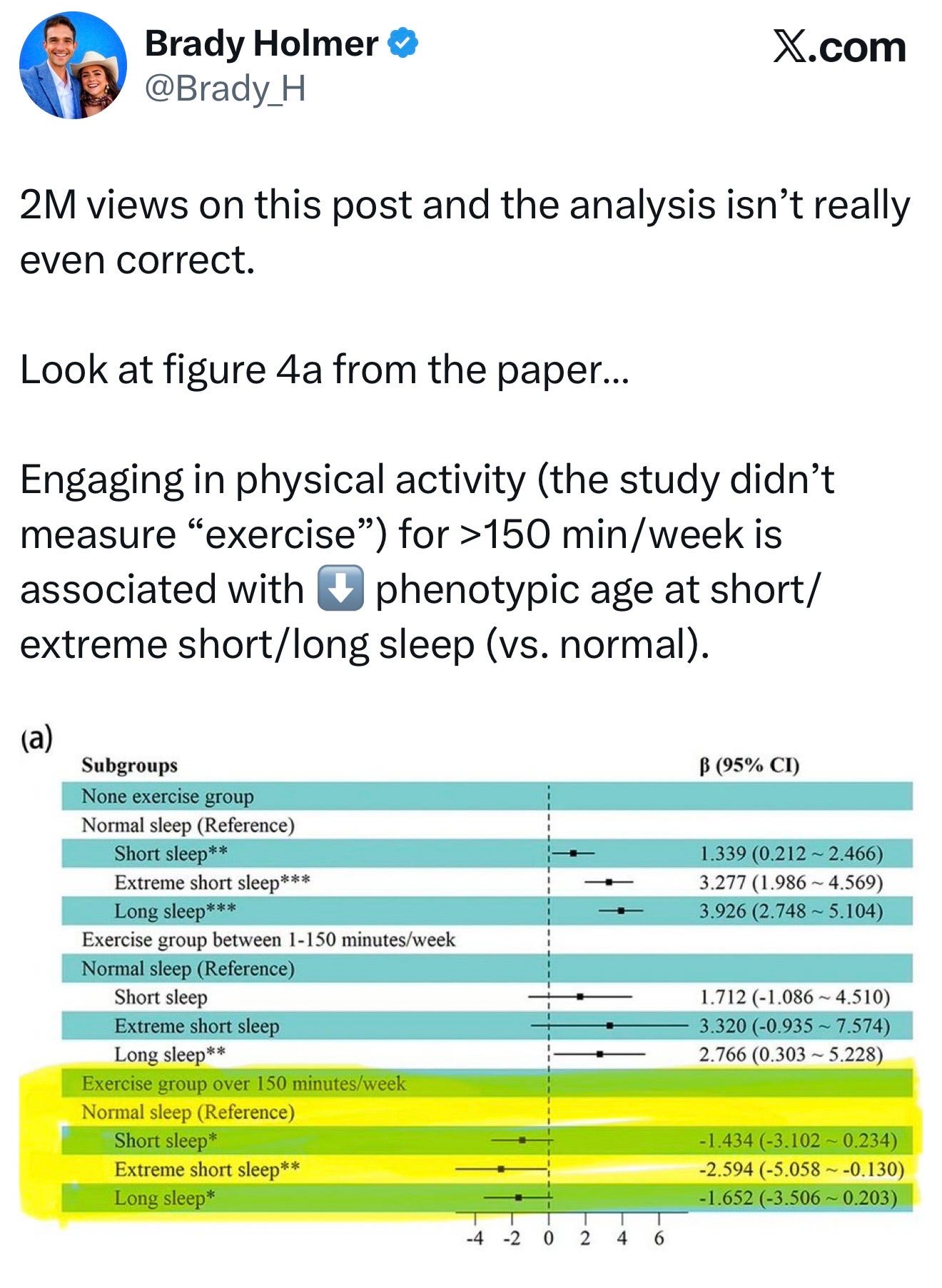
The authors then say that “the short sleep group with more exercise tended to have a higher phenotypic age.” That’s their interpretation of that figure. But that is very different from saying the study showed that exercising while sleeping under 6 hours “ages you faster.” It didn’t. At minimum, the results are mixed and messy.
Maybe it seems like I’m being nit-picky. But I don’t think posts like this are inconsequential. Especially when they get millions of views. Because it potentially changes health behaviors.
If someone comes away from that viral post thinking, “I’m not sleeping enough, so maybe I shouldn’t exercise either,” that is a genuinely bad takeaway. Sleep matters. A lot. But “sleep matters” is not the same thing as “exercise becomes harmful when sleep isn’t perfect.” Those are very different claims, and the evidence here does not justify the second one. In fact, it suggests exactly the opposite—exercise is protective in the context of insufficient sleep.
One example…
A much better recent study followed 59,078 UK Biobank participants prospectively and used device-measured sleep and physical activity rather than relying only on self-report. It tracked people for a median of 8.1 years and looked at how sleep, moderate-to-vigorous physical activity, and diet interacted to influence lifespan and healthspan. The big picture was not “exercise only helps if sleep is already perfect.” It was that modest concurrent improvements across these behaviors were associated with meaningful gains in lifespan and healthspan. And importantly, the authors noted that MVPA appeared to be the primary contributor to those gains. In fact, several of the lower-sleep, higher-MVPA groups did better on both lifespan and healthspan than groups with more normal sleep but low activity. Sleep still matters, but inactivity is not some neutral fallback position. In a way, you can out-exercise poor sleep, but you can’t outsleep inactivity.
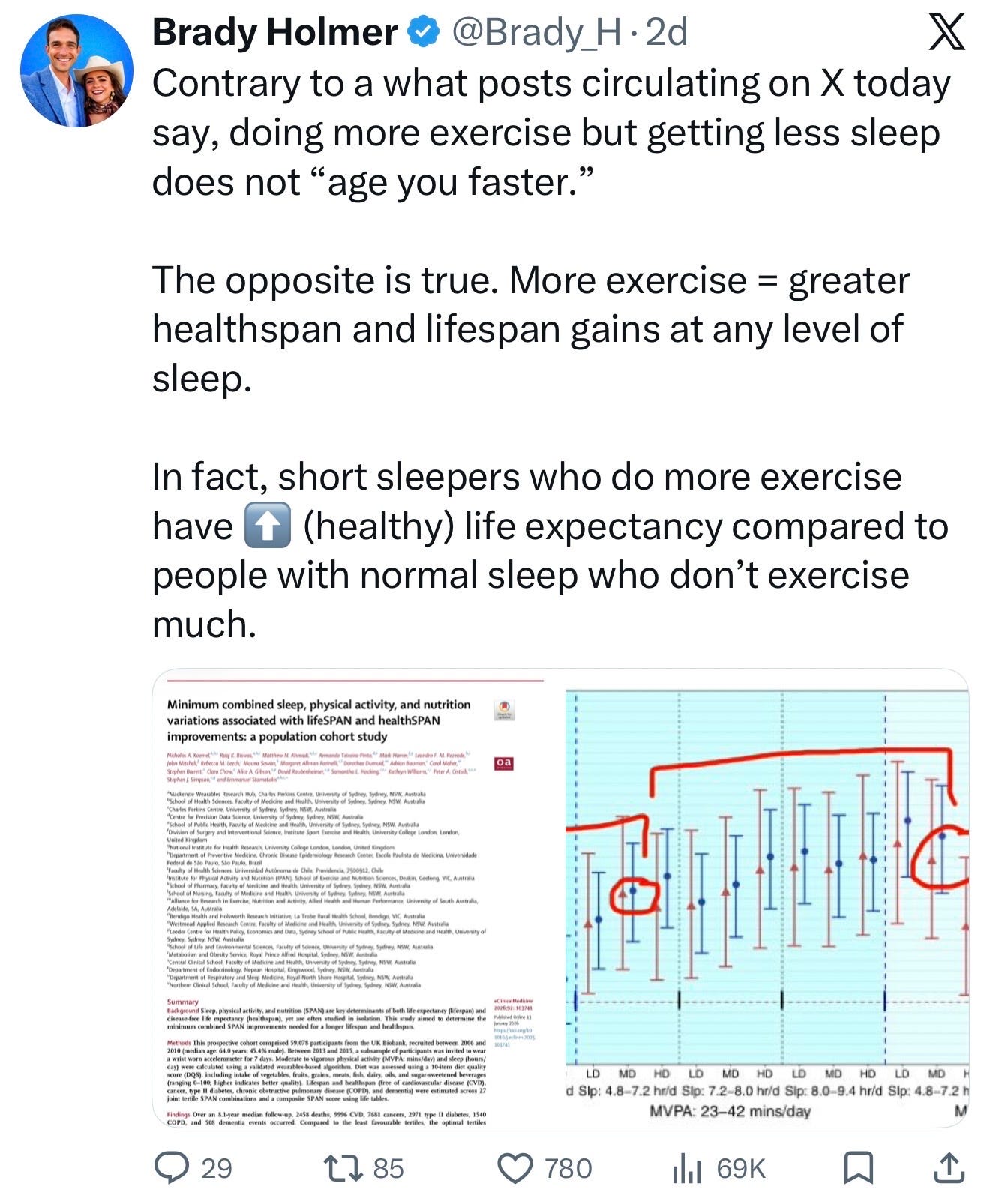
That paper also found that the minimum combined pattern associated with better lifespan and healthspan became apparent once people moved into the moderate MVPA category, regardless of the corresponding sleep and diet patterns. In other words, physical activity was one of the main drivers of benefit.
Of course, the highest gains were seen in people with high MVPA, moderate sleep, and high diet quality, but the broader pattern was clear—activity was protective, not dangerous.
That is why I think the viral interpretation of the first study is technically wrong (at best) and probably harmful (at worst).
A lot of people already have an all-or-nothing mindset with health. If sleep isn’t perfect, they assume the workout doesn’t count. If the diet isn’t perfect, they assume they blew the day. If recovery isn’t perfect, they assume training is pointless. That mindset is already a problem. And a message like “exercise may age you faster if you sleep under 6 hours” is not helping anyone.
The better message is that yes, poor sleep is a problem. Yes, you should work on it. But poor sleep is usually a reason to improve sleep and keep exercising—not a reason to avoid exercise.
To be clear, I’m not saying the first paper is worthless. It adds to the literature showing that abnormal sleep duration is associated with worse health-related outcomes and that the relationship between sleep and biological aging is complicated. It also raises an interesting hypothesis about how sleep duration and activity might interact. But hypothesis-generating is not the same thing as proving a clean public-health message. And it definitely is not the same thing as telling millions of people that exercise might be aging them faster if they didn’t sleep enough the night before.
A paper with self-reported sleep, cross-sectional data, and internally messy subgroup findings became a viral warning against exercise in short sleepers. Meanwhile, the broader literature points in the other direction. Overwhelmingly, physical activity remains one of the strongest protective behaviors we have, including in the context of imperfect sleep.
That’s the real story here.
And unfortunately, the version that spread left people with exactly the wrong idea. And what’s even more frustrating is that dozens of health influencers quoted that same post reinforcing the message, even though it was clear they didn’t even take a glance at the study that was being referenced.
That’s all I have for now. But safe to say this won’t be the last time I make a post like this. Unfortunately.
Thanks for reading. See you next Friday.
~Brady~
Ketone-IQ is high-performance energy in a bottle. I use it for post-exercise recovery along with enhancing focus, mood, and cognition. Take 30% off your order.

Create is the first “modern creatine” brand. They sell a wide range of creatine monohydrate gummies—and yeah, their gummies actually contain creatine, unlike some other brands. They’re giving my audience 20% off their order.

ProBio Nutrition—the all-in-one supplement that I use every single day—is offering 20% off. My preference is the tangy orange flavor, but they also sell an unflavored “smoothie booster” that’s great in a shake, smoothie, or juice.

Equip Foods makes some of the cleanest, best-tasting protein products around. I am absolutely obsessed with their Prime grass-fed protein bars (the peanut butter ones are to die for). Take 35% off a subscription.

If I'm not sleeping well exercise tends to help in my study of one. A few 5 k runs a week seems to do it.
It's great to see this research being clarified so thoughtfully. The connection between physical activity and mental resilience is vital, and it is important that people don't let "perfection" in one area, like sleep, prevent them from gaining the significant mental and physical benefits of movement. Thanks for a great read!