


Greetings!
Welcome to the Physiology Friday newsletter.
Details about the sponsors of this newsletter and deals on products I love, including Ketone-IQ, Create creatine, Equip Foods, and ProBio Nutrition can be found at the end of the post.
We like to think of exercise as falling neatly into one of two buckets: aerobic (“with oxygen”) or anaerobic (“without oxygen”).
Sprinting is anaerobic. Endurance exercise is aerobic. Nice and simple.
The problem is that the body is not nearly that tidy… it doesn’t flip from one energy system to another like a switch. It relies on overlapping pathways from the very first seconds of exercise, and what changes is the relative contribution of each pathway as the effort goes on.
I think this is one of those areas where exercise science has suffered a little from its own terminology. The labels “aerobic” and “anaerobic” are useful, but they can also be misleading when they get turned into hard categories instead of broad descriptions. And it’s really affected the way we (incorrectly) talk about exercise.
A background on energy systems
Muscle contraction always runs on ATP. That’s the immediate currency.
But ATP stores inside our muscles are tiny, so the body has to regenerate ATP constantly during exercise. It does that through three main bioenergetic pathways: the phosphagen system, glycolysis, and oxidative phosphorylation.
The phosphagen system is the fastest. It can resynthesize ATP almost instantly using phosphocreatine, which is why it dominates explosive efforts right out of the gate.
Glycolysis is also fast, relying mostly on carbohydrate and supplying ATP quickly without directly requiring oxygen, though it comes with a limited capacity and a fair amount of metabolic disruption (lactate is a byproduct of this process).
Oxidative phosphorylation is slower to ramp up, but it has by far the largest capacity, because it can keep supplying ATP over much longer durations as long as oxygen delivery and mitochondrial metabolism can keep up.
The key point is that these systems are always interacting. One may predominate, but they are not taking turns.
This is a concept underscored and (updated) in a new review paper.1
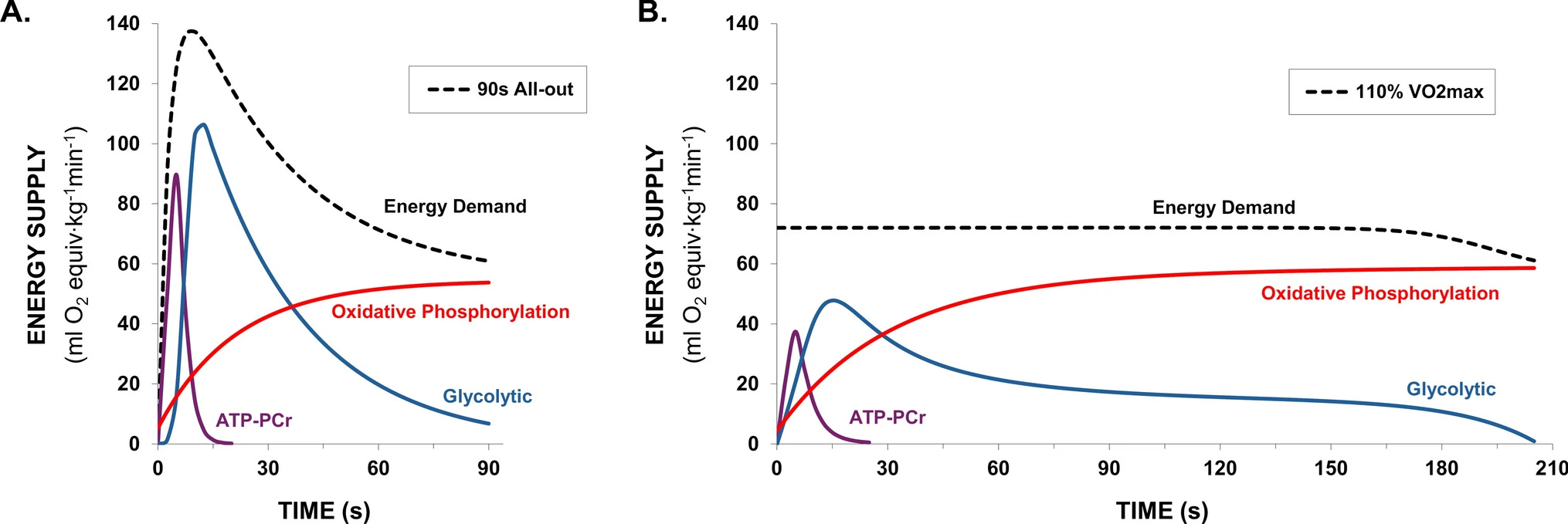
There’s a nice bit of historical context in the review.
A lot of this conversation traces back more than a century to the earliest studies measuring oxygen uptake during and after exercise. That work led to the concept of oxygen deficit, which is basically the gap between the oxygen an exercise bout would theoretically require and the oxygen the body has actually consumed. That gap became one of the classic ways to estimate the anaerobic contribution to energy production. In 1965, researchers introduced a concept known as critical power, which gave physiologists another way to think about the relationship between sustainable aerobic power and a finite amount of work that can be done above that threshold. This new review is really an updated attempt to synthesize decades of work built on those ideas.
The authors systematically searched seven databases and ended up including 102 studies, which together provided 311 data points from maximal exercise trials. Most of the data came from cycling and running, though the review also included swimming, kayaking, skiing, rowing, climbing, and arm-crank exercise. The participants were mostly trained adults, mostly male (unfortunately common in exercise physiology research), with an average age of about 24 years. The exercise bouts ranged from 6 seconds to more than 28 minutes. Then the authors modeled how the relative aerobic and anaerobic contributions changed across exercise duration.
One thing I appreciated is that the paper doesn’t pretend this is an easy measurement problem. A quick explanation…
Aerobic contribution is relatively straightforward to estimate because oxygen uptake during exercise can be measured directly (hence why you can get your maximal aerobic capacity measured in a lab). Anaerobic contribution is where things get messy. The review grouped studies into three main categories of how they measured it: oxygen deficit methods, mixed methods, and theoretical models.
Oxygen deficit methods estimate how much oxygen the exercise should have required, then compare that to what was actually consumed.
Mixed methods try to break anaerobic metabolism into phosphagen and glycolytic components using things like blood lactate, excess post-exercise oxygen consumption, and estimates of phosphocreatine.
Theoretical models use published physiology and mathematical assumptions to estimate the same thing.
All of these are useful, but none of them is perfect. In fact, the authors are very clear that there is still no universally accepted gold standard for quantifying anaerobic energy release during whole-body maximal exercise. Despite all of that methodological messiness, the overall pattern that emerged was pretty consistent. The model estimated that:
A 10-second maximal effort is about 91% anaerobic and 9% aerobic.
At 20 seconds, it’s 82% anaerobic and 18% aerobic.
At 30 seconds, it’s 75% anaerobic and 25% aerobic.
By 60 seconds, the effort is already estimated at 58% anaerobic and 42% aerobic.
Then comes the number that’s the cornerstone of the review. Equal aerobic and anaerobic contribution occurs at about 78.6 seconds. By 90 seconds, the aerobic contribution has already moved ahead, at roughly 54% aerobic and 46% anaerobic. At 2 minutes, the review estimates about 62% aerobic. At 3 minutes, about 72% aerobic. At 5 minutes, about 81% aerobic.
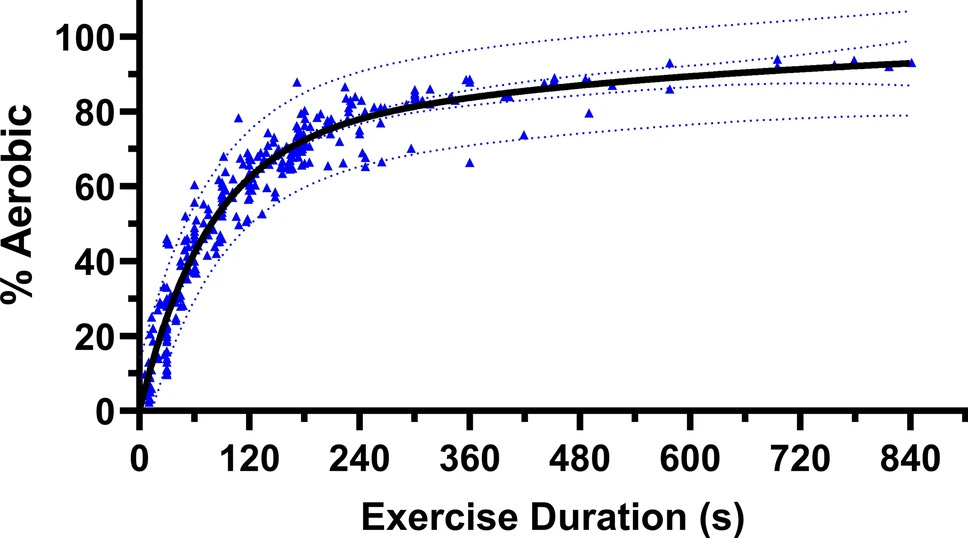
For me, the headline of the paper is that the aerobic system becomes important much earlier than most people assume. And it challenges the lazy version of the aerobic vs. anaerobic story.
We often talk as if short, hard exercise is basically anaerobic until some later point when the aerobic system finally joins the party. But the review makes clear that oxidative metabolism ramps up quickly during intense exercise.
The aerobic system is not a backup generator that kicks in late. It is contributing meaningfully even in very short maximal efforts, and its contribution rises fast. The authors also point out that oxygen uptake kinetics are faster during high-intensity exercise than traditionally appreciated, which helps explain why aerobic contribution is already substantial within the first minute or so.
The paper is careful not to oversell precision, which I think is important. These percentages are modeled estimates built from several different studies with varying exercise modes, protocols, and pacing strategies. So I wouldn’t treat 78.6 seconds as some magical physiological law written in stone. But the general conclusion is pretty persuasive—anaerobic energy supply is finite, aerobic energy supply is ongoing, and the balance between the two shifts earlier and more rapidly than a lot of our conventional thinking suggests.
In short, our old binary framing is too rigid.
The phosphagen, glycolytic, and oxidative energy systems are all involved from the outset of exercise. So the real question is not whether an effort is aerobic or anaerobic. The better question is how much each system is contributing, how quickly that balance changes, and what that means for performance and fatigue. That’s a much better (and much more interesting) way to think about exercise physiology, in my opinion.
Thanks for reading. See you next Friday.
~Brady~
Ketone-IQ is high-performance energy in a bottle. I use it for post-exercise recovery along with enhancing focus, mood, and cognition. Take 30% off your order.

Create is the first “modern creatine” brand. They sell a wide range of creatine monohydrate gummies, and just launched a new creatine + electrolyte mix product plus travel-size packets of creatine gummies. They’re giving my audience 20% off their order.

ProBio Nutrition—the all-in-one supplement that I use every single day—is offering 20% off. My preference is the tangy orange flavor, but they also sell an unflavored “smoothie booster” that’s great in a shake, smoothie, or juice.

Equip Foods makes some of the cleanest, best-tasting protein products around. I am absolutely obsessed with their Prime grass-fed protein bars (the peanut butter ones are to die for, but they also just released a new chocolate peanut butter flavor).

“the headline of the paper is that the aerobic system becomes important much earlier than most people assume. “
If you think how glucose is used isn’t it obvious we need oxidation after 20 sec or so? Otherwise one would bath in lactate and then hydrogen ions.
I am actually blown away for the fact that about every athlete and coach misses this most basic thing about metabolism. People really assume that we can oxidize CHO without glycolysis. Just look the pathway process chart!
Btw, basically high school biology taught that we get atp in roughly 1:15 ratio (glycolysis:oxidation) thus if we assume the same time for the processes the equilibrium is 6 % glycolysis and 94% for oxidation.
Thanks for explaining this to the world. It makes me extremely happy if people would understand what metabolia is.
Explains why I get winded just doing pushups and pull-ups.