


Greetings!
Welcome to the Physiology Friday newsletter.
Details about the sponsors of this newsletter and deals on products I love, including Ketone-IQ, Create creatine, Equip Foods, and ProBio Nutrition can be found at the end of the post.
I’ve run a few marathons in my life (4 to be exact). One thing that’s consistent after each one is the debilitating muscle soreness that often lingers for up to a week.
Another is that my brain typically feels like mush for a few days. I get the “runner’s high” like anyone else (especially after a personal best), but when it comes to any high-level thinking… consider me useless.
There’s probably a good explanation for that.
A few months ago, I wrote about a study showing temporary reductions in brain myelin content after marathon running. Myelin is the fat-rich insulation around axons in the brain that helps neural signals travel efficiently. So if you hear “myelin reduction,” your mind may immediately go to neurological disease or damage. But the prior study suggested that this reflected a reversible change after extreme endurance exercise, with recovery over time (levels normalized after about a month). What I found most interesting about the study was the mechanism.
Myelin is not just passive insulation. It’s a dynamic, metabolically active structure. Myelin is rich in lipids, and the cells that produce it (called oligodendrocytes) are increasingly understood as part of the brain’s energy-support system. That means myelin may not just help neurons communicate, but it may also be involved in how the brain manages energy demand under stress. Marathon running creates a very unusual metabolic state.
During prolonged endurance exercise, the body (and brain) gradually shifts toward greater reliance on fat as carbohydrate availability becomes more constrained. We understand that shift reasonably well in skeletal muscle. We understand it less well in the brain, which is usually thought of as a glucose-hungry organ, but it is not metabolically static. Under certain conditions, it can use alternative fuels, and the support cells around neurons may play an important role in helping neural circuits keep functioning when energy demand is high. The possibility raised by this line of research is that myelin is more metabolically flexible than we used to assume.
When the brain runs low on glucose in the latter stages of a marathon, myelin might provide energy-rich lipids as an “alternative” fuel source. Hence, myelin levels dropped post-race in the group of runners.
Well, the authors of that study just published a follow-up paper that asks (at least I think) a more interesting question: If myelin changes after a marathon, does brain function change too?1
The answer is not as simple as “yes” or “no.” The researchers found that basic neural signal transmission appeared preserved, while some higher-order cognitive functions showed temporary changes after the race. Let’s take a deeper look.
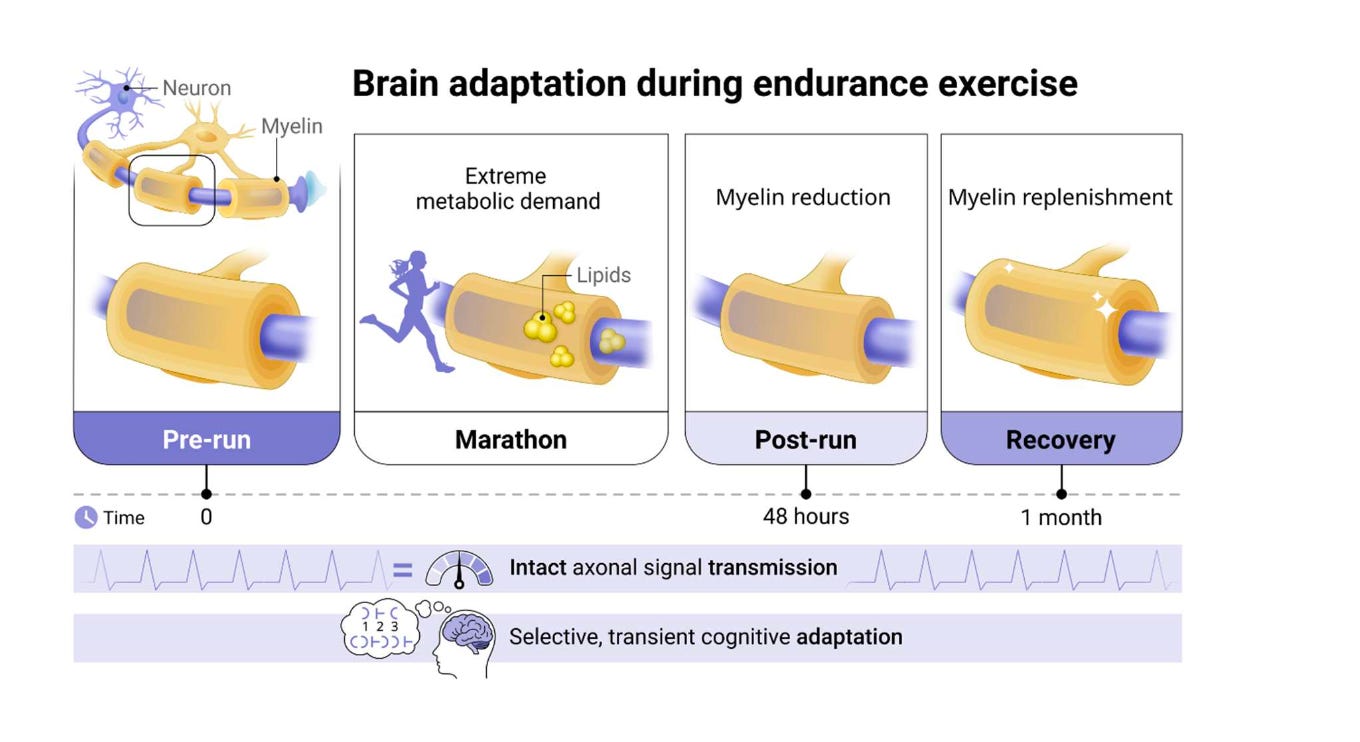
The study focused on two main questions.
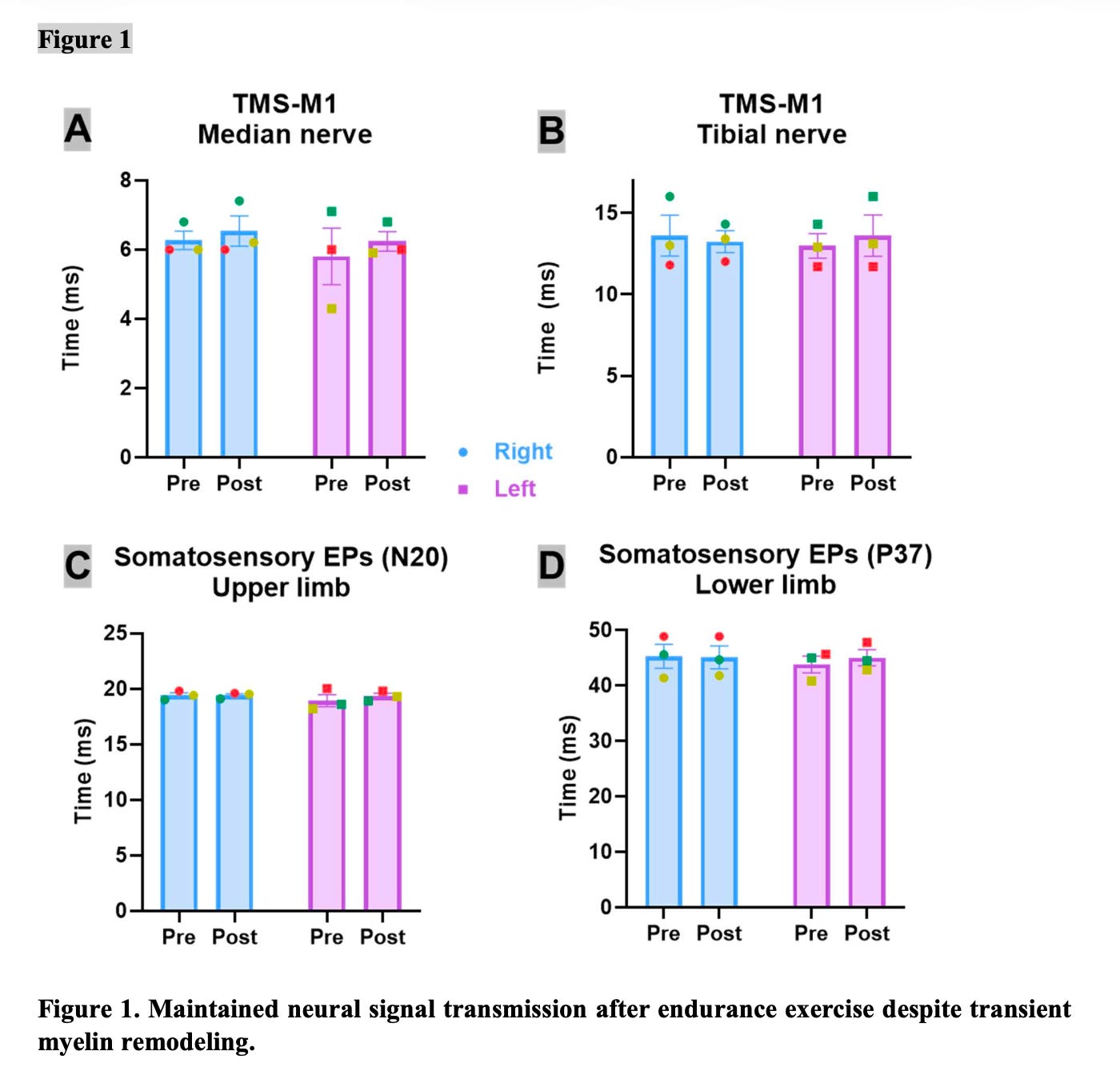
First, the researchers wanted to know whether neural signal transmission was preserved after marathon running. Since myelin helps determine how quickly signals travel through the nervous system, the most direct concern would be slower conduction. If a marathon meaningfully disrupted myelin function, you might expect motor, sensory, visual, or auditory pathways to show impairments.
Second, the researchers wanted to know whether cognitive performance changed after the race. They tested specific domains, including processing speed, interference control, visuomotor speed, attention, and executive flexibility.
I like this design because it separates basic neural transmission from higher-order cognition. Those are related, but they are not the same. The nervous system can preserve basic signaling while still showing temporary changes in more demanding cognitive tasks.
It turns out that distinction ends up being central to the study!
The participants were healthy adults divided into a marathon-running group and a non-running control group. The runners were recruited from official marathon or ultramarathon events and regularly engaged in endurance training. The control group came from the same general population, was matched as closely as possible for age and sex, and did not complete endurance events during the study period. Overall, the cognitive testing sample included 43 marathon runners and 29 controls. The neurophysiology portion (measuring conduction speeds) was much smaller, with only three runners, so I would treat that part as preliminary and proof-of-concept rather than definitive.
Participants were tested before the race, within 48 hours after finishing, and again one month later. Controls were tested at similar time intervals. This is important because cognitive testing has practice effects. If you repeat the same test multiple times, you often improve simply because you understand the task better. Having a control group allowed the researchers to compare post-race changes against normal learning effects.
The most reassuring result (if you’re a marathon runner) was that neural signal transmission appeared stable after marathon running. The researchers also looked at response amplitudes, which can reflect the strength or excitability of the brain’s response to stimuli. These were stable as well, with no consistent post-marathon reductions.
This suggests that even if MRI markers of myelin content change after extreme endurance exercise (as shown in the prior study), the basic timing of neural communication may be preserved. The nervous system may have enough redundancy or “buffering capacity” that short-term myelin remodeling does not translate into obvious deficits in neuron signaling.
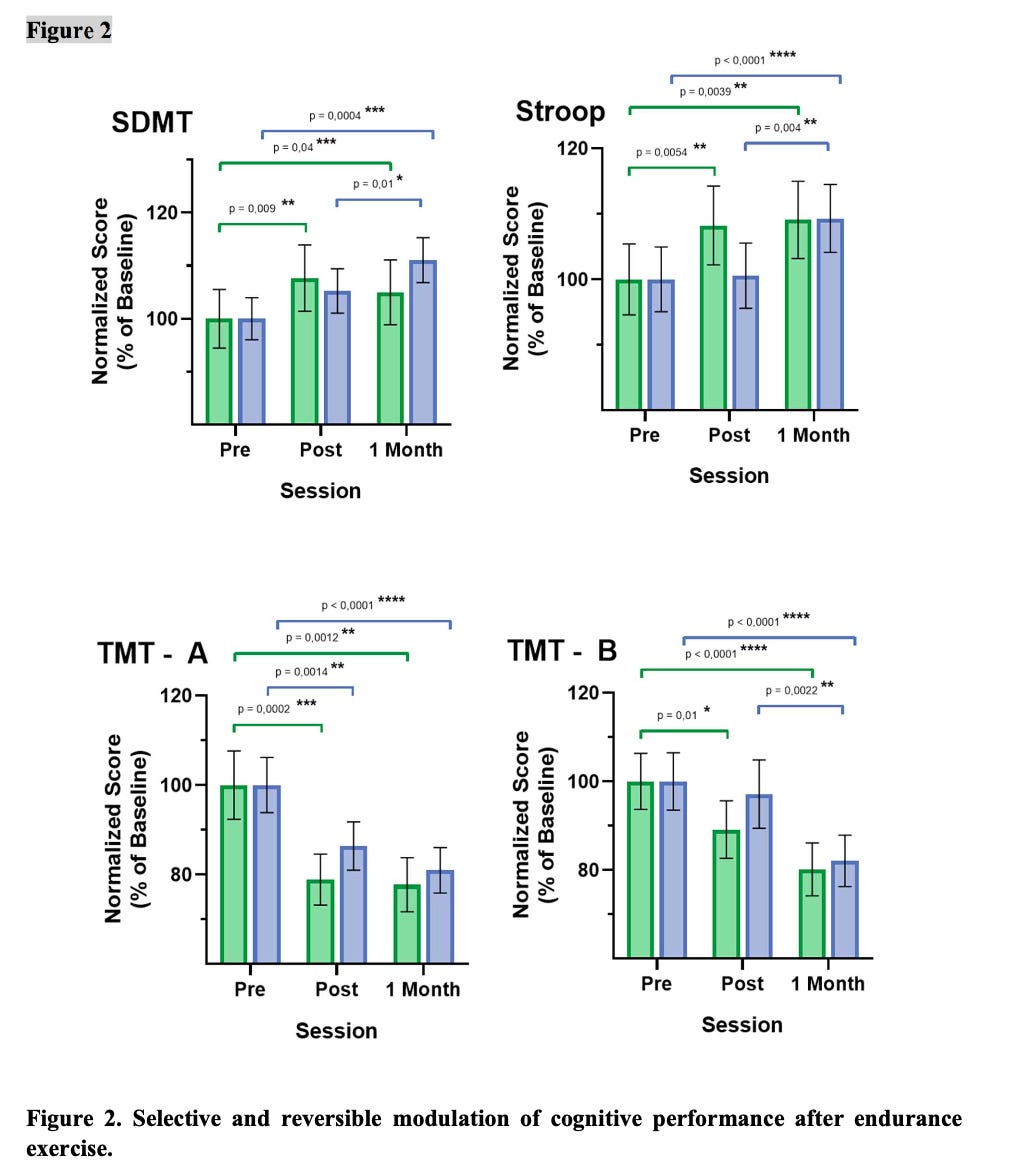
On the cognitive tests, the pattern was not that runners became broadly impaired after the marathon, but that certain higher-order functions looked temporarily less efficient. In a processing speed test, controls improved across repeated sessions (as you would expect from practice), while runners showed a smaller immediate post-race improvement before catching up by one month. On a test known as the Stroop Test, controls again improved with repetition, but runners showed a temporary increase in interference after the race, suggesting it was briefly harder to suppress an automatic response and stay focused on the correct one. By one month, that effect had normalized, too.
On the other hand, basic visual/motor, attention, and executive tasks were preserved after the marathon. Runners and the control group improved over time on tests of these measures, with runners showing no clear post-race impairment.
To me, this is the key result. The marathon seemed to selectively affect more demanding cognitive processes while sparing more basic mental tasks. They didn’t broadly experience “marathon brain.”
The way I read this paper is that the marathon brain is not damaged. It is metabolically stressed and temporarily adapting. I’ll insert one of my favorite quotes from the paper here:
“Rather than demonstrating cognitive failure during extreme endurance exercise, these findings reveal a dissociation between intact neural signal transmission and selective, reversible modulation of higher-order cognition, highlighting an adaptive framework for brain resilience under metabolic stress.”
A marathon places the body in a state of prolonged energetic demand, and we need to think about how that affects the brain as much as it does the muscles, heart, and other organs. The brain has to help regulate movement, effort, pain, motivation, temperature, autonomic function, and decision-making throughout the event. In fact, it would be surprising if the brain looked exactly the same afterward, especially in the first 48 hours.
At the same time, the brain appears to protect its most essential signaling systems, and the authors connect this to other stress states where higher-order cognition is more vulnerable than basic sensory or motor function. Under fatigue, low-oxygen conditions, or acute physiological stress, the brain “sacrifices” higher-order thinking but keeps basic processes online. That’s how evolution wired us, after all.
Most of us can understand this intuitively, even if we have not thought of it as neuroscience. After a major race or hard competition, the body is not the only thing that feels a little off. The brain can feel slightly foggy, and study gives a “why” and a “how” to that experience.
The practical takeaway is not that marathons are dangerous for the brain (maybe just your mental health).
The more useful takeaway is that the brain should be included in how we think about recovery from extreme endurance exercise.
It’s normal for athletes to think about muscle repair, glycogen restoration, hydration, and sleep. But cognitive recovery matters. The day or two after a major endurance event is probably not the best time to schedule your most cognitively demanding work, make major decisions, or expect yourself to be mentally sharp for hours (it’s perhaps ironic that most marathon races occur on a Sunday).
What does that recovery look like? Probably not much different than how we think about bodily recovery. Sleep, adequate carbohydrate intake, enough total energy, hydration, and reducing stress levels. The study did not test recovery strategies, so we cannot say that any one intervention speeds cognitive normalization. But from a physiology perspective, it is reasonable to assume that restoring energy availability and sleep would support brain recovery and are probably the strategies with the biggest return on investment.
Honestly, what makes endurance exercise such a fascinating model for human physiology is that it’s not just a test of the legs or the cardiovascular system. It is a test of the entire human being, including the brain’s ability to maintain function under stress.
The brain after a marathon may not be “worse.” It may be doing exactly what a resilient biological system is supposed to do. It protects what matters most, adjusts what can temporarily be adjusted, and recovers when the stress has passed.
A good metaphor for running… and for life.
Thanks for reading. See you next Friday.
~Brady~
Ketone-IQ is high-performance energy in a bottle. I use it for post-exercise recovery along with enhancing focus, mood, and cognition. Take 30% off your order.

Create is the first “modern creatine” brand. They sell a wide range of creatine monohydrate gummies, and just launched a new creatine + electrolyte mix product plus travel-size packets of creatine gummies. They’re giving my audience 20% off their order.

ProBio Nutrition—the all-in-one supplement that I use every single day—is offering 20% off. My preference is the tangy orange flavor, but they also sell an unflavored “smoothie booster” that’s great in a shake, smoothie, or juice.

Equip Foods makes some of the cleanest, best-tasting protein products around. I am absolutely obsessed with their Prime grass-fed protein bars (the peanut butter ones are to die for, but they also just released a new chocolate peanut butter flavor).
