

Greetings!
Welcome to the Physiology Friday newsletter.
Details about the sponsors of this newsletter and deals on products I love, including Ketone-IQ, Create creatine, Equip Foods, and ProBio Nutrition can be found at the end of the post.
“The best time to exercise is the time that works for you.”
At the most basic level, I agree with this statement. Exercise is good for you, no matter when you do it.
But if we look a little deeper into the biology of it, theoretically, there should be a time of day—one that’s unique to each of us—that produces the most robust response to a workout, and therefore the greatest health, fitness, or performance benefit.
It all has to do with circadian biology.
Circadian clocks are present throughout our bodies. They coordinate everything from sleep-wake cycles to hormone release to when we feel most alert. Muscle strength and aerobic endurance also exhibit circadian variation—we tend to be stronger or have greater endurance at certain times of day.
Much of this is determined by your chronotype—the biological predisposition to be a “morning person” or a “night person.” This isn’t just about when you like to go to bed or wake up. Your chronotype literally influences when you prefer to engage in physical activity, your motivation to do so, and, perhaps more importantly, when you perform your best.
This suggests that personalizing exercise to one’s chronotype could optimize its benefits, whether by improving blood pressure, glucose regulation, or VO₂ max. It also suggests that, unfortunately, “night owls” forced to exercise in the morning (or “early birds” forced into a late-night workout) due to work schedules and society’s structure might be blunting their physiological adaptations.
There is biological plausibility here. The concept is clean and easy to understand. And according to a new study, there may be some genuine merit to the idea that exercise works better when it’s aligned with your internal biological rhythm.1
The study included 134 adults who had at least one cardiovascular risk factor, such as high blood pressure, overweight or obesity, impaired fasting glucose, low physical activity, or a family history of cardiovascular disease. So they were at risk for cardiovascular disease, but didn’t actually have a clinical diagnosis of it.
The participants were classified using a validated questionnaire as either a morning or an evening chronotype. Then they were assigned to one of two groups:
A chronotype-aligned group that trained at their preferred biological time—morning types trained in the morning, and evening types trained in the evening.
A chronotype-misaligned group that trained at the opposite time—morning types exercised in the evening, and evening types exercised in the morning.
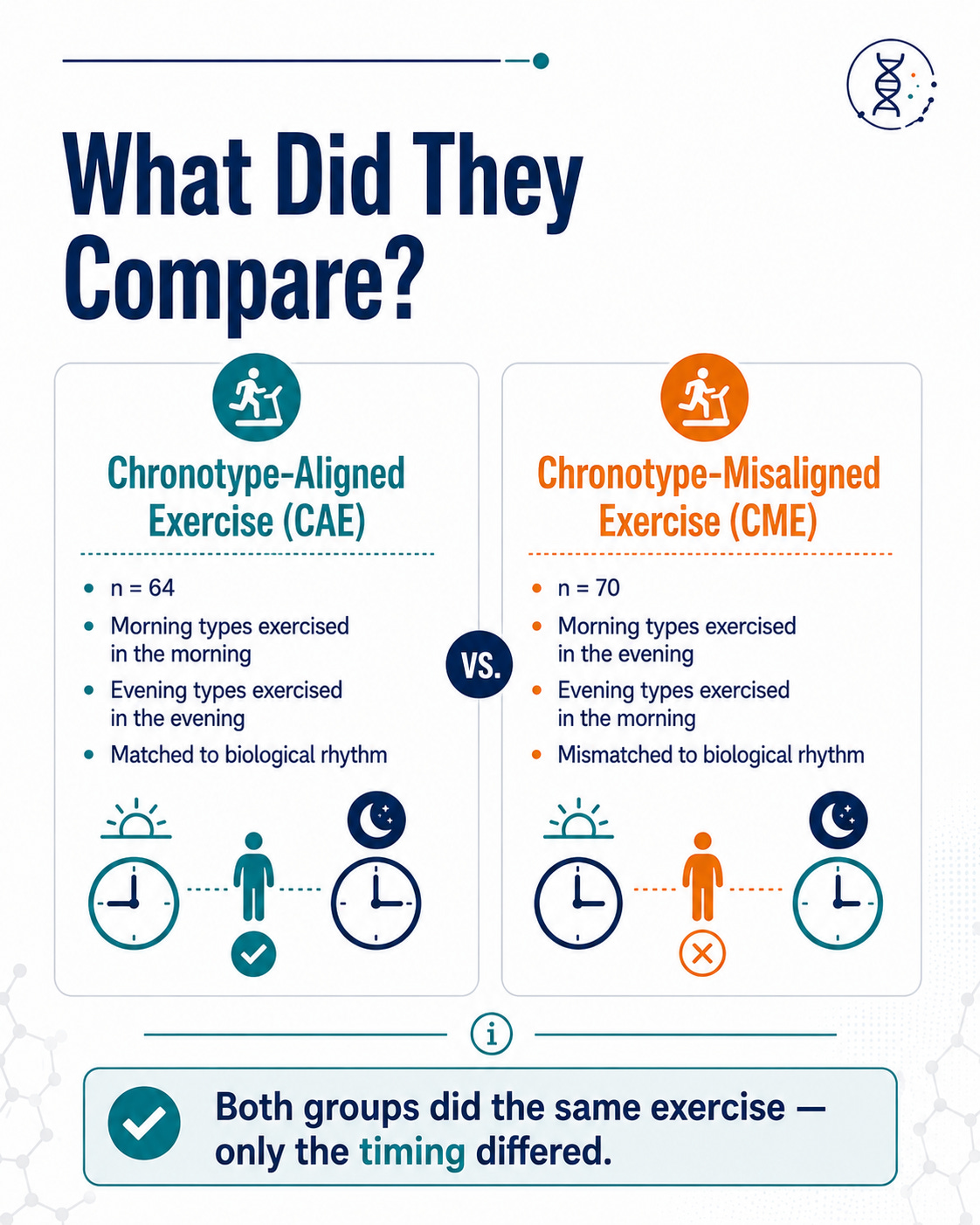
Everyone performed the same training: 40 minutes of moderate-intensity aerobic exercise, at 60–70% of max heart rate, five times per week for 12 weeks.
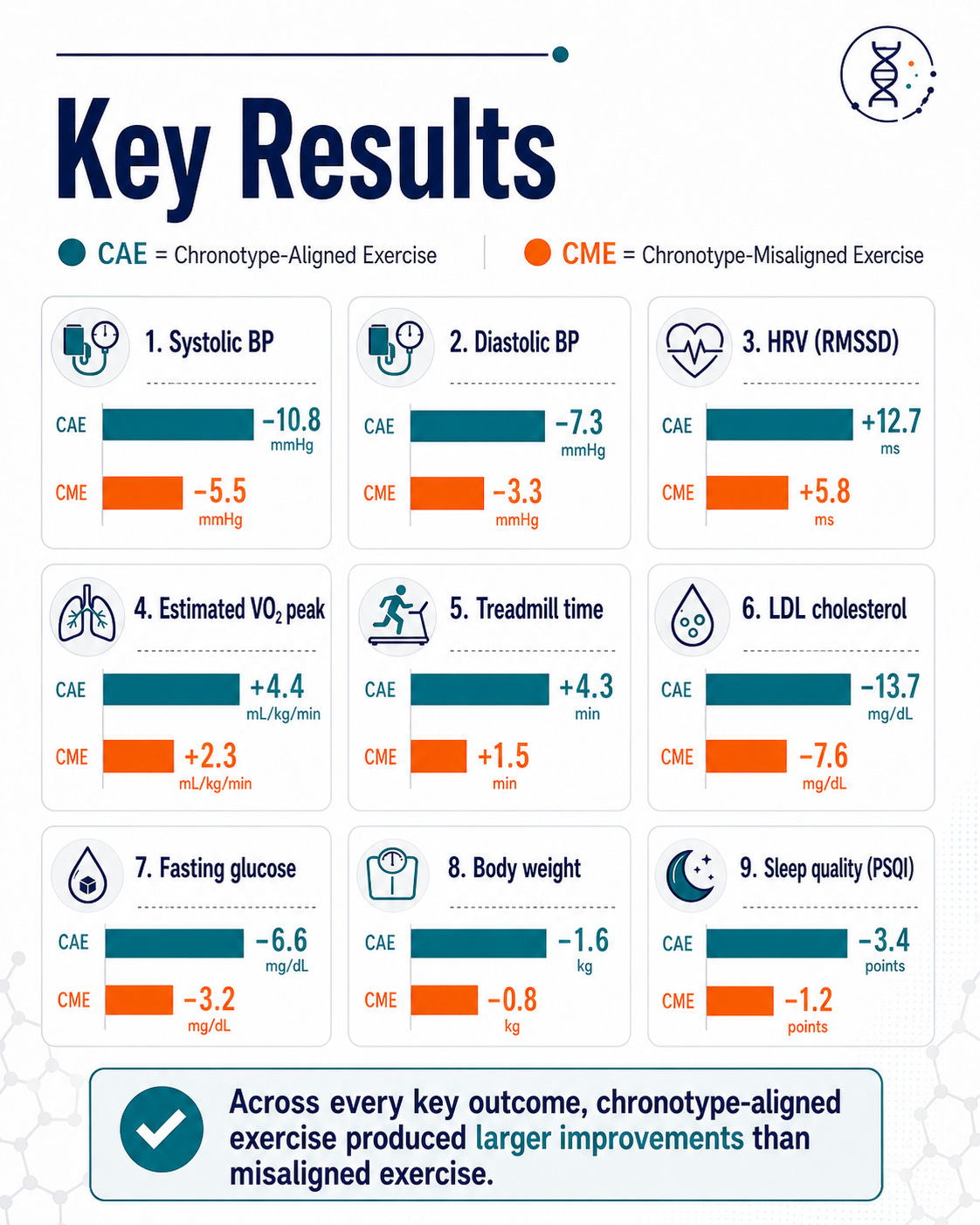
Both groups improved, as you would expect, but the participants in the chronotype-aligned exercise group improved more… much more in fact. For most outcomes, the improvements were roughly twice as large in the group that exercised at a time aligned with their chronotype:
Their systolic and diastolic blood pressure dropped by 11 mmHg and 7 mmHg, respectively, versus drops of about 6 mmHg and 3 mmHg in the misaligned group.
Their estimated VO₂ peak increased by 4.4 mL/kg/min, versus a 2.3 mL/kg/min improvement in the misaligned group, and they also lasted longer on a treadmill test: +4.3 minutes versus +1.5 minutes.
Their HRV improved by 12.7 ms, versus a 5.8 ms improvement in the misaligned group.
Their LDL cholesterol dropped by 13.7 mg/dL, versus a 7.6 mg/dL drop in the misaligned group.
Their fasting glucose decreased by 6.6 mg/dL, versus a 3.2 mg/dL drop in the misaligned group.
Their body weight decreased by about 1.6 kg, versus a 0.8-kg drop in the misaligned group.
Their sleep quality improved by 3.4 points, versus a 1.2-point improvement in the misaligned group.
There was one finding (though exploratory) that I found interesting. All of the participants—regardless of whether they were a morning or evening chronotype—experienced improvements in blood pressure, HRV, aerobic fitness, and other risk factors. However, the magnitude of improvement generally appeared to be larger in morning chronotypes compared to evening chronotypes, regardless of whether they were in the aligned or misaligned group. What that implies, I’m not quite sure.
I have probably read and/or written about dozens of studies at this point investigating whether the time of day at which exercise is performed is important. The results of most of these studies have been pretty unequivocal—it doesn’t matter. Exercising in the morning or evening generally produces similar health and performance outcomes.
But after reading this study, I realize that the research has been asking the wrong question.
It’s not “night vs. day.” It’s biological alignment versus not.
Many of these studies failed to account for chronotype. In other words, they were isolating time of day as a variable without taking into account individual biological variation.
When we do that, it turns out that timing does make a difference.
Does this mean you should reorganize your workout routine to sync with your biological clock?
Most likely, you’re already doing this out of pragmatism. With at least some control over our daily schedules, most of us have chosen to work out when it’s most enjoyable. For some, that means early in the morning before the workday. For others, that means late-afternoon exercise after leaving the office.
But the reality is that not everyone has full autonomy. Many people exercise whenever they can fit it in. And for some, that means a clash between what their biology “wants” and what is feasible given life’s constraints. A “night owl” might find that the only time they have to exercise is in the dark, early hours of the morning. A “morning person” may struggle mentally if they are forced to work out after a long day at work, when motivation isn’t as high.
The good news from this study is that even when exercise isn’t performed at our biological “sweet spot,” it’s still beneficial.
On the other hand, I think there is a strong case that if you do have the freedom to choose when to exercise, doing so at a time that aligns with your chronotype is smart. Chronotype-aligned exercise produced roughly twice the improvement as misaligned exercise in this study. That meant larger gains in aerobic fitness, larger reductions in blood pressure and other cardiovascular risk factors, and even a greater reduction in body weight. And that was when participants did the exact same exercise. If you told me I could get twice the benefit from my workout just by shifting when I performed it, I’d take that deal.
These findings can also apply more broadly. All of us should probably be thinking about when we schedule our tasks and obligations during the day so that they align with when our alertness, mood, and performance peak. I know myself well enough to never plan on doing deep or creative work after about 4 PM. And if I want to be at my best for a podcast, I know that scheduling it for late morning, immediately after my workout, is when I’m giving the best performance.
Circadian biology has been one of my favorite topics for a while. I think that’s because it takes health and makes it more granular.
It’s not just about what we do, but when we do it. Biology thrives when we’re aligned.
Thanks for reading. See you next Friday.
~Brady~
Ketone-IQ is high-performance energy in a bottle. I use it for post-exercise recovery along with enhancing focus, mood, and cognition. Take 30% off your order.

Create is the first “modern creatine” brand. They sell a wide range of creatine monohydrate gummies, and just launched a new creatine + electrolyte mix product plus travel-size packets of creatine gummies. They’re giving my audience 20% off their order.

ProBio Nutrition—the all-in-one supplement that I use every single day—is offering 20% off. My preference is the tangy orange flavor, but they also sell an unflavored “smoothie booster” that’s great in a shake, smoothie, or juice.

Equip Foods makes some of the cleanest, best-tasting protein products around. I am absolutely obsessed with their Prime grass-fed protein bars (the peanut butter ones are to die for, but they also just released a new chocolate peanut butter flavor).

You need to tell us how to find out if we are biologically night or morning people or the whole thing is pointless.
Curious if you found literature on to the extent that chronotypes are malleable? I was always a "night" chronotype but with kids, have shifted and would dread evening exercise now. Enjoyed the piece!