


Greetings!
Welcome to the Physiology Friday newsletter.
Details about the sponsors of this newsletter and deals on products I love, including Ketone-IQ, Create creatine, Equip Foods, and ProBio Nutrition can be found at the end of the post.
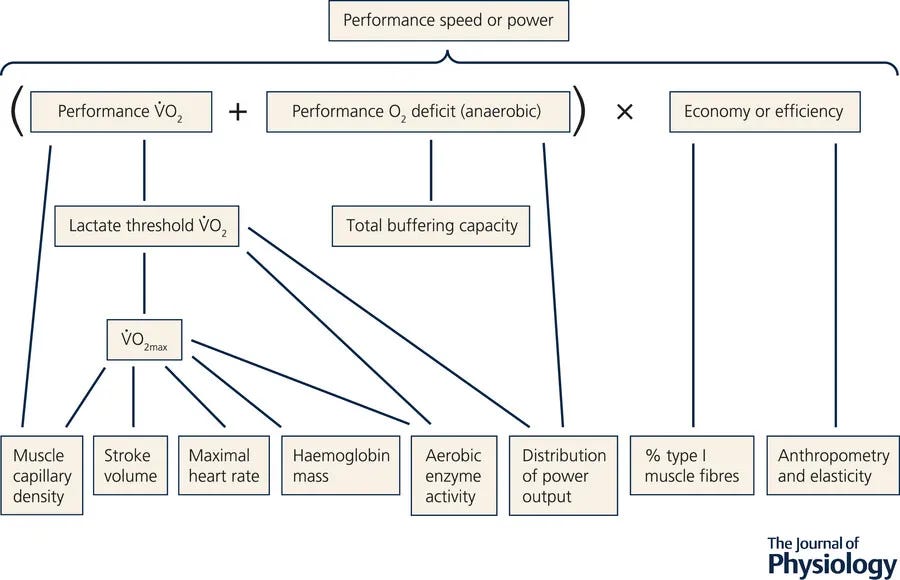
Endurance performance comes down to three things: VO₂ max, threshold, and economy.
VO₂ max is your aerobic ceiling. Threshold is how much of that ceiling you can use and sustain. Economy is how much oxygen it costs you to produce a given pace or power output.
This framework is often associated with Dr. Michael Joyner’s classic 1991 model of marathon performance, which estimated the limits of human endurance based on these three physiological determinants. Since then, the model has become one of the foundational ways scientists, coaches, and endurance geeks like me think about performance across sports like running, cycling, triathlon, cross-country skiing, and other long-duration events.
The “problem” with the model is that it’s never been used to answer this question: if you take a large group of real endurance athletes, ranging from recreationally trained people to world-class performers, how much does each factor actually matter? What separates “good” from “great”?
A new study in Sports Medicine tried to answer that question with a huge dataset of 888 endurance athletes, including 495 runners and 393 cyclists. The researchers examined how VO₂ max, exercise economy, and fractional utilization of VO₂ max related to endurance performance.1
They wanted to know which physiological traits best explain why some athletes can sustain faster speeds or higher power outputs than others.
The answer? VO₂ max still matters a lot. Economy matters a lot too. But fractional utilization, the percentage of VO₂ max you can sustain at threshold, may not be as useful for separating higher- and lower-performing athletes as we often assume.
The classic endurance model
Dr. Michael Joyner’s model is elegant because it reduces endurance performance to three big pieces (I like to think of them as “pillars” of endurance performance).
First, there is VO₂ max, the maximum amount of oxygen your body can take in, deliver, and use during intense exercise. A bigger aerobic engine gives you more room to work with. This matters not only for performance, but also for health, because VO₂ max reflects the integrated function of the heart, lungs, blood, blood vessels, mitochondria, and working muscles.
Second, there is fractional utilization of VO₂ max. This is the percentage of your VO₂ max you can sustain at a key threshold. Two athletes might both have a VO₂ max of 60 ml/kg/min, but if one can sustain work near threshold at 85% of VO₂ max and the other can only sustain 75%, that changes the performance equation.
Third, there is exercise economy. For running, this is the oxygen cost of running at a given speed. For cycling, it is the oxygen cost of producing a given power output. More broadly, economy is how much energy it costs your body to perform a specific endurance task. A more economical athlete uses less oxygen at the same pace or power (they’re more efficient).
Together, these three factors can be used to estimate the speed or power an athlete can sustain at lactate threshold or lactate turnpoint—an intensity that’s close to “marathon pace.” Lactate threshold was defined in this study as the first rise in blood lactate above baseline, while lactate turnpoint represented a more rapid and sustained increase in lactate. The researchers used speed at these points for runners and power at these points for cyclists as performance proxies.
So this study did not directly test race outcomes, finishing times, or real-world competition results. It tested physiological markers that are strongly related to endurance performance.
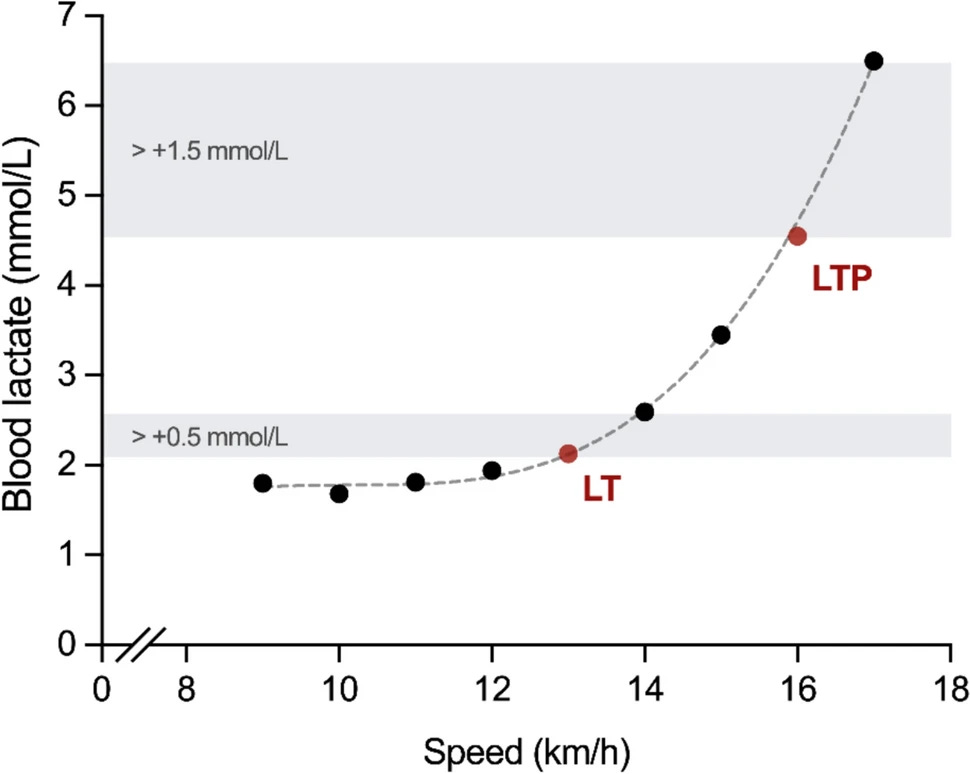
The study included 495 runners (105 of whom were female) and 393 cyclists (42 of whom were female). The participants ranged widely in ability, from recreational athletes to world-class performers.
Everyone completed lab-based incremental exercise testing. For runners, the test was performed on a treadmill. They ran in four-minute stages, with short rests for blood lactate sampling, while researchers measured oxygen uptake and ventilation. After the submaximal test, participants rested for 15–20 minutes and then completed a separate test to exhaustion to determine VO₂ max.
For cyclists, the protocol was similar but performed on a smart trainer or cycle ergometer. They completed four-minute stages with increasing power, blood lactate sampling, and gas exchange measurements, followed by a ramp test to exhaustion.
From these tests, the researchers calculated VO₂ max, exercise economy, fractional utilization at lactate threshold and lactate turnpoint, and speed or power at those thresholds.
They then asked two big questions.
First, how strongly does each physiological trait relate to threshold speed or power (our “performance proxy”)?
Second, how much does each trait contribute to the overall prediction of these performance proxies?
VO₂ max is still the heavyweight
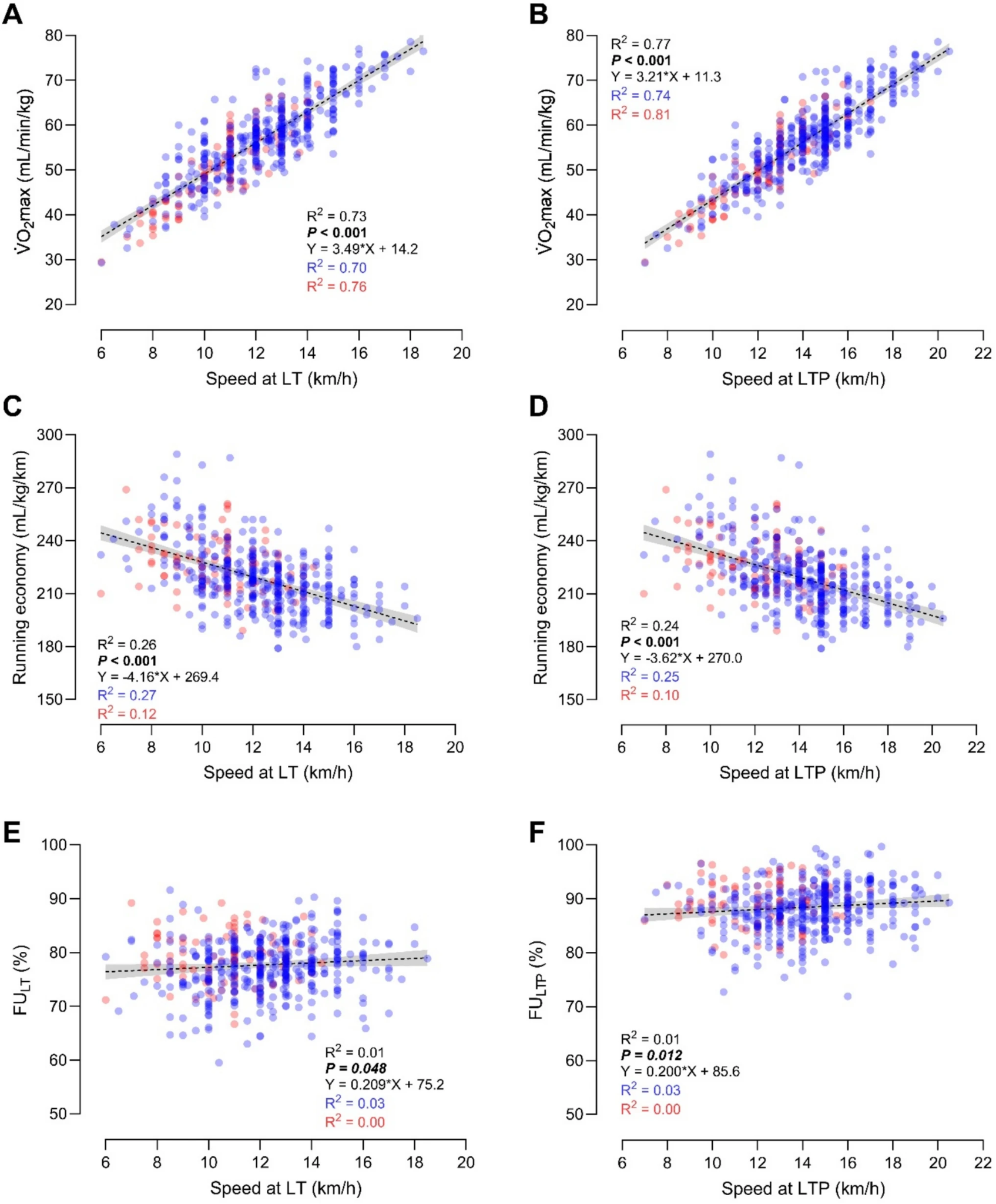
VO₂ max was the strongest predictor of performance proxies in both runners and cyclists.
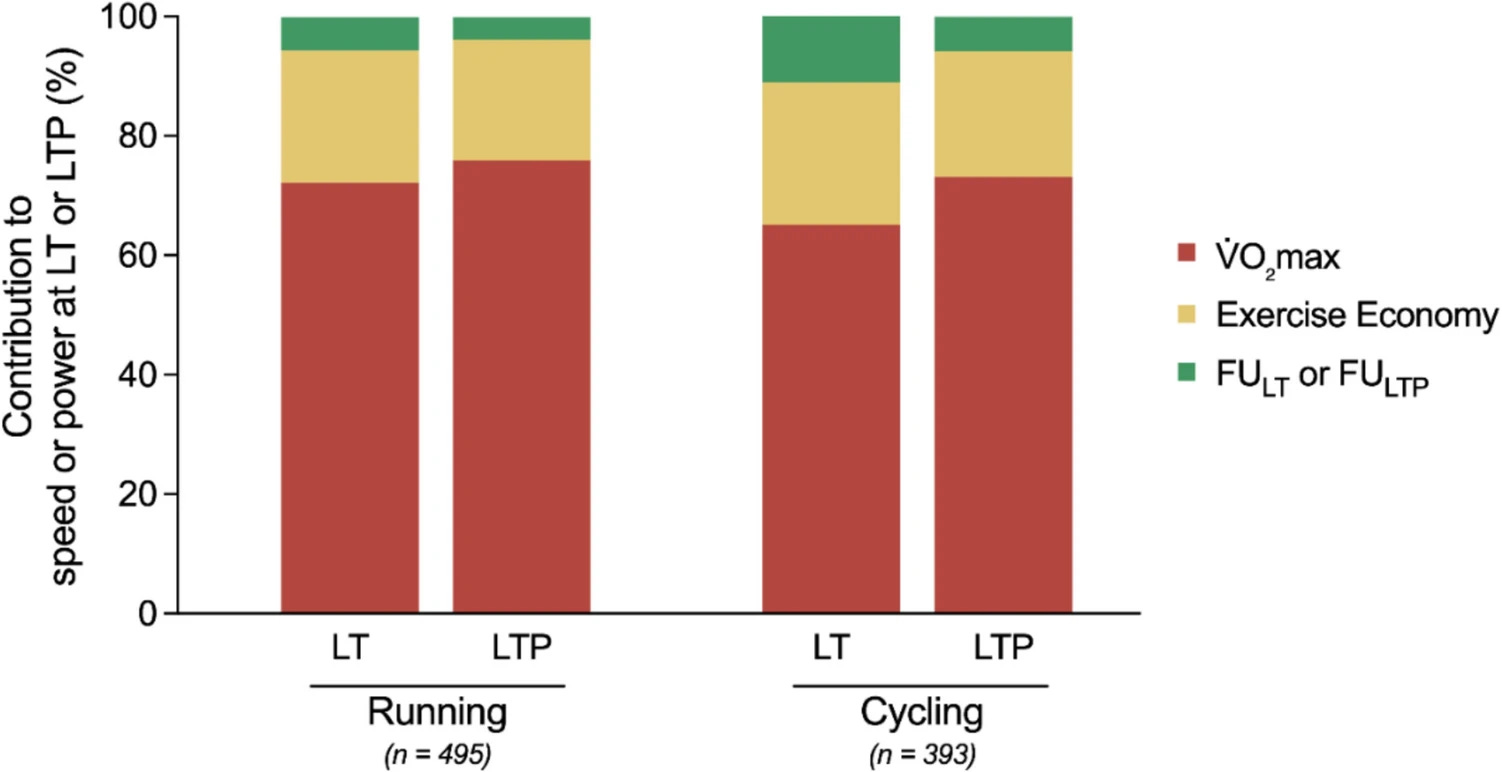
In runners, VO₂ max explained about 73% of the variation in speed at lactate threshold and 77% of the variation in speed at lactate turnpoint. In cyclists, VO₂ max explained about 65% of the variation in power at lactate threshold and 71% at lactate turnpoint.
That means when you look across a broad range of endurance athletes, the people with bigger aerobic engines tend to perform better. There are exceptions, of course, and exceptions are often the most interesting cases. But at the population level, VO₂ max remains the physiological variable that most clearly separates lower-performing from higher-performing endurance athletes.
VO₂ max is not destiny, but it is still one of the biggest determinants of endurance potential.
The key nuance is that VO₂ max becomes less useful when you compare athletes who are already very similar. If you take a group of elite endurance athletes with VO₂ max values clustered in a narrow range, economy, durability, fueling, biomechanics, tactics, heat tolerance, and threshold characteristics may explain more of the difference. But if you compare recreational athletes, competitive amateurs, sub-elites, and elites together, VO₂ max is going to do a lot of explanatory work, and that’s exactly what happened here.
The second big contributor was exercise economy.
For runners, economy explained about 20–22% of the contribution to speed at lactate threshold and lactate turnpoint. For cyclists, cycling economy contributed about 21–24%.
Lastly, fractional utilization of VO₂ max—the percentage of VO₂ max used at lactate threshold or lactate turnpoint—contributed far less to performance differences than VO₂ max or economy.
In runners, fractional utilization contributed about 5.6% to speed at lactate threshold and 3.8% to speed at lactate turnpoint. In cyclists, it contributed about 11% at lactate threshold and 5.8% at lactate turnpoint.
That does not mean threshold does not matter. It absolutely does.
But it does suggest that when you look across a broad range of endurance athletes, fractional utilization is not very good at distinguishing who is better. A recreational athlete with a relatively low VO₂ max might operate at a high percentage of that VO₂ max at threshold. Meanwhile, a better-trained athlete with a much higher VO₂ max might have a similar or even lower fractional utilization but still produce a much higher absolute output because the engine is so much larger.
Here’s a simple way to think about it.
Athlete A has a VO₂ max of 45 and can sustain 85% of it.
Athlete B has a VO₂ max of 65 and can sustain 78% of it.
Athlete A may look better if you only focus on fractional utilization. But Athlete B is almost certainly producing more work because 78% of a much larger engine is still a bigger absolute output.
Similar performance can come from different physiological profiles
If we could accurately predict who wins a race by just looking at, say, VO₂ max, then it wouldn’t be much fun, would it?
Not every endurance athlete needs the same physiology. In fact, similar performances can be achieved with very different combinations of VO₂ max, economy, and fractional utilization.
This is one of the reasons endurance performance is so fascinating. There is not one perfect physiological profile. Some athletes are engine monsters. Some are economy freaks. Some have exceptional threshold characteristics. Some are durable and barely fade. Some are biomechanically gifted. Some are unusually efficient in a specific sport. Some are just really, really good at doing the work for a very long time.
The Joyner model gives us the major ingredients, but athletes can combine those ingredients in different ways.
The paper gives a great historical example of this idea using Frank Shorter and Steve Prefontaine (two legendary American distance runners).
On paper, their race performances over 5,000 and 10,000 meters were remarkably similar. Shorter ran 13:26.6 for 5K and 27:45.9 for 10K, while Prefontaine ran 13:21.9 and 27:43.6. That’s essentially the same performance neighborhood. But physiologically, they were not identical athletes. Prefontaine reportedly had a much higher VO₂ max (84.4 ml/kg/min) compared with Shorter’s 71.3 ml/kg/min.
That difference is enormous. If we only looked at VO₂ max, we might assume Prefontaine should have been far superior. But the stopwatch says otherwise. Shorter was able to arrive at almost the same performance outcome with a smaller aerobic engine, which implies that other factors (likely economy, fractional utilization, durability, pacing skill, biomechanics, and race execution) helped close the gap. Pre just had a monster engine.
This is also a useful reminder for everyday athletes. You may never know your exact VO₂ max, economy, or lactate profile, and you probably don’t need to obsess over any single number. It’s better to ask: “What is my current limiter?”
Some athletes need to build the engine. Others need to become more economical. Others need to improve fatigue resistance, fueling, or race execution.
This is an incredibly foundational study, in my opinion. And its biggest strength is the sample size.
A lot of endurance physiology studies include 10, 15, or 20 participants. This study included 888 athletes.
The study also included both runners and cyclists, both males and females, and athletes ranging from recreational to world-class. That makes the findings more useful than studies limited to a tiny group of homogeneous athletes.
The main limitation is that this study did not directly measure race performance. It used speed or power at lactate threshold and lactate turnpoint as performance proxies.
Those are meaningful proxies, but real-world performance is messier. Competition is not just a lab test stretched over a longer time period. Actual endurance performance includes pacing, fueling, heat, terrain, equipment, tactics, muscle damage, psychology, and durability.
Durability may actually be the biggest missing piece here.
The classic Joyner model focuses on VO₂ max, fractional utilization, and economy, but endurance performance is increasingly being understood through a fourth lens: how well these variables hold up under fatigue. An athlete’s economy when fresh is useful. Their economy two, three, or four hours into an event may be more important (for more on durability, see my previous post on it).
Two athletes may have identical VO₂ max, threshold, and economy in the lab, but one may maintain those traits after prolonged work while the other deteriorates. That is performance durability, and it may help explain why some athletes are much better competitors than their lab values suggest. And honestly, I think it’s the variable that still gives much of endurance sports its mystique.
How should we apply this paper to training and health?
Let’s stop treating VO₂ max, threshold, and economy as competing explanations and start seeing them as interacting pieces of the same performance and health puzzle.
If you are newer to endurance training or still developing aerobically, raising VO₂ max and building a bigger aerobic engine probably matters a lot, which means consistent training volume, aerobic development, intervals, long sessions, and long-term exposure are foundational.
As you become more trained, economy, threshold, and durability likely become increasingly important. They are what’s going to move you from “good” to “great” within your current performance capabilities.
The best endurance programs probably touch all three determinants across a season: build the engine, make the engine more efficient, and then teach the body to sustain a high output when fatigue sets in.
This study is a nice reminder that endurance performance is both simple and complicated.
The simple version is that better endurance athletes usually have a bigger aerobic engine and better economy. That was true 35 years ago, and it is still true now. Dr. Joyner’s model still holds up.
The complicated version is that athletes can arrive at similar performances through different physiological routes, and the best athletes often have several of these traits stacked together, but the combination is not identical for everyone.
For anyone interested in improving their endurance performance, the art is figuring out which part of the puzzle needs the most attention right now.
Thanks for reading. See you next Friday.
~Brady~
Ketone-IQ is high-performance energy in a bottle. I use it for post-exercise recovery along with enhancing focus, mood, and cognition. Take 30% off your order.

Create is the first “modern creatine” brand. They sell a wide range of creatine monohydrate gummies, and just launched a new creatine + electrolyte mix product plus travel-size packets of creatine gummies. They’re giving my audience 20% off their order.

ProBio Nutrition—the all-in-one supplement that I use every single day—is offering 20% off. My preference is the tangy orange flavor, but they also sell an unflavored “smoothie booster” that’s great in a shake, smoothie, or juice.

Equip Foods makes some of the cleanest, best-tasting protein products around. I am absolutely obsessed with their Prime grass-fed protein bars (the peanut butter ones are to die for, but they also just released a new chocolate peanut butter flavor).

I agree that VO2Max is a huge piece of the puzzle but what is left out in this piece is fat oxidation, including crossover....both of which are intimately tied to VO2Max which is a proxy for aerobic capacity (since most endurance athlete really never go to VO2Max but do use threshold as a tool). While not sexy, beta-oxidation, is that unseen foundation of metabolic performance and any increase in beta-oxidation will improve lactate threshold, endurance at competition level intensities, overall performance and longevity in sport and life. We have athletes who can compete all day burning 1.5 g/min of fat at ultra-endurance intensities at elite levels, effectively use plenty of CHO for performance, just not the crazy levels we are seeing some use today and are able to compete at elite levels in their 40's and 50's or top of their AG in their 60's & 70's. Two of our athletes can even sustain over 2 g/min for 20 minutes. This is NOT keto diet stuff because CHO plays an integral part in achieving these fat oxidation and performance results. The other missing piece due to beta-oxidation when the metabolism is optimized is the liver will also produce substantial glucose via hepatic gluconeogenesis and ketone via ketosis from liver fat to meet the metabolic need thus sparing/slowing the depletion of liver glycogen. .....but there is nothing to sell and the conversation / information requires an attention span and curiosity that is currently beyond what is 'trendy'.