

Greetings!
Welcome to the Physiology Friday newsletter.
Here’s my “favorite social post of the week". Maybe it’s the fact that the algorithm is feeding me more of this guy’s content, but Dr. Sean OMara seems to one-up himself every day with a more ridiculous take on health. Here, he claims that “fruit ages you” despite mounds of evidence that it probably does exactly the opposite (it’s loaded with nutrients, fiber, and other stuff that’s beneficial for health).


Details about the sponsors of this newsletter and deals on products I love, including Ketone-IQ, Create creatine, Equip Foods, and ProBio Nutrition can be found at the end of the post.
The world of comparative physiology has always fascinated me. How do humans stack up against other animals when it comes to our ability to function and adapt at the cellular or structural level?
One of my favorite examples is the heart.
A shrew’s heart can beat more than 1,000 times per minute. At that rate, the entire cardiac cycle (the squeeze, the relaxation, the refill, and the next squeeze) happens in about 60 milliseconds.
A blue whale lives at the other end of mammalian physiology. Its heart rate can drop to just 2 to 8 beats per minute, giving each heartbeat somewhere between 7.5 and 30 seconds to unfold.
This incredible contrast reveals one of the most important constraints in cardiovascular physiology: the heart is always racing against time. Let me explain.
Every beat has to accomplish two things. First, the heart has to fill with blood. Then, it has to eject that blood into circulation. When heart rate is low, there is plenty of time for both. When heart rate rises during exercise, the cardiac cycle shortens. The body needs more blood flow, so the heart beats faster. But the faster it beats, the less time it has to fill.
That presents somewhat of a paradox. To exercise harder, our heart has to pump more blood per minute. But to pump more blood per minute, it often has to beat faster. And the faster it beats, the less time it has to fill the ventricles (our heart’s largest chambers) before the next contraction.
This is where the endurance athlete’s heart becomes so interesting.
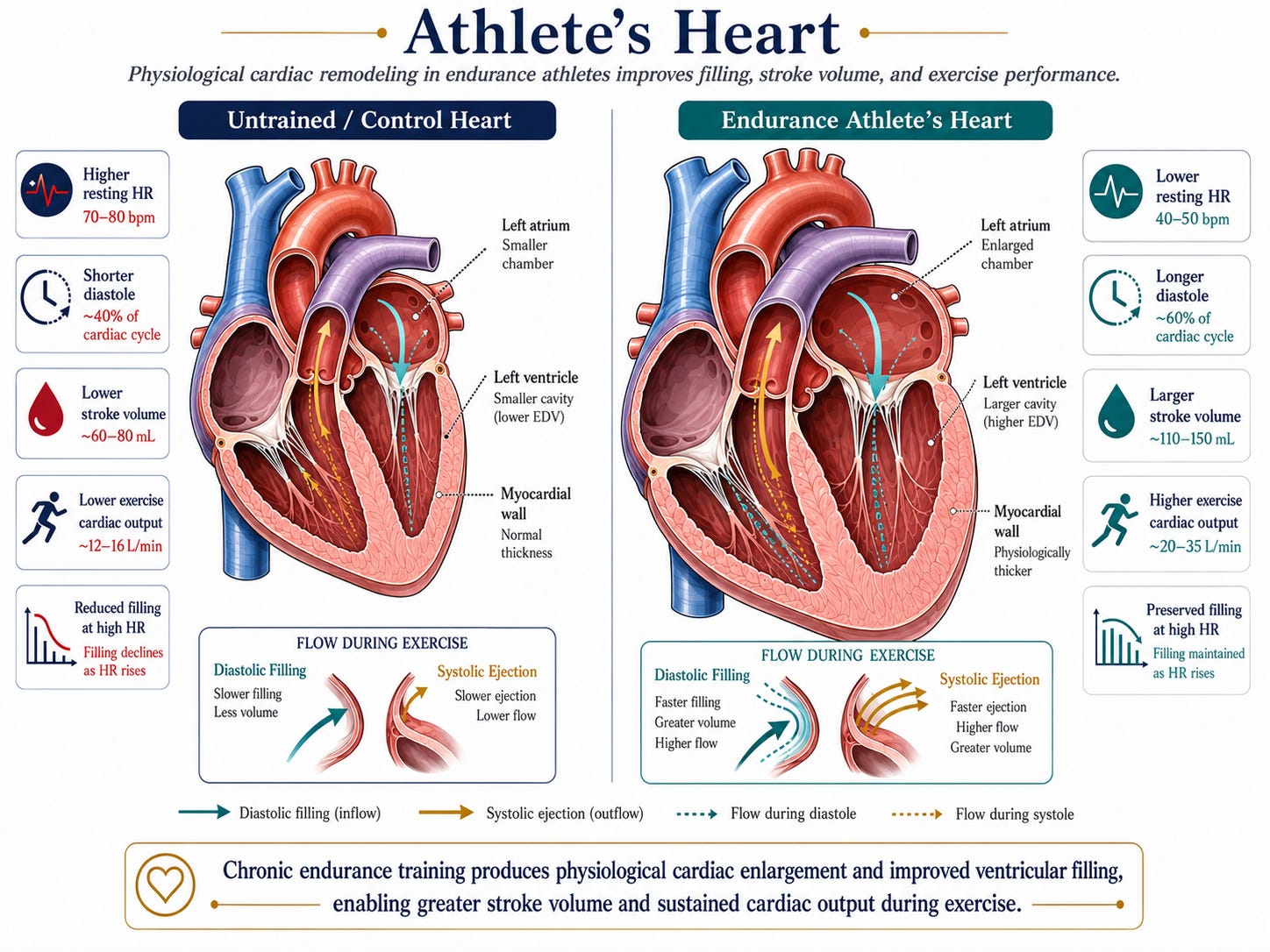
Elite endurance athletes are often bradycardic, meaning they have unusually low resting heart rates. In my case, my overnight resting heart rate is often around 33 beats per minute, which is deep in the “athlete’s heart” range.
“Athlete’s heart” refers to the structural and functional remodeling that occurs in response to long-term endurance training. It is not a disease. It is usually a physiological adaptation to repeated exposure to high cardiac output demands (e.g., chronic endurance training).
During endurance exercise, cardiac output can increase dramatically. Cardiac output is the amount of blood the heart pumps per minute, and it is determined by two things: heart rate (how often the heart beats) × stroke volume (how much blood the heart ejects per beat).
Most people think about exercise intensity through the lens of heart rate. But endurance performance is not just about beating faster. In fact, endurance athletes often have lower heart rates at rest, lower heart rates at the same absolute workload, and sometimes slightly lower maximal heart rates than non-athletes.
Their major advantage is stroke volume.
With chronic endurance training, the heart adapts to move more blood per beat. The left ventricle often becomes larger and more compliant, meaning it can accommodate more blood. The heart also becomes better at relaxing quickly between beats, a property called lusitropy.
This matters because diastole (the filling phase) is not passive in the simplistic sense. The heart does not just flop open and wait for blood. It actively relaxes. That relaxation creates a pressure gradient that helps pull blood into the ventricle. Then, late in the relaxation phase, the atrium contributes an additional push.
So for an endurance athlete, the heart is not simply bigger. It is better timed. It can fill more and eject more. And during exercise, when the cardiac cycle is getting squeezed into smaller and smaller windows of time, it can preserve performance by moving blood faster through each phase of the heartbeat.
That brings us to the central question of a new study: how do endurance athletes maintain larger stroke volumes during exercise when rising heart rate progressively steals away the time available for the heart to fill with blood?1
The results show us that a low resting heart rate may not just be a marker of fitness. It may represent a built-in timing advantage. A slower heart rate gives the ventricle more time to fill. And in endurance athletes, that extra time is paired with a bigger, more compliant, more powerful pump.
The researchers studied 32 people: 21 endurance athletes and 11 controls.
The athlete group included cyclists and runners primarily, with a few athletes from other endurance or highly trained sporting backgrounds. The control group exercised less than three hours per week and had no long-term history of competitive endurance sport. The groups were similar in age, sex distribution, and resting blood pressure. But as expected, they were very different physiologically. The athletes had a VO₂ peak of 56.2 mL/kg/min compared with 33.1 mL/kg/min in controls. They also produced much higher peak power on the exercise test: 394 watts versus 251 watts. So we’re definitely looking at two “levels” of performers here (important).
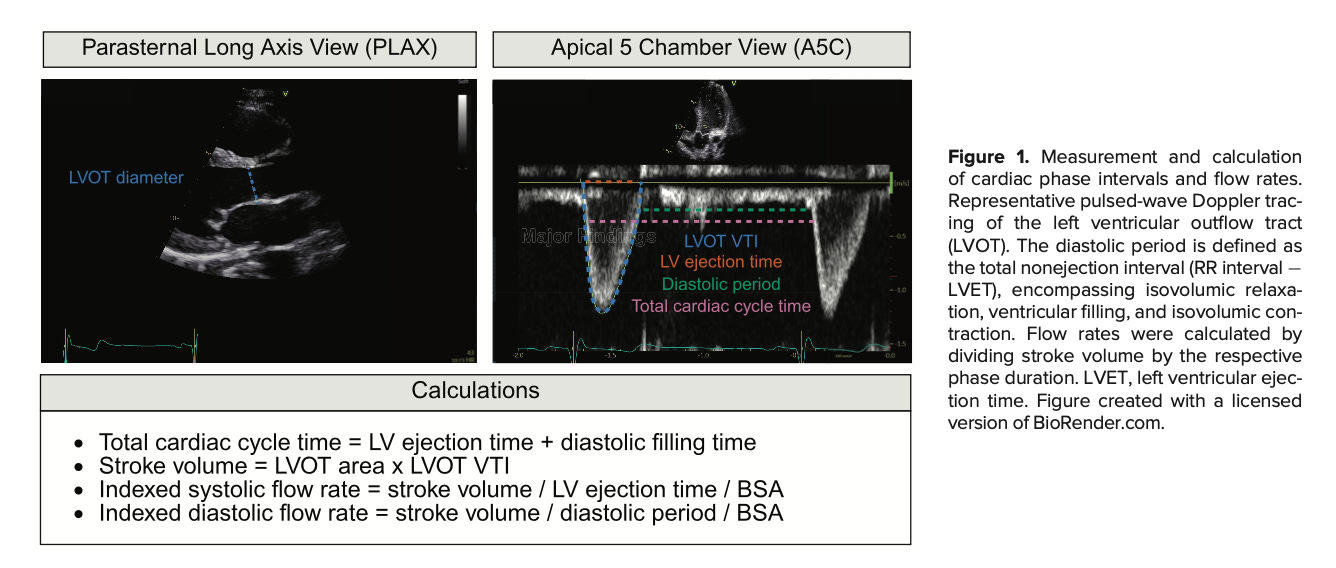
Participants exercised on a cycle ergometer at 20%, 40%, and 60% of their peak power output (representing light, moderate, and high-intensity exercise, respectively) while researchers measured heart rate, stroke volume, cardiac output, left ventricular ejection time, diastolic filling time, and something called the systolic-to-diastolic duration ratio.
That last variable is important, so let’s break it down. Systole is the ejection phase, when the left ventricle contracts and sends blood into the aorta. Diastole is the filling phase, when the ventricle relaxes and refills before the next beat.
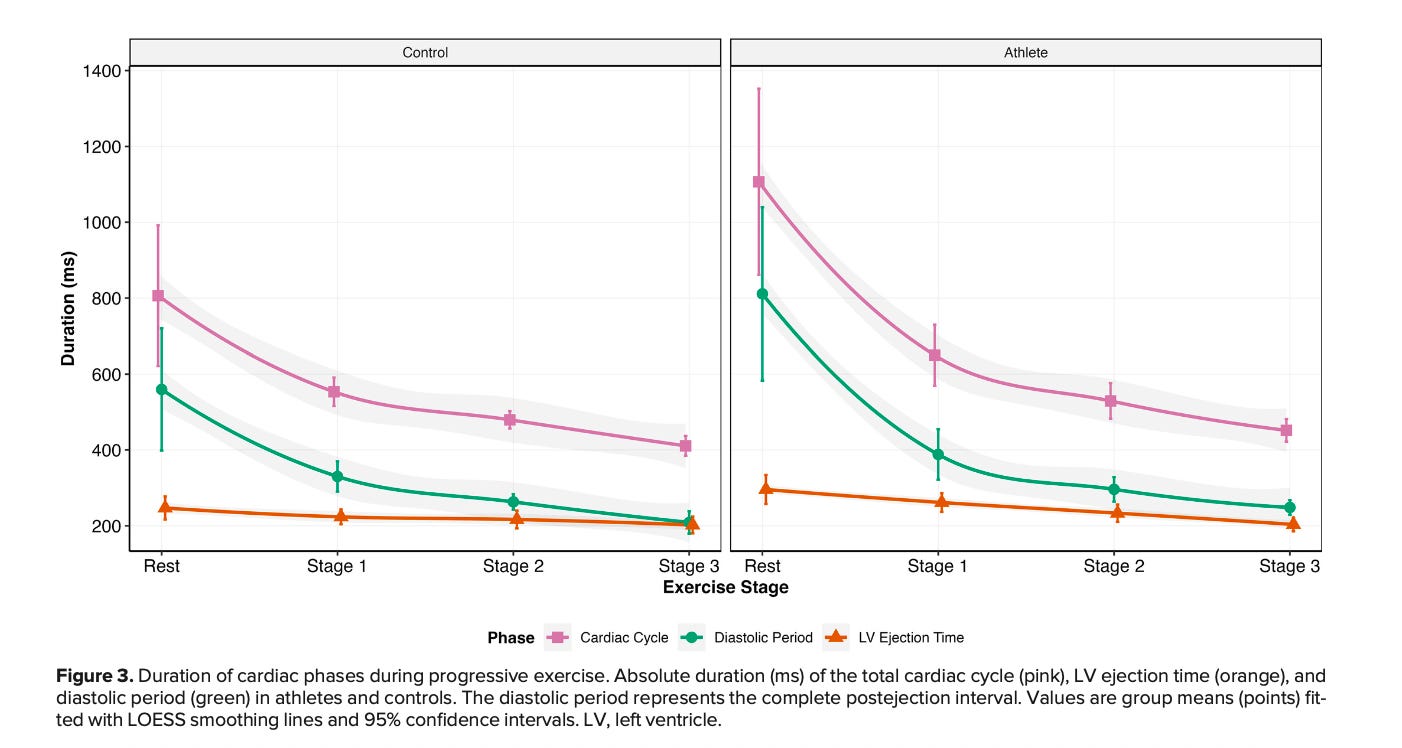
At low heart rates, diastole takes up most of the cardiac cycle. This is good for filling. But as heart rate rises, diastole shortens much more dramatically than systole. Eventually, the heart starts “running out” of filling time.
The researchers also calculated systolic and diastolic flow rates. Plainly speaking, what we’re looking at here is how fast the athlete’s heart can empty, and how fast it can refill.
At rest, the athletes showed the classic features of athlete’s heart.
Their resting heart rate was much lower than controls: 44 vs. 68 beats per minute.
Their left ventricular end-diastolic volume index was much larger: 98 vs. 65 mL/m².
Their left atrial volume index was also larger: 47 vs. 31 mL/m².
That means the athletes had bigger filling chambers.
But the heart was not just bigger. It also showed signs of enhanced diastolic filling and appeared to “front-load” filling. The ventricle relaxes well, fills efficiently early in diastole, and does not need to depend as heavily on a forceful atrial push at rest. The athletes also had a longer cardiac cycle, a longer diastolic (filling) period, and a longer ejection time compared to controls. In other words, the athlete’s heart had more time for everything. More time to fill. More time to eject. More time to operate.
That is the benefit of a low resting heart rate!
The problem during exercise
In both athletes and controls, exercise dramatically shortened the cardiac cycle. But the athletes handled the timing constraint differently.
At high-intensity exercise, the athletes were working at a much higher absolute workload: 226 watts compared with 145 watts in controls. Despite this, their heart rate was lower: 133 vs. 147 beats per minute.
That lower exercise heart rate gave the athletes slightly more time per beat—they had a longer total cardiac cycle, a longer filling phase, but a similar ejection time. By high-intensity exercise, the difference between athletes and controls was mainly on the filling side. The athletes preserved a little more diastolic time while also moving a much larger stroke volume.
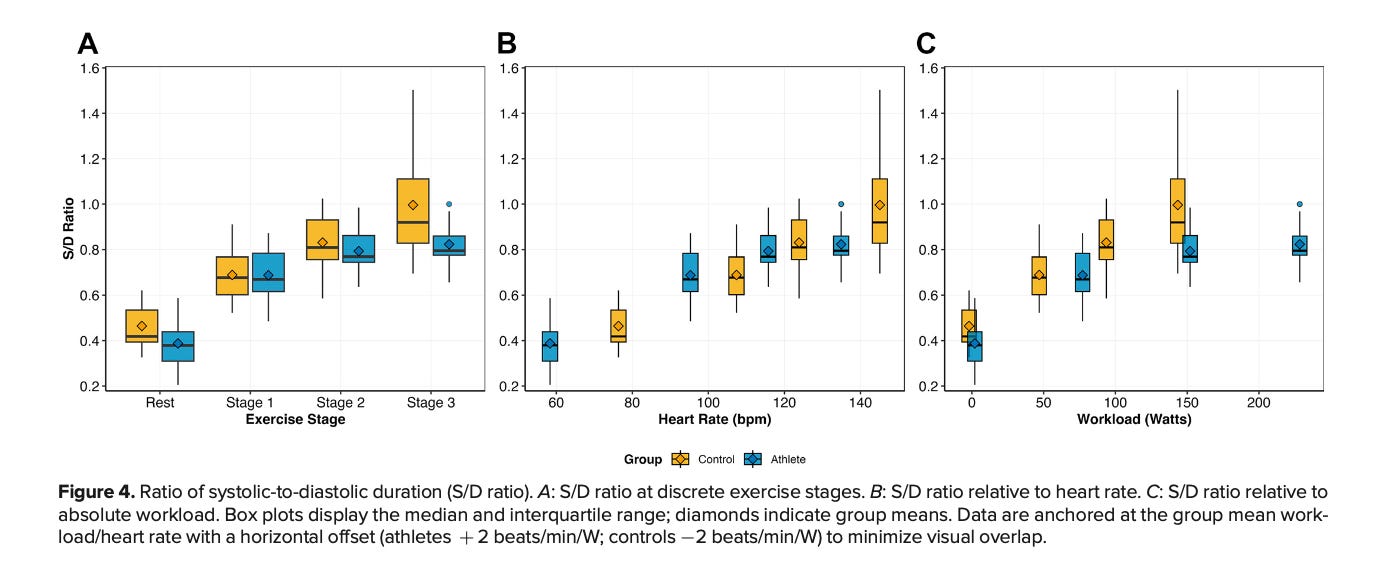
The systolic-to-diastolic (S/D) ratio gives us a way to visualize the shifting balance between ejection time and filling time.
At rest, both groups spent more time in diastole (filling) than systole (ejection). During exercise, the S/D ratio increased in both groups. This is expected. As heart rate rises, diastole shortens disproportionately, so systole occupies a larger fraction of the cardiac cycle. But at high-intensity exercise, the athletes maintained a lower S/D ratio than controls: 0.82 vs. 1.00.
That means the controls had reached a point where systolic time and diastolic time were roughly equal. The athletes, despite doing more mechanical work, still preserved a more favorable balance toward diastolic filling. This may be one reason endurance athletes can sustain high stroke volumes at high heart rates. They are not simply forcing the heart to beat faster. They are preserving enough filling time while also increasing the velocity of filling and ejection.
But the new insight from this study was how athletes maintained those stroke volumes under severe timing constraints.
At rest, systolic and diastolic flow rates were similar between athletes and controls. But during exercise, the athletes pulled away. At high-intensity exercise, systolic flow rate was significantly higher in athletes. Diastolic flow rate was also higher during moderate exercise, though by the highest exercise stage, the groups were closer together. From rest to high-intensity exercise, systolic flow rate increased by 89% in athletes compared with 63% in controls. Diastolic flow rate increased even more dramatically: 400% in athletes and 370% in controls.
That last number is wild. During exercise, the heart has to fill with approximately the same volume it ejects, but it has to do it in a dramatically shorter time window. The only way to make that work is to increase filling velocity. This is where the athlete’s heart appears to excel. It has a larger ventricle, better filling characteristics, and the ability to generate high flow rates to fill the ventricle with more blood before the next ejection phase (don’t you just love physiology?)
Stroke volume and cardiac output
The athletes had higher stroke volume indexes at every stage (rest and low-, moderate-, and high-intensity exercise). That higher stroke volume translated into higher cardiac output during exercise.
At rest, cardiac output was identical between groups: 5.8 L/min in both athletes and controls. This is one of the elegant features of endurance adaptation. The athlete’s resting cardiac output is not necessarily higher because the low heart rate offsets the larger stroke volume. Fewer beats, more blood per beat, similar flow per minute.
But during high-intensity exercise, the athlete advantage became obvious. Cardiac output reached 17.3 L/min in athletes compared with 14.4 L/min in controls. The athletes were pumping more blood per minute, producing more power, and sustaining larger stroke volumes despite having less and less time to fill the heart with each beat.
This is one of the central physiological advantages of endurance training.
Why do athletes have lower maximal heart rates?
One interesting observation was that athletes had a slightly lower maximal heart rate than controls: 171 vs. 179 beats per minute, which is consistent with prior research suggesting endurance training can slightly reduce maximal heart rate.
Why would an endurance athlete benefit from a lower peak heart rate? The answer may be that heart rate is only helpful as long as filling is preserved.
At some point, increasing heart rate further may not increase cardiac output because the ventricle has too little time to fill. For a highly trained endurance athlete with a large ventricle and high stroke volume, the constraint may not be whether the heart can beat faster. The constraint may be whether the heart can fill fast enough. A slightly lower maximal heart rate may preserve diastolic filling time just enough to maintain a large stroke volume. In that model, the athlete’s heart is not underperforming by beating slightly slower. It may actually be optimizing the balance between rate and filling.
Thoughts on overtraining and suppressed heart rate
The most intriguing application for athletes may be overtraining, overreaching, and the sometimes confusing observation that heart rate can become suppressed when an athlete is fatigued.
Many endurance athletes (myself included) have experienced this. You go out for a workout expecting to hit a normal high-end heart rate, but your body will not get there. The usual explanation is autonomic fatigue, altered sympathetic drive, or reduced cardiac responsiveness. Those explanations may still be true. But this study adds another possible layer.
If the fatigued heart has impaired relaxation, it may not be able to fill as quickly. If filling rate is compromised, then pushing heart rate higher could further reduce diastolic filling time and threaten stroke volume. In that situation, a suppressed heart rate response might be “protective.” The system may be limiting heart rate to preserve enough time for the ventricle to fill.
That idea is speculative, but it makes sense, physiologically speaking.
During normal training adaptation, the athlete’s heart becomes better at filling quickly and ejecting powerfully. During excessive fatigue, the opposite may occur temporarily: filling dynamics may be impaired, stroke volume may be harder to maintain, and the heart may avoid higher rates because the time cost is too great.
So, while a low resting heart rate can be a sign of endurance adaptation, a suppressed exercise heart rate during a workout can be a sign of fatigue.
This study paints an awesome picture of how every heartbeat is a negotiation between filling and ejection. Between the need to move more blood and the need to allow enough time for the ventricle to refill.
The athlete’s heart wins that race not by ignoring the clock, but by adapting to it.
Hopefully, you found this exploration interesting, even though the usual “practical applications” aren’t there. When a study like this catches my eye, I can’t help but write about it. Because even if there’s not a clear takeaway, I think that when we learn the physiology of how our bodies work, we can intuit more about our own health and performance. Which is perhaps the biggest practical application of them all.
Thanks for reading. See you next Friday.
~Brady~
Ketone-IQ is high-performance energy in a bottle. I use it for post-exercise recovery along with enhancing focus, mood, and cognition. Take 30% off your order.

Create is the first “modern creatine” brand. They sell a wide range of creatine monohydrate gummies, and just launched a new creatine + electrolyte mix product plus travel-size packets of creatine gummies. They’re giving my audience 20% off their order.

ProBio Nutrition—the all-in-one supplement that I use every single day—is offering 20% off. My preference is the tangy orange flavor, but they also sell an unflavored “smoothie booster” that’s great in a shake, smoothie, or juice.

Equip Foods makes some of the cleanest, best-tasting protein products around. I am absolutely obsessed with their Prime grass-fed protein bars (the peanut butter ones are to die for, but they also just released a new chocolate peanut butter flavor).

This topic always interests me. In addition to your information, another factor that makes athletes' hearts unique is the hypertrophy of the supraventricular crest with endurance training. It decreases in size when the athlete does less training. When I did my master's thesis, I found the EKGs showed an Rsr' with hypertrophy and the r' disappeared with decreased training. This happened in both male and female endurance athletes.
It is a muscular ridge within the right ventricle of the heart. It is located between the tricuspid and pulmonic valves, at the junction of the right ventricular anterior (free) wall and the interventricular septum. It has a "U-shaped" morphology, which serves as a "trough" for the proximal right coronary artery. It guides blood flow from the inflow tract into the outflow tract, ensuring a smoother transition between the trabeculated ventricular wall and the conus. The Rsr' can be mistaken for right bundle branch block.
The low resting heart rate point deserves more attention than it gets. Everyone obsesses over training zones and heart rate variability, but the real signal is what your resting heart rate tells you about your filling dynamics. At 33 bpm you're not 'unfit' — you're operating with fundamentally different cardiac architecture. The question isn't whether your heart rate goes high enough during exercise, it's whether your stroke volume can keep up when the filling window gets compressed. The athlete's heart doesn't ignore the clock — it learns to negotiate with it.