


Greetings!
Welcome to the Physiology Friday newsletter.
Details about the sponsors of this newsletter and deals on products I love, including Ketone-IQ, Create creatine, Equip Foods, and ProBio Nutrition can be found at the end of the post.
Carbs are the hottest and most divisive topic in endurance.
That’s odd, because carbs aren’t new… a century of research tells us that carbohydrate availability influences endurance performance.
But endurance sport has changed. Athletes (myself included) are practicing nutrition more deliberately.
At the elite end, we are seeing cyclists, marathoners, triathletes, and ultra-endurance athletes experimenting with carbohydrate intakes approaching 120 grams per hour or more. Those are levels that would have seemed absurd a few decades ago (and still do to some people). They’re amounts that would give any low-carb advocate an aneurysm.
Though we know a lot about how carbs work and why, there’s still a lot of conflicting info and, really, a lack of guidance on what athletes really need and how they should fuel.
That’s why I wanted to cover a timely review article titled: From Metabolism to Medals: Contemporary Perspectives and Revisiting Carbohydrate Guidelines for Fueling Endurance Athletes during Exercise.1
It’s probably the best and most nuanced view of carbs and endurance performance I’ve read, and it also provides some incredibly practical guidelines.
The authors argue that the old carbohydrate ceiling of 90 grams per hour may be too conservative for some trained endurance athletes. The emerging evidence suggests that 90–120 grams per hour is likely a more appropriate upper evidence-based range, at least for athletes who have trained their gut and are using the right carbohydrate blends. But the paper doesn’t conclude that more carbs are better all the time. Rather, the goal is to match carbohydrate intake to the metabolic demands of the event, your ability to absorb and oxidize that fuel, and the practical constraints of the sport.
Why carbs remain central to endurance performance
Carbohydrates (carbs, as we like to call them) and fat are the two major fuels used during exercise, but they are not interchangeable, nor is one automatically “better.”
Fat is abundant and essential, especially for long-duration performance. A well-trained endurance athlete needs a high capacity for fat oxidation, particularly during moderate-intensity exercise and in events lasting many hours.
But carbohydrate is the higher-performance fuel. It can support higher rates of ATP production and is generally more oxygen-efficient, meaning we can produce more work for a given oxygen cost.
Carbohydrate intake during exercise helps performance through several overlapping mechanisms:
It maintains blood glucose availability.
It delays or reduces liver glycogen depletion.
It helps sustain high rates of whole-body carbohydrate oxidation.
It may modestly spare muscle glycogen in some contexts.
It suppresses fat oxidation as carbohydrate remains available.
It may help preserve economy, efficiency, and durability late in prolonged exercise.
The problem is that, while the human body can store carbohydrates as glycogen in the liver and muscle, those stores are finite. Muscle glycogen supports local muscular work. Liver glycogen helps maintain blood glucose. During prolonged moderate-to-high intensity exercise, both become increasingly important.
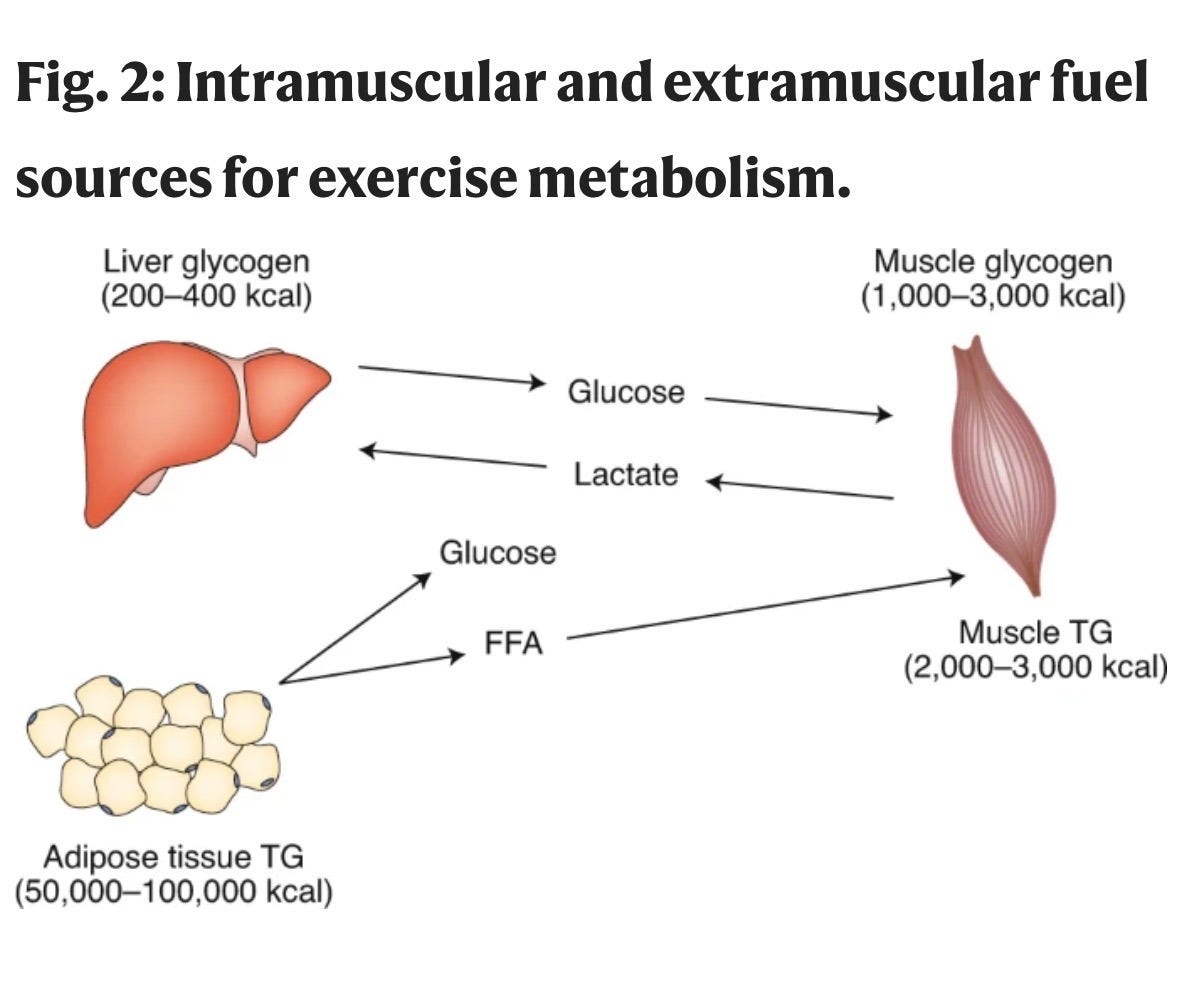
Without carbohydrate intake from outside sources (termed “exogenous carbohydrates”), blood glucose can eventually fall because liver glucose output can’t keep up with the muscles’ demand for glucose. Hypoglycemia (low blood sugar) can develop around the 3-hour mark if you’re not taking in carbs, largely because liver glycogen availability drops.
Carbohydrate feeding changes this equation. Even relatively modest intakes of 20–30 grams per hour can reduce the body’s reliance on endogenous glucose production. Higher intakes, particularly around 90–120 grams per hour, may further suppress liver glucose output/help preserve liver glycogen.
Muscle glycogen is more complicated. Carbs clearly help spare liver glycogen, but their effect on muscle glycogen is smaller and more variable.
The bigger point is that carbohydrate intake helps maintain carbohydrate availability across the whole system. It keeps blood glucose stable, supports exogenous carbohydrate oxidation, and allows the body to continue relying on carbohydrate as a major fuel source.
Delaying the drift toward fat
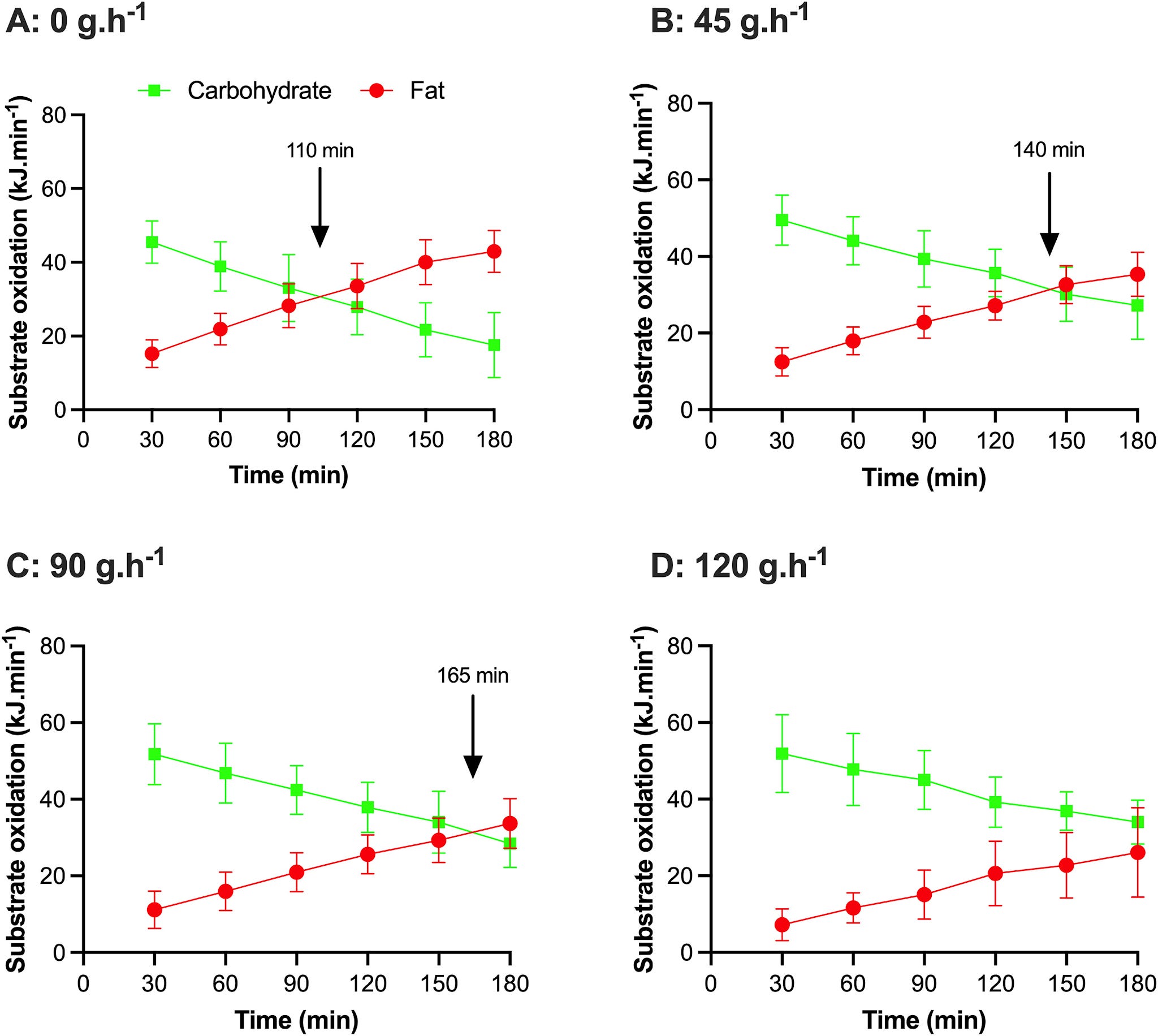
One of my favorite concepts in this area is something called the “crossover point.”
During prolonged endurance exercise, the body often shifts gradually from carbohydrate-dominant metabolism toward greater fat oxidation as glycogen stores deplete. This is not inherently bad. In fact, the ability to oxidize fat at high rates is a hallmark of elite endurance physiology. But if you’re trying to sustain a high pace or power output, a forced shift away from carbohydrate can reduce performance. Fat is valuable, but it cannot fully replace carbohydrates.
In studies cited by the review, carbohydrate intake delayed this crossover point during prolonged cycling. At 45 and 90 grams per hour, the shift from carbohydrate toward fat is delayed. At 120 grams per hour, carbohydrate remains the predominant fuel source (in other words, the “crossover” never occurs).
Reconsidering the 90-gram “ceiling”
The 2016 sports nutrition guidelines recommend 30–60 grams of carbohydrate per hour for endurance exercise lasting 1–2.5 hours, and up to 90 grams per hour for events longer than 2.5–3 hours.
That 90 g/h recommendation was grounded in the evidence available at the time. But newer studies suggest that trained athletes can oxidize more carbohydrate than previously assumed, especially when using glucose-fructose or maltodextrin-fructose mixtures (combining multiple carb sources allows you to utilize different sugar transporters in the body and absorb more of what you’re eating. More on that below).
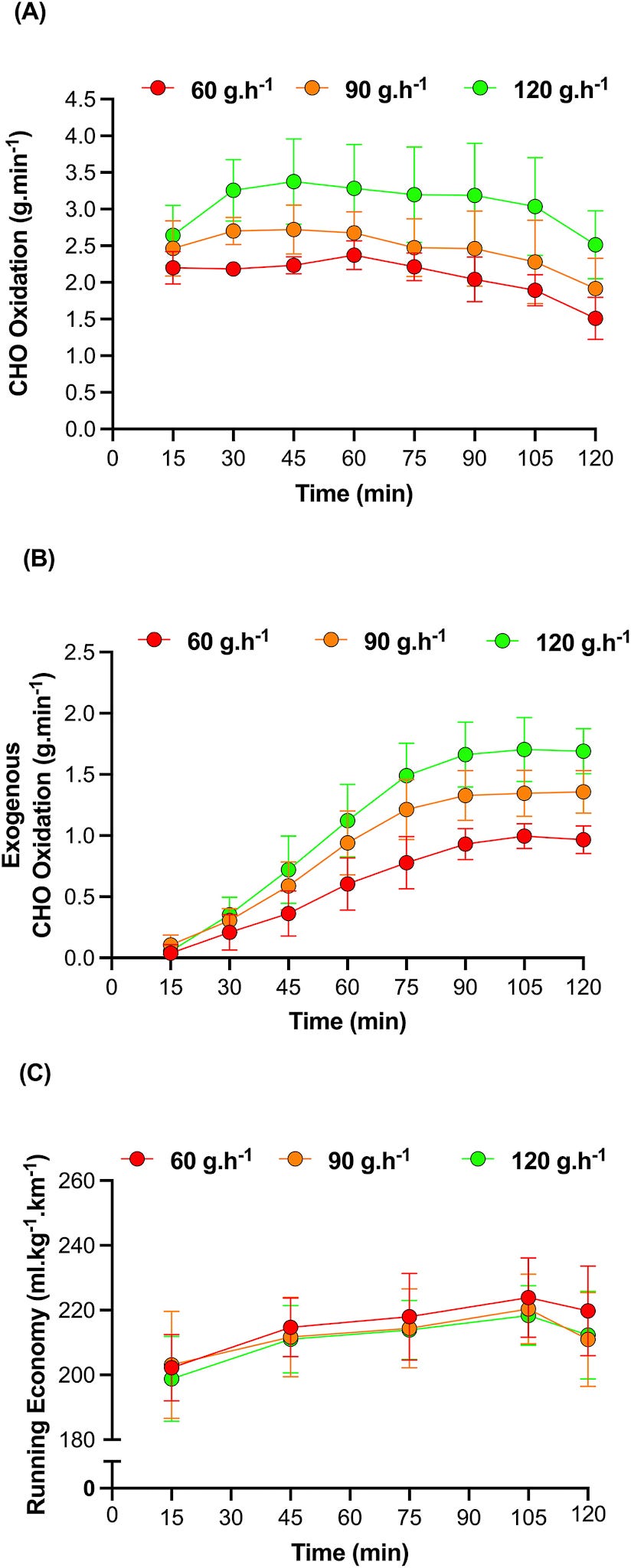
There is research showing that carbohydrate intakes of 120 grams per hour can increase both exogenous carbohydrate oxidation and whole-body carbohydrate oxidation compared with lower intakes. When you eat more carbs, you can use more of them during exercise. Simple to grasp.
Now, this says nothing about the performance implications of such high intakes. Just because you can use more carbs doesn’t automatically mean you’ll run or bike faster. We don’t yet have hard performance outcomes for ultra-high-carb consumption… only anecdotes (which aren’t useless).
In that case, 90 grams per hour should probably no longer be considered the absolute upper limit. For trained athletes, 90–120 grams per hour appears to be a more contemporary evidence-based upper range. Intakes beyond that are being explored in the field, especially in cycling, but the scientific evidence is not yet strong enough to recommend them across the board. This is where I think some people in the endurance space are putting the cart before the horse. Are carbs good? Yes. But the idea that everyone should be fueling with 90+ grams per hour for every session lacks support.
Carb type matters
At lower carbohydrate intakes, the type of carbohydrate matters less. You can consume 30–60 grams of glucose or maltodextrin alone, and it’ll work out fine.
But as intake rises, the source matters more.
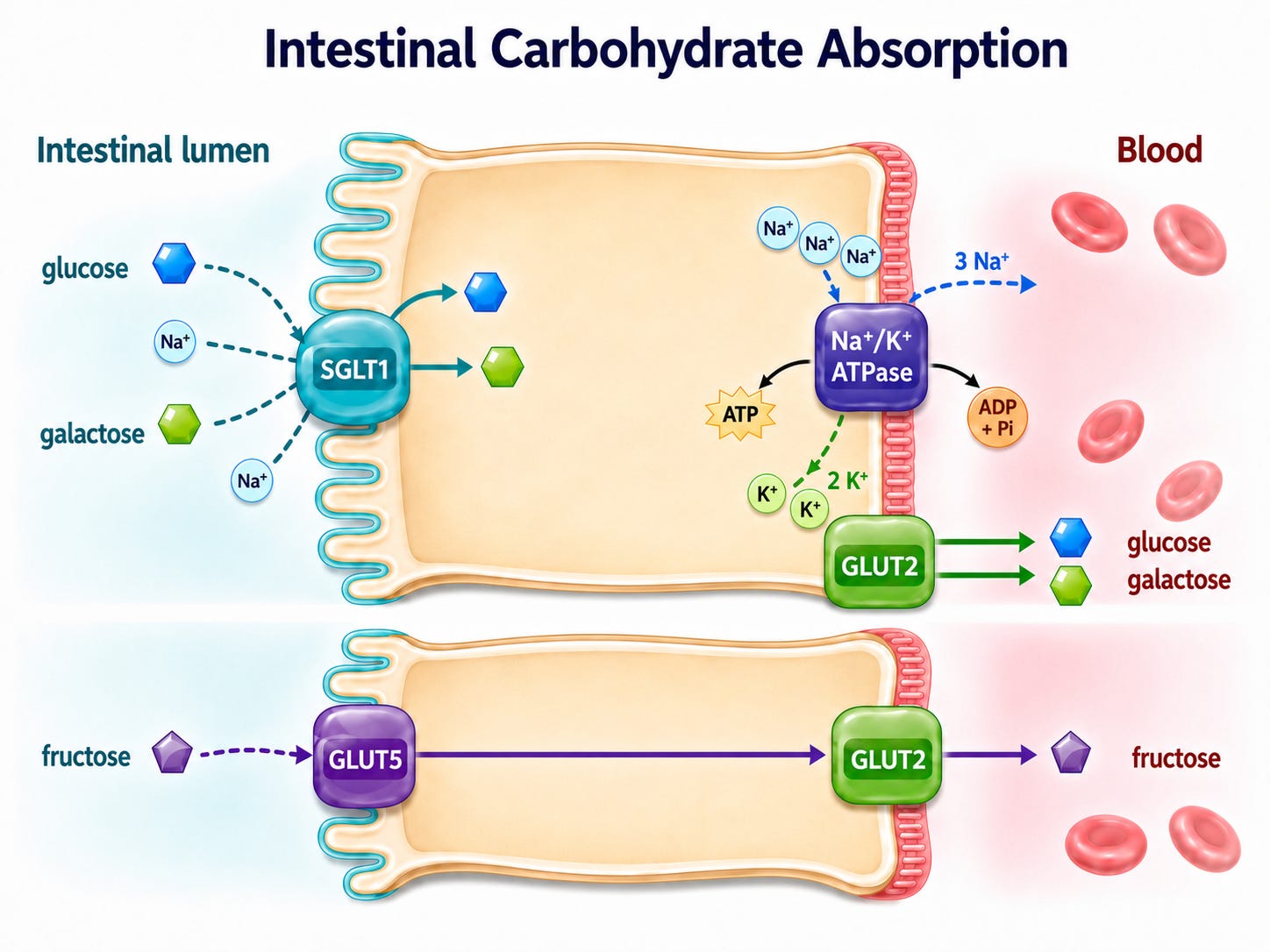
Glucose and maltodextrin rely primarily on a transporter in the intestine known as SGLT1.
Fructose uses a different transporter, GLUT5. When you consume only glucose-based carbohydrates, absorption eventually plateaus because that single transport pathway becomes saturated. But when glucose or maltodextrin is combined with fructose, you can use multiple transporters, increasing total carbohydrate absorption and oxidation.
This is the logic behind “multiple-transportable carbohydrates.” Glucose-fructose combinations can increase exogenous carbohydrate oxidation by roughly 20–55% compared with single-source carbohydrates when high doses are consumed.
The ratio also matters. The authors discuss evidence suggesting that a fructose-to-glucose ratio between about 0.6 and 1.0 may optimize exogenous carbohydrate oxidation. In practice, this includes common formulations such as 2:1 glucose-to-fructose, 1:0.8, or even 1:1 blends. And that’s what many modern-day fueling products deliver (if you have an energy gel handy, take a look at the package and you’ll probably see one of these numbers).
The gut is adaptable
During strenuous endurance exercise, the GI tract is under stress. When carbohydrate intake exceeds absorption capacity, unabsorbed sugar can pull water into the intestine and contribute to bloating, cramping, nausea, and diarrhea. No fun…
But repeated exposure to carbohydrates during exercise can reduce symptoms. This is the idea of gut training, and the evidence for it is well-established.
Across gut-training interventions using 30–90 grams per hour, athletes generally report less GI discomfort over time. The evidence is not yet clear that gut training dramatically increases exogenous carbohydrate oxidation, but it does appear to improve tolerance and reduce issues with absorption. Maybe you can’t train the gut to use more carbs, but you can train it to handle more without issues.
But when you add in environmental stress, things get more complex.
In heat, carbohydrate demands may increase because exercising at a given intensity becomes more physiologically stressful. Heat can increase glycogen use and reliance on carbohydrate. At the same time, heat appears to reduce exogenous carbohydrate oxidation by roughly 20–30%. That creates a difficult scenario where carb needs rise, but our ability to tolerate and use them effectively drops.
At altitude, especially high altitude above around 4,000 meters, exogenous carbohydrate oxidation appears to be reduced. Cold exposure is less likely to impair exogenous carbohydrate oxidation.
Carb intake should probably be modified not only according to the demands of the exercise you’re doing, but also the environment in which you’re doing it.
Updated carbohydrate targets
The review proposes a more nuanced model that considers both exercise duration and intensity. Let’s translate that into some practical targets:
Exercise less than 60 minutes
Carbohydrate during exercise is usually unnecessary, unless the session is very intense, you’re starting with low carbohydrate availability, or the event involves repeated high-intensity efforts. I emphasized usually here because, of course, what’s needed and what’s optimal don’t always overlap.
Typical range:
0–30 g/h
1–2.5 hours
Carbohydrate becomes more relevant, especially as intensity rises.
Typical range:
30–60 g/h
Single-source carbs may be sufficient at the lower end.
Dual-source carbohydrates may be useful as intake rises closer to 60 g/h
2.5–4 hours
Typical range:
60–90 g/h for many athletes
90–120 g/h for well-trained athletes with practiced gut tolerance
Multiple-transportable carbohydrates are strongly recommended at higher intakes.
More than 4–6 hours
Typical range:
60–90 g/h as a practical baseline for many athletes
90–120 g/h for competitive athletes who tolerate it
Mixed-format fueling becomes increasingly useful.
Beyond 120 g/h
This is where the science becomes less certain. Some elite athletes are experimenting with intakes far above 120 g/h, but the review makes clear that efficacy is not yet well established. For now, these strategies should be considered experimental and highly individualized.
A subtle but important point in the review is that high-carbohydrate fueling during competition does not mean athletes should consume maximal carbohydrate in every training session. I feel like that goes without saying, but some of the discussions in the endurance world lack this crucial nuance.
This is where the idea of carb periodization, sometimes summarized as “fuel for the work required,” comes in.
Some sessions may benefit from lower carbohydrate availability to stimulate endurance adaptations related to fat oxidation and mitochondrial signaling. Other sessions, especially high-intensity workouts, race-specific long sessions, and competitions, should be fueled aggressively enough to support quality and performance.
While I have become increasingly intentional about fueling my workouts and races, I still intuitively use this “fueling the work” approach. There are several times per week when I’ll run or ride fasted for 60–90 minutes simply because the session intensity is low, and practically, it’s just more feasible not to eat before a 5:30 AM workout. I do not think this compromises my performance in any way, but I’m still wary of too much fasted training due to the risks of low energy availability.
That being said, I fuel when the session requires it, often using many of the same guidelines provided in this review.
A major limitation in this field is the lack of female-specific research. Much of the carbohydrate fueling literature has been conducted in male athletes, and female-only studies are rare.
However, the existing evidence does not suggest that female athletes cannot benefit from carbohydrates. They clearly can. But it remains uncertain whether absolute intake targets should be identical across male and female athletes, especially at very high carbohydrate intakes. I’m aware of at least a few ongoing or completed studies that are conducted specifically in female athletes. So that’s promising.
Some coaches and athletes think that all exercise should be fueled maximally all the time. I disagree with that sentiment, especially because most people exercising at a recreational level aren’t “under-fueling” in any respect. I said it at the start of this post, and I’ll say it again: Carbs are not a magic bullet.
And I don’t even think they are the main reason we are seeing an explosion in endurance performances (it’s the shoes).
But they are one of the most reliable performance tools endurance athletes have. They allow harder and healthier training. Which means better performance across the board. In this sense, adequate fueling can be revolutionary for many athletes. Carbs are still king when it comes to endurance sports.
If anyone tells you differently, they’re wrong.
Thanks for reading. See you next Friday.
~Brady~
Ketone-IQ is high-performance energy in a bottle. I use it for post-exercise recovery along with enhancing focus, mood, and cognition. Take 30% off your order.

Create is the first “modern creatine” brand. They sell a wide range of creatine monohydrate gummies, and just launched a new creatine + electrolyte mix product plus travel-size packets of creatine gummies. They’re giving my audience 20% off their order.

ProBio Nutrition—the all-in-one supplement that I use every single day—is offering 20% off. My preference is the tangy orange flavor, but they also sell an unflavored “smoothie booster” that’s great in a shake, smoothie, or juice.

Equip Foods makes some of the cleanest, best-tasting protein products around. I am absolutely obsessed with their Prime grass-fed protein bars (the peanut butter ones are to die for, but they also just released a new chocolate peanut butter flavor).

Super useful article! Thank you!
Many of us use a low carb diet to lose weight and it’s hard to lose the fear of carbs, even when exercising. Context is key.
Also, you previously wrote about carbs for recovery. Does the amount of exercise similarly scale to the amount of carbohydrate intake required to optimize recovery?
Probably the best article yet on this topic! Although, it presumes that the athlete is chasing an optimized time rather than an optimized experience. At $2 plus per gel imbibing on the regular can be expensive.