

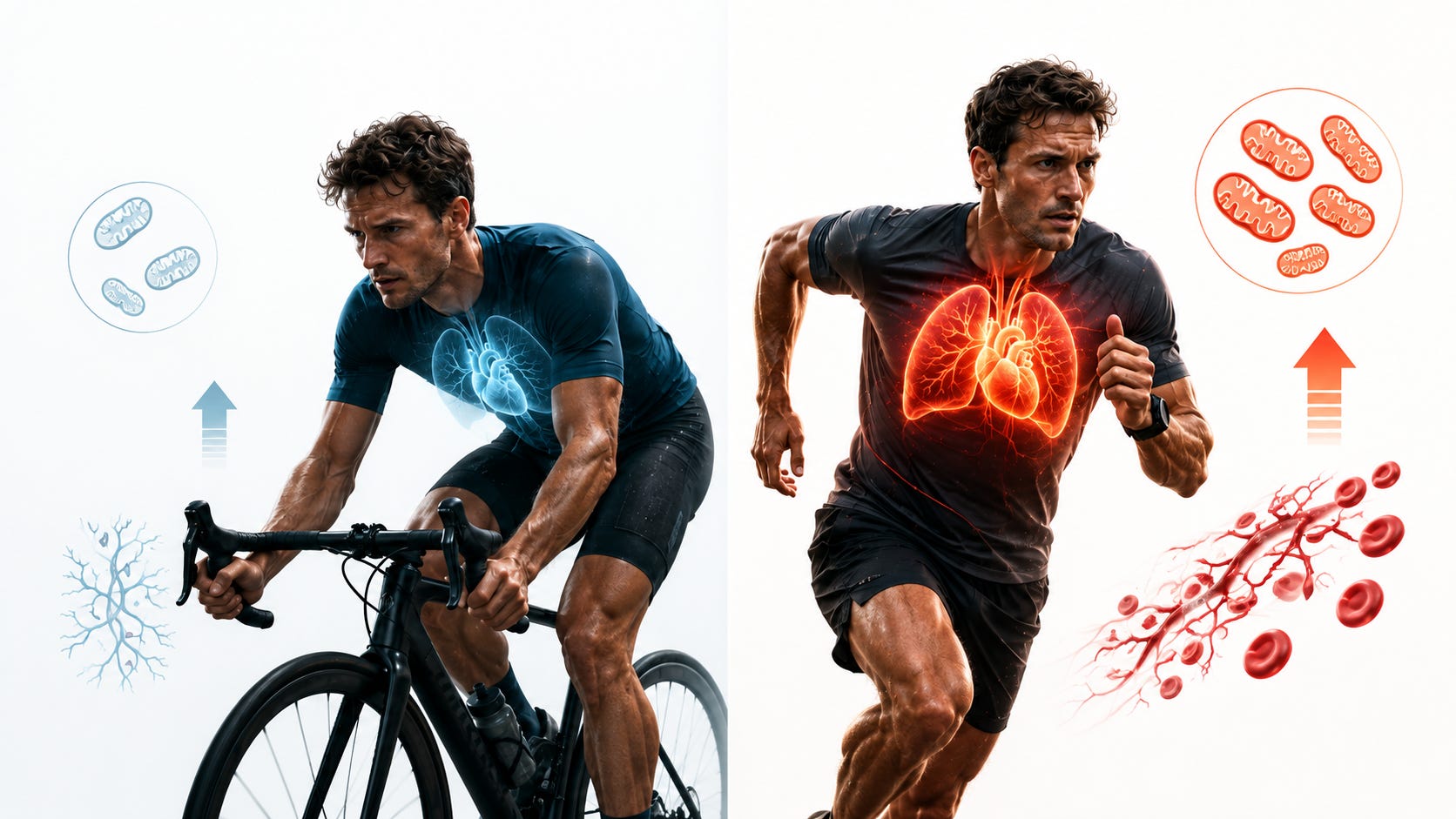
Greetings!
Welcome to the Physiology Friday newsletter.
Details about the sponsors of this newsletter and deals on products I love, including Ketone-IQ, Create creatine, Equip Foods, and ProBio Nutrition can be found at the end of the post.
“It’s tough to make predictions. Especially about the future.” – Yogi Berra
Most of us take our workouts for granted.
When we embark on a marathon training plan or progressive overload regimen in the gym, we expect that it’ll lead to the desired result—a faster time or bigger, stronger muscles.
That’s especially true if we’ve performed the same training before with reasonable success. We responded well the first time, so we should respond in a similar way the next, right?
Let’s refer to this idea as “reproducibility of training adaptation.” The basic idea is that if I put you through 12 weeks of high-intensity intervals, tempo runs, and a hefty amount of zone 2 training, you might improve your VO₂ max by 5–10%.
If I let you take some time off to eat some ice cream and enjoy a few drinks by the beach (the more scientific word for this is “detraining”), and then put you through the exact same training again, we’d expect your VO₂ max to improve by that same 5–10%, assuming you started at the same baseline.
Once a responder, always a responder.
A new study suggests our assumptions about this are wrong.
Exercise science might have a reproducibility problem.
The study—aptly titled “Limited reproducibility of individual physiological adaptations to repeated endurance exercise training”—used a design that is surprisingly rare in exercise science: the same people completed the same endurance training program… twice.1
Rather than comparing one group of people to another, the researchers essentially asked what happens if we put the same individuals through the same training stimulus, under carefully controlled conditions. Do they adapt the same way both times?
The study was built to directly test the idea that people have somewhat consistent “trainability”—someone who improves a lot from one endurance block should also improve a lot when exposed to a similar block again.
Participants completed two separate eight-week endurance training periods, with an eight-week detraining period between them. Each training block included 24 supervised cycling interval sessions, lasting 45 minutes each, performed at intensities ranging from moderate to maximal effort. Every session was supervised, the workouts were prescribed, and the same individuals repeated the same training program twice.
Before and after each eight-week training period, participants completed two submaximal cycling tests, a VO₂ max test to exhaustion, and a 15-minute maximal performance test.
This gave the researchers several layers of information:
How participants responded at lower fixed workloads.
How their maximal oxygen uptake changed.
How their actual cycling performance changed in a sustained maximal effort.
They even had participants perform a familiarization session one week before the first baseline testing period to reduce learning effects, and a rest day was scheduled before each testing block so fatigue from recent exercise would be less likely to distort the results.
The study also went well beyond performance testing to include whole-body DXA scans to assess body composition, leg muscle biopsies, blood samples, total hemoglobin mass measurements, and questionnaires. If it’s relevant to performance, they measured it.
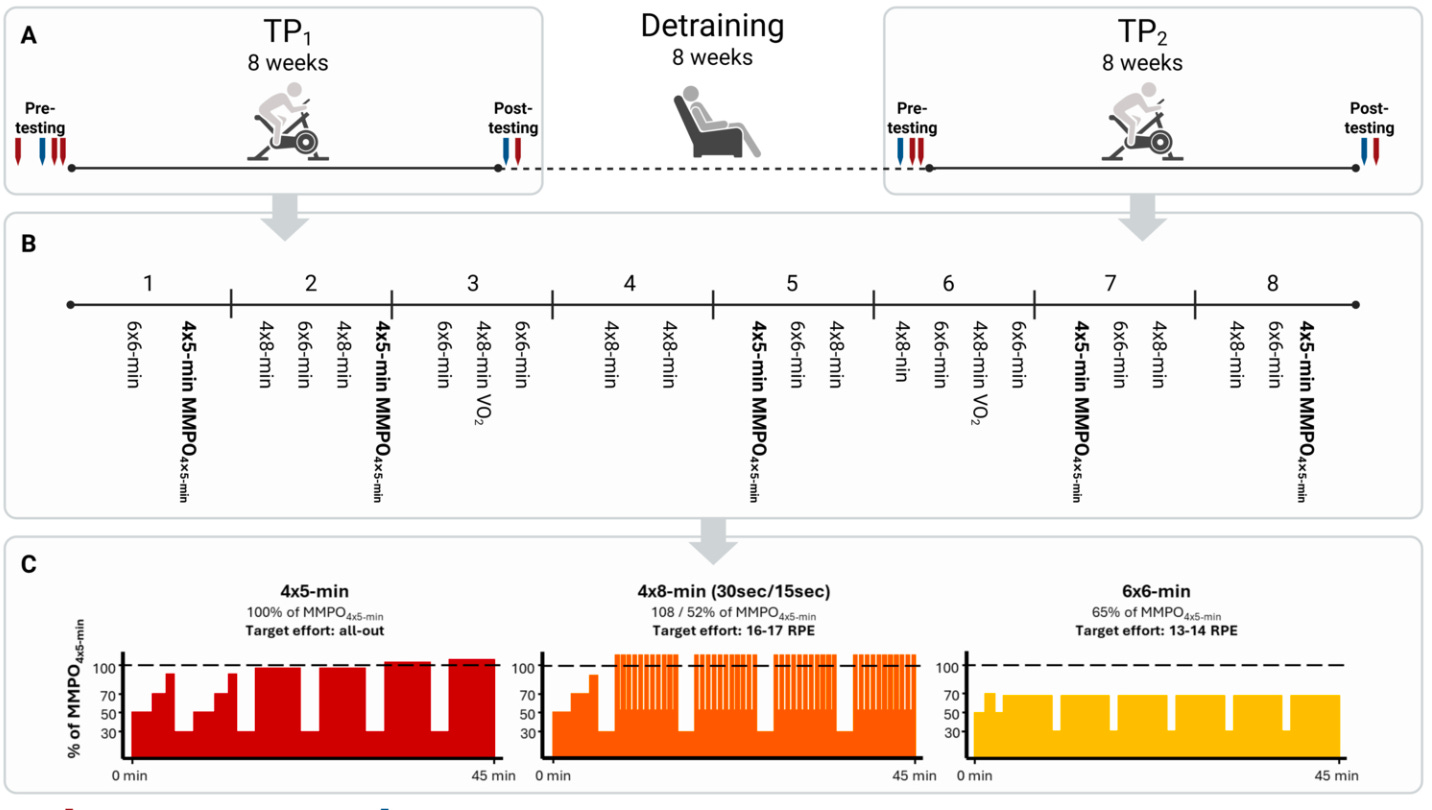
When the researchers zoomed out and looked at the average response (what’s typical in exercise science research), the endurance training intervention was effective and remarkably reproducible.
But when they zoomed in and asked whether the same person responded the same way to the same training program, the answer was mostly no.
That distinction is the entire study.
First, the basics: participants actually did the training. Adherence was nearly perfect, and participants entered the two training periods in a highly comparable state. Baseline VO₂ max, 15-minute cycling power, maximal power, hemoglobin mass, blood volume, body mass, and lean mass were all very reproducible before the first and second training blocks. That means the eight-week detraining period was largely successful, and people were not simply carrying the adaptations from the first block into the second. The study had essentially “reset the clock” well enough to ask the main question.
Here’s what happened at the group level:
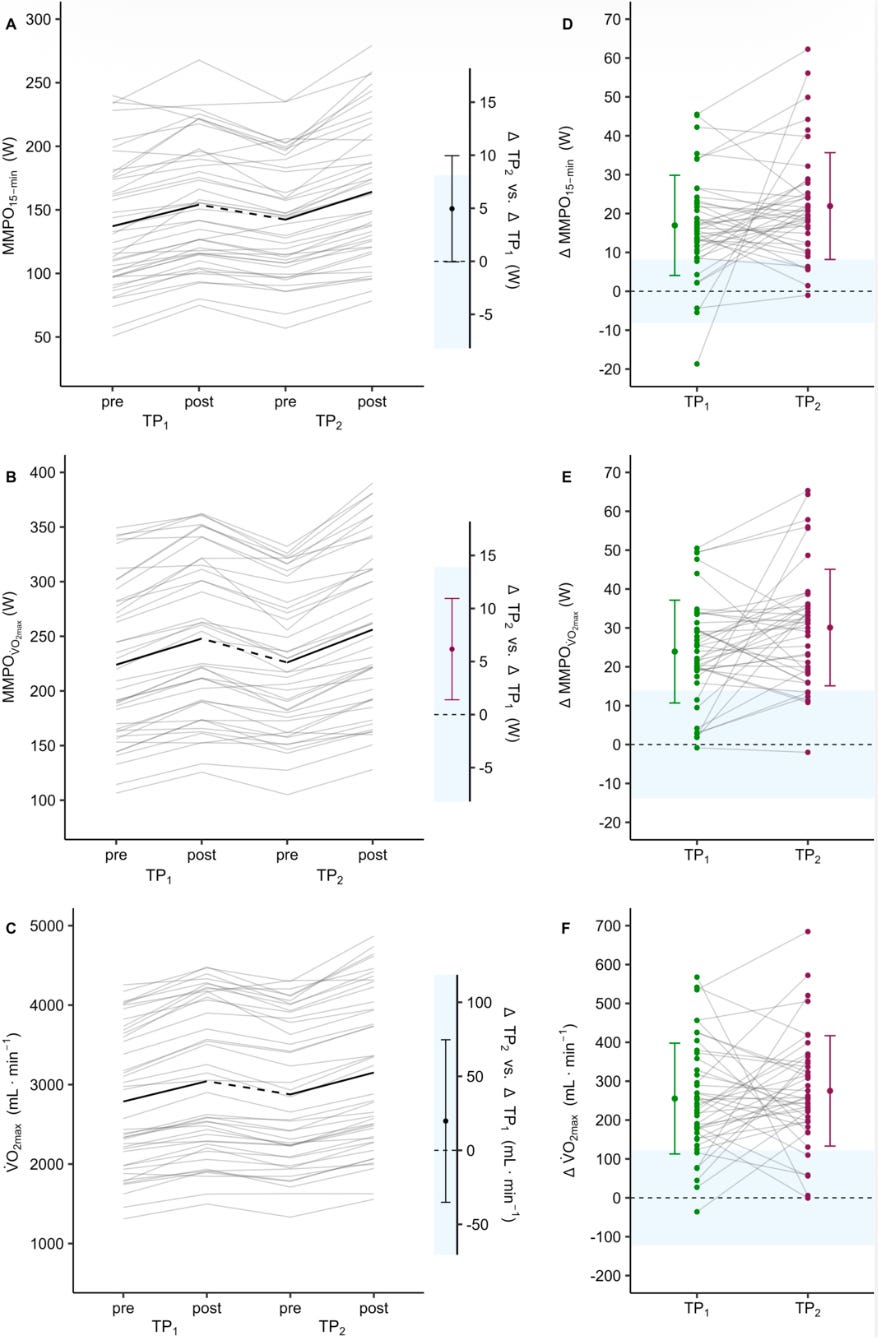
The first eight-week training block increased 15-minute maximal power output from 137 to 154 watts, a gain of 17 watts or about a 15% improvement. The second block increased it from 142 to 164 watts, a gain of 22 watts or about a 16% improvement.
VO₂ max increased by 3.3 mL/kg/min in the first block and 3.4 mL/kg/min in the second (a 9.4% vs. a 9.8% increase).
Maximal power output during the final minute of the VO₂ max test increased by 24 watts in the first block and 30 watts in the second.
So, from the perspective of classic exercise physiology, this study looks almost beautifully successful. Give previously untrained adults eight weeks of supervised interval training, and they improve VO₂ max, maximal cycling power, and 15-minute performance. Let them detrain, repeat the program, and the average improvements show up again.
But then we look at the individual data…
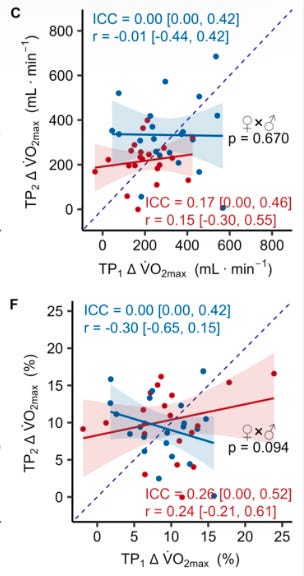
The researchers asked whether the people who improved the most in the first training period were also the people who improved the most in the second. If “trainability” were a stable personal trait, you would expect a fairly strong relationship. That is not what happened.
Individual changes in VO₂ max showed poor reproducibility between the two training periods. The same was true for 15-minute cycling performance, maximal power, submaximal performance, hemoglobin mass, blood volume, red blood cell volume, plasma volume, muscle fiber size, mitochondrial enzyme activity, and capillarization outcomes. Almost everything that mattered physiologically showed weak within-person agreement from one training block to the next.
This is the key result: the group average was stable, but the individual rankings were not.
A person could gain a lot of VO₂ max in the first block and much less in the second. Another person could look like a modest responder the first time and then adapt more strongly the second time (if you look at the right panel in the figure below, which depicts individual responses, this is clear to see).
We see the same story when we look at the muscle level.
Citrate synthase activity, a marker of mitochondrial oxidative capacity, increased in both training periods: by about 47.7% in the first block and 38.4% in the second.
Another enzyme involved in fat metabolism increased more in the second training period than in the first.
Capillary density increased more in the first training period than in the second, and the number of capillaries per muscle fiber (a marker of capillary density) showed a larger numerical increase in the first block as well.
Hemoglobin mass, blood volume, red blood cell volume, and plasma volume increased more in the first training period than in the second, while hemoglobin concentration changed more in the second. But many of these differences were small (close to the expected measurement error for some blood-volume assessments).
The broader point is not simply whether capillaries or hemoglobin mass increased more in one block than the other.
The bigger issue is that these muscle-level adaptations did not neatly explain why a given person’s performance or VO₂ max response differed between training periods.
Because VO₂ max is driven by improvements in oxygen delivery and extraction (i.e., hemoglobin mass, mitochondrial function, and capillarization), we might expect variability in these measures to explain a large portion of the variability in VO₂ max or performance. But they didn’t.
Hemoglobin mass variability explained only a small portion of the maximal power changes. Capillary density explained a modest portion of 15-minute performance and VO₂ max changes. But most of the tested relationships were weak—there was no single obvious mechanism that explained why someone responded differently the second time.
In other words, the “instability” of training response was not simply because hemoglobin or mitochondria changed differently. The adaptive response appeared to be distributed across systems, and the variability probably emerges from the interaction of many moving parts… and maybe even some random biological noise!
The researchers also found no clear evidence that the relationship between the first and second training response differed by sex or age.
Why might the same training program produce different responses in the same person?
I don’t think “noise” fully captures what is happening here.
To me, two explanations stand out. The first is that the body remembers. The second is that life is never the same twice.
Let’s start with muscle memory, or, more broadly, biological memory. The researchers did an impressive job trying to reset participants before the second training period. But “returning to baseline” on a few measurable outcomes does not mean the body has returned to the exact same biological state.
Cardiac remodeling, skeletal muscle capillarization, fiber-size changes, mitochondrial adaptations, or training-induced changes in gene expression may not disappear on the same timeline as performance outcomes. Previous work has shown that exercise can leave behind epigenetic and transcriptional signatures—molecular traces of prior training that may persist even after conventional fitness markers fade.
In that case, the second training block may have been applied to a subtly different biological organism, one that had already experienced eight weeks of structured endurance training. This is especially true since these participants were initially “untrained” and had never really performed formal exercise training. That point should be underscored.
“Muscle memory” probably isn’t one clean mechanism, though. It may be a collection of partially retained adaptations—structural, metabolic, vascular, neural, and molecular—that influence the starting state for the next block of training.
The second explanation is one that we’re all familiar with—lifestyle variables are never the same.
Even in a tightly controlled study, people are not lab animals. We sleep differently from week to week. We eat differently. We experience stress, illness, travel, family obligations, work demands, mood changes, changes in motivation, subtle changes in daily activity, and countless other fluctuations that are hard to measure and impossible to fully control.
Training adaptation is a result of the workout interacting with the body’s current state. A 45-minute interval session performed after a good night of sleep, adequate carbohydrate intake, low stress, and a normal week of activity is not the same biological stimulus as the same interval session performed after poor sleep, under-fueling, elevated stress, or the tail end of a mild illness.
This is why I think the study is so important for how we talk about “responders” and “non-responders.” A person’s response to training is not just a fixed trait. It depends on the training stimulus, but also on the physiological context in which that stimulus lands.
That context includes stable factors like genetics, sex, age, and baseline fitness, but it also includes ever-changing factors like recovery, sleep, energy availability, stress, inflammation, illness, glycogen stores, and prior training history. Some of these variables may shift enough that they never show up in a standard baseline test, yet still meaningfully influence the adaptive response.
So if we really think about it, the “messiness” of the study might actually be its most realistic feature. The researchers controlled everything they could, yet individual responses still varied widely. It makes the findings reflective of real life. None of us ever repeats the same training block under identical conditions.
Here’s the question we should all be asking when starting any training program (or even a workout): “What state am I in right now, and what does my body need in order to respond?”
When I initially read this paper, it seemed like the nail in the coffin for exercise science research. After all, if we can’t even get reliably consistent results in the same exact person, then everything we know about how to prescribe training is wrong. And what to make of the hundreds, if not thousands, of studies we’ve used to base our training, nutrition, and even sleep recommendations on for decades? Should we just throw them out the window and concede that none of it matters if we can’t predict whether they’ll work or not?
After some reflection, I don’t think we’ve hit crisis mode quite yet. Exercise science doesn’t have a “reproducibility problem.”
Exercise science has a human problem.
We’re all unique. So we should take what we can from training studies, apply it to our unique selves, and adapt and respond accordingly. That’s the real takeaway here.
And I think it’s a real paradigm shift for how we think about exercise.
Thanks for reading. See you next Friday.
~Brady~
Ketone-IQ is high-performance energy in a bottle. I use it for post-exercise recovery along with enhancing focus, mood, and cognition. Take 30% off your order.

Create is the first “modern creatine” brand. They sell a wide range of creatine monohydrate gummies, and just launched a new creatine + electrolyte mix product plus travel-size packets of creatine gummies. They’re giving my audience 20% off their order.

ProBio Nutrition—the all-in-one supplement that I use every single day—is offering 20% off. My preference is the tangy orange flavor, but they also sell an unflavored “smoothie booster” that’s great in a shake, smoothie, or juice.

Equip Foods makes some of the cleanest, best-tasting protein products around. I am absolutely obsessed with their Prime grass-fed protein bars (the peanut butter ones are to die for, but they also just released a new chocolate peanut butter flavor).

Working out this much seems contrary to good health. Nature may give generously at one crack at this level of intensity in the belief you are trying to survive. But only is only fooled once. Maybe what should be studied more and shared in popular culture is the real health risk of overtraining. Marathons and full triathlons are popular but at some point, probably for psychological reasons, too many people venture way over the line of diminishing returns physically and socially.
This is the within-person version of a problem I keep running into in the data: "responder" looks like a stable trait until you measure the same person twice, and then most of it turns out to be context and noise.
The Odden design you walk through (same people, same block, twice) is the right way to expose it, and the group-stable but individual-unstable split is the whole story.
My bioinformatics read is that a single measurement of a noisy trait is mostly regression to the mean wearing a costume, which is also why one VO2max test, like one ApoB, can mislead you.
The signal lives in the trajectory, the repeated measure over time, not the snapshot. So your "human problem, not a reproducibility problem" framing is right, and I would push it one step further: it is an argument for tracking your own response longitudinally and ignoring whether you were a "responder" on any single block.
Did the paper report within-person test-retest error as a share of the individual variance?