


Greetings!
Welcome to the Physiology Friday newsletter.
Details about the sponsors of this newsletter and deals on products I love, including Ketone-IQ, Create creatine, Equip Foods, and ProBio Nutrition can be found at the end of the post.
Exercise is generally accepted as a great way to lose weight, maintain weight, or prevent weight regain.
And that’s because we tend to view metabolism as a math equation.
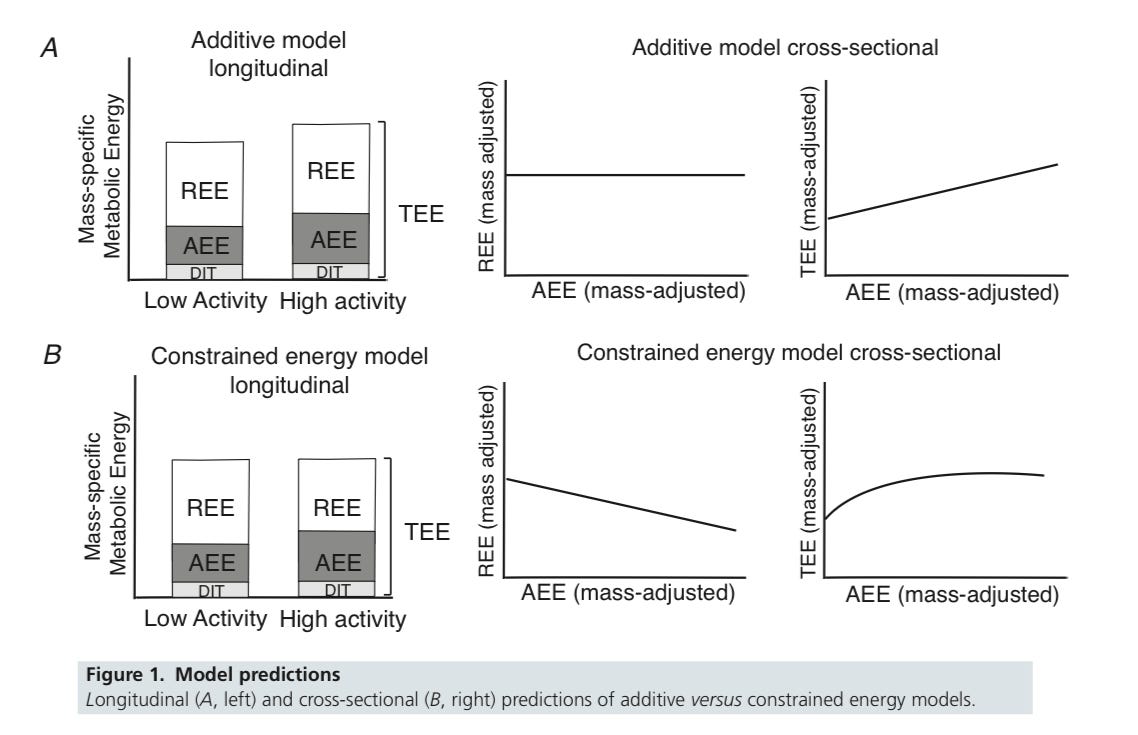
The number of calories we burn in a day—our total energy expenditure, or TEE—is ultimately determined by three things:
Resting energy expenditure (REE), which reflects how many calories your body uses to support normal physiological processes.
Activity energy expenditure (AEE), which reflects how many calories you burn through exercise and other physical activity.
Diet-induced thermogenesis (DIT), which reflects the energy required to digest and process food… think “meat sweats.”
This equation assumes that if, say, I increase my activity energy expenditure by 800 calories in a day—maybe by going on a 10-mile run—then my total energy expenditure for the day also rises by roughly 800 calories.
Researchers call this the additive model of energy expenditure. It assumes resting and activity energy expenditure are independent: one does not meaningfully reduce the other.
Over the past decade or so, the additive model has been challenged by another theory known as the constrained model.
Researchers observed that among highly active people, activity energy expenditure tended to be high, but total daily energy expenditure was not always much greater than it was in less-active people. In some studies, when people undertook huge amounts of exercise, their total daily energy expenditure rose less than their activity level would predict—or sometimes not at all.
This discrepancy was attributed to something called metabolic compensation. It’s the idea that doing more activity somehow causes the body to reduce energy allocation elsewhere, lowering resting energy expenditure and keeping total daily energy expenditure relatively constant. I go on that same 10-mile run, burn 800 calories, but my body “offsets” that by investing less energy in other stuff my body has to do.
That compensation might come from lower hormone production, fewer resources devoted to reproduction, or what researchers call behavioral compensation, where people simply engage in less non-exercise activity, such as fidgeting, pacing, or spontaneous movement throughout the day. I’ll admit that I spend a bit more time on the couch after a long run… that’s behavioral compensation in action.
The constrained model is often used to explain why exercise is not a particularly powerful tool for weight loss: the body “adapts,” and eventually calorie burn becomes something like a zero-sum game.
It’s a highly controversial idea—and according to a new study, this particular version of it is not well supported by the evidence.1
• • •
To test whether energy expenditure is truly additive or constrained, researchers used two complementary approaches.
First, they conducted a tightly controlled experiment in 12 adults. Each person completed two separate 10-day periods—a high-activity and a low-activity period—separated by a washout period:
During the high-activity period, participants added 135 MET-minutes of physical activity per day. A MET is a unit of activity intensity: 1 MET is the rate of energy expenditure at rest. 35 MET-minutes is roughly equivalent to 30–45 minutes of moderate-intensity activity or a few hours of brisk walking. Not elite-athlete levels, but well above their usual baseline.
During the low-activity period, they were essentially told to be “as lazy as possible” (my wording, not theirs).
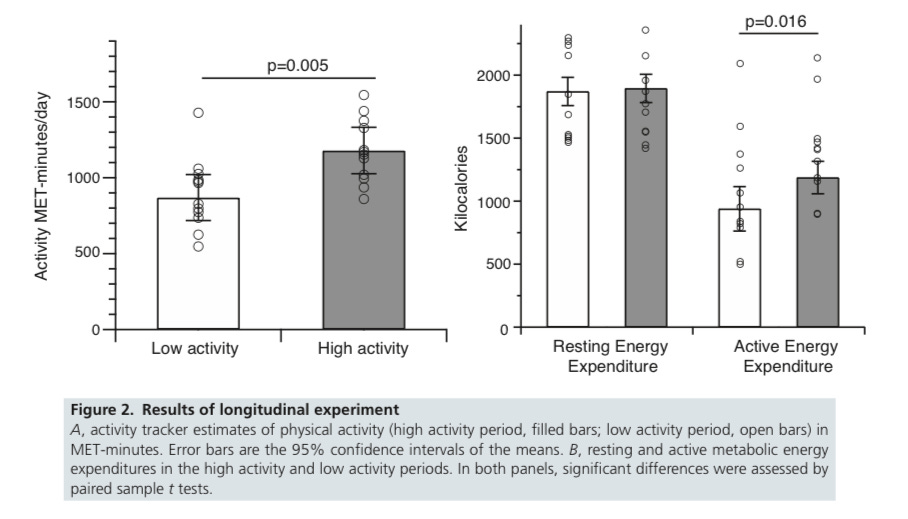
During the high-activity phase, activity energy expenditure rose by about 28%, or roughly 250 calories per day.
What happened to total energy expenditure?
It rose by about 272 calories per day—a 10% increase—while resting energy expenditure, adjusted for body size and composition, did not fall (neither body weight nor body composition changed meaningfully in either group during each 10-day period).
In other words, the extra activity these participants were doing added almost one-for-one to their total energy expenditure, without measurable compensation through a suppressed resting metabolism—exactly what the additive model predicts.
Case closed, right?
Somewhat.
This was a short-term study, and one argument for the constrained model is that there may be a time lag between increases in activity and metabolic compensation. Ten days might not be enough for that compensation to emerge.
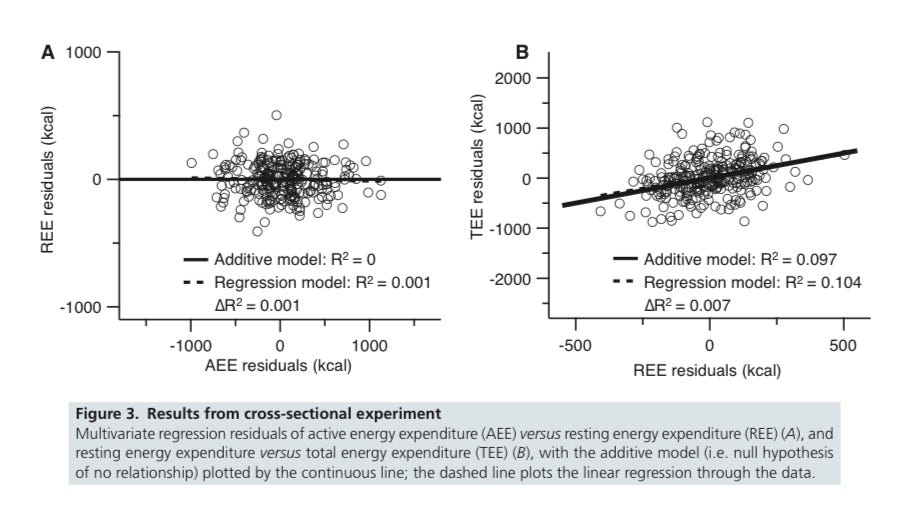
So the researchers complemented the experiment with observational data from 268 adults living under normal, free-living conditions.
If long-term physical activity really causes resting metabolism to drop, you would expect to see that relationship across a diverse group ranging from sedentary to highly active.
But the findings again failed to support the constrained model. There was no relationship between activity energy expenditure and resting energy expenditure—highly active people did not have a suppressed resting metabolic rate. Knowing how active someone was told the researchers essentially nothing about what that person’s resting metabolism was doing.
As a final sanity check, the researchers also compared the human data with metabolic scaling patterns across other mammals. The same basic relationship held: resting and activity energy expenditure behaved independently. Their findings in the large group of adults did not appear to be some unique quirk of human biology.
• • •
Most of us do not exercise simply to burn calories. Nor are the benefits of exercise limited to losing or maintaining weight.
But it is nice to know that, within the range of activity most people are likely to perform, our energy budget appears to be more additive than constrained. The more you exercise, the more energy you burn.
That does not mean you should take the calorie number on your fitness tracker literally. This study supports the direction of the equation, not the precision of a wrist-worn estimate.
The body is not a perfectly predictable math equation. Energy expenditure on any given day fluctuates with activity, body composition, diet, sleep, and a host of other factors we cannot fully account for.
I also don’t think this study proves once and for all that the constrained model of energy expenditure has been debunked. I’m not even sure science can ever do that with a single model. But I think anecdotal experience alone is enough to convince most of us that the additive model makes intuitive sense.
Anybody who has done a block of intense exercise training—preparing for a marathon or triathlon, for example, or simply increasing activity for the fun of it—has probably noticed that unless they stay on top of their eating, weight tends to drop. When I run more, I lose weight. If I eat more to offset that running, my weight stays stable.
On the opposite end of the spectrum, there is even some evidence that energy expenditure may remain elevated after strenuous exercise through a phenomenon known as excess post-exercise oxygen consumption, or EPOC.
Oxygen consumption—and therefore energy expenditure—can remain higher for several hours after exercise as the body repairs tissue and restores itself. If you train regularly, those repeated recovery costs may add a little more to the total. It’s a supply-and-demand issue.
I’ll end with one final nuance that I don’t think much of this research has fully addressed. Even the high-activity condition in today’s study involved a fairly moderate amount of daily exercise. There is still a chance that some metabolic compensation occurs at the extreme upper end of exercise—what you might see in Tour de France cyclists, Ironman triathletes, or ultramarathon runners.
I’m open to the possibility that there is some kind of cap on sustained human energy expenditure (in fact, it’s an idea that has been proposed in the literature). Once you approach that cap—which very few people ever do—the body may begin diverting resources away from physiological maintenance. That is probably part of what we see in athletes who lose their menstrual cycle when high training loads are combined with inadequate energy intake.
Whether metabolism is constrained probably does not change how you or I are going to train. Regardless of which model is ultimately closest to the truth, it probably shouldn’t.
But I’m curious: would it change anything for you?
Thanks for reading. See you next Friday.
~Brady~
Ketone-IQ is high-performance energy in a bottle. I use it for post-exercise recovery along with enhancing focus, mood, and cognition. Take 30% off your order.

Create is the first “modern creatine” brand. They sell a wide range of creatine monohydrate gummies, and just launched a new creatine + electrolyte mix product plus travel-size packets of creatine gummies. They’re giving my audience 20% off their order.

ProBio Nutrition—the all-in-one supplement that I use every single day—is offering 20% off. My preference is the tangy orange flavor, but they also sell an unflavored “smoothie booster” that’s great in a shake, smoothie, or juice.

Equip Foods makes some of the cleanest, best-tasting protein products around. I am absolutely obsessed with their Prime grass-fed protein bars (the peanut butter ones are to die for, but they also just released a new chocolate peanut butter flavor).

Yegian, A.K., Pachus, E., Redman, L.M., Heymsfield, S.B., Falkenhain, K., Harris, A.R., Chacko, S.K., Wong, W.W. and Lieberman, D.E. (2026), Longitudinal and cross-sectional evidence that daily resting and activity energy expenditures are independent in humans. J Physiol, 604: 5952-5967. https://doi.org/10.1113/JP291108
Is this chiefly a shot across the bows of Herman Pontzer’s work on metabolism (as detailed in his book ‘Burn’)? Any response from his team so far?
Encouraging news for those of us who’d like to think our efforts to exercise are contributing something positive to our body composition goals, even if we know diet is the bigger influence.
Experience of one here. The model is additive. However as weight is lost energy expenditure goes down through simple physics.