

Greetings!
Welcome to the Physiology Friday newsletter.
Details about the sponsors of this newsletter and deals on products I love, including Ketone-IQ, Create creatine, Equip Foods, and ProBio Nutrition can be found at the end of the post.
Exercise burns energy. Food replaces it. And if too little energy remains after training, the body starts cutting costs. And when athletes under-fuel, we tend to treat the problem as a simple “calorie shortage.”
That basic idea is captured by a concept known as energy availability. It is the energy you consume minus the energy you expend during exercise, divided by your fat-free mass:
Energy availability = (energy intake − exercise energy expenditure) ÷ fat-free mass
Imagine a runner with 60 kilograms of fat-free mass who eats 2,500 calories and burns 1,000 calories during training. That leaves an energy availability of 25 calories per kilogram of fat-free mass per day. That’s a level low enough to trigger physiological changes within a matter of days.
What does that look like? Well, the body responds to this shortage by becoming more selective about where it spends energy. Processes essential to immediate survival take priority. Processes related to growth, reproduction, bone remodeling, and other longer-term investments may receive less. This is the physiology underlying low energy availability, the Female Athlete Triad, and Relative Energy Deficiency in Sport, also known as REDs.
But there is one huge complication…
When athletes reduce calories, they often reduce carbohydrate intake at the same time. Sometimes that is intentional (someone eating a low-carb diet, for example). Other times it simply happens because eating less of everything means eating fewer carbohydrates.
That creates a difficult question: how much of the body’s response is caused by the energy shortage itself, and how much is caused by having too little carbohydrate available? Because they are not necessarily the same thing!
Two athletes can have identical energy availability while finishing the day with very different amounts of carbohydrate left after training. Researchers call this carbohydrate availability:
Carbohydrate availability = carbohydrate intake − carbohydrate oxidized during exercise
One athlete might replace most of the carbohydrate burned during a long workout. Another might consume the same number of calories but replace those calories largely with fat or protein. Their energy budgets are identical. Their carbohydrate budgets are not. And carbs are much more than just fuel. They influence IGF-1 (a hormone important for growth and tissue repair), testosterone, thyroid hormones, appetite hormones, and more.
Many of these reliably fall during short periods of low energy availability. So the question is whether some of that decline reflects low carbohydrate availability layered on top of the calorie deficit.
A new randomized crossover study tried to separate the two.1
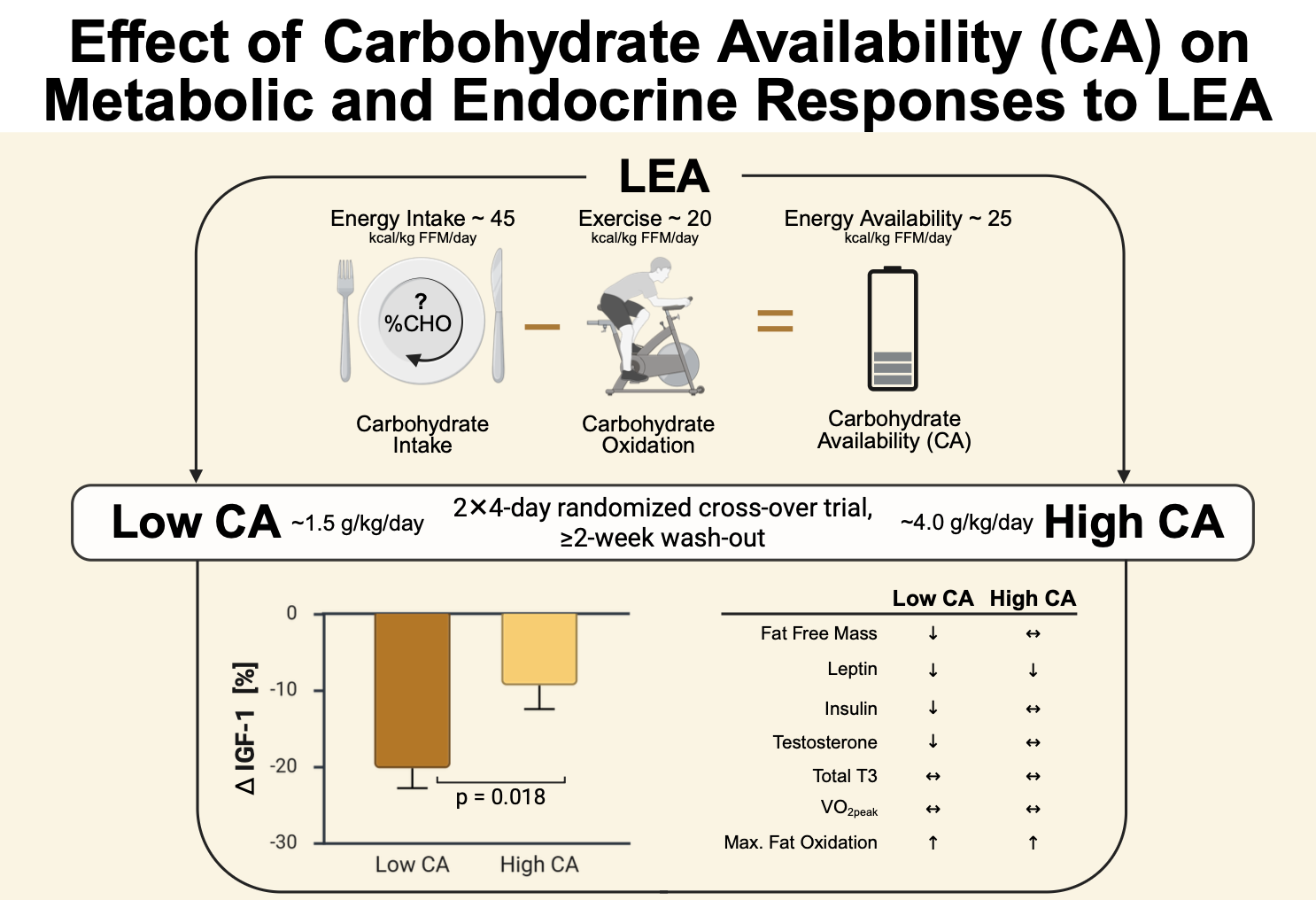
Researchers recruited 16 young, recreationally active adults—nine women and seven men—and put each participant through two four-day periods of low energy availability.
Both conditions were designed to produce the same energy (un)availability of about 25 calories per kilogram of fat-free mass per day. Participants ate roughly 2,600 calories per day, but they also performed enough stationary cycling at 60% of peak oxygen uptake to expend about 1,150 calories—or around two hours of exercise—every day.
That brings up an important point. Low energy availability does not always mean someone is eating very little. A high training load can create the same shortage even when food intake looks substantial on paper. In fact, I think there’s good reason to assume that a calorie deficit achieved via eating less is NOT the same as the same deficit achieved by exercising more. But I digress…
The two conditions differed in how their calories were distributed:
During the low-carbohydrate-availability condition, participants consumed 4.2 grams of carbohydrate per kilogram of body mass per day. After subtracting the carbohydrate used during exercise, their carbohydrate availability was about 1.4 grams per kilogram per day.
During the high-carbohydrate-availability condition, participants consumed 6.7 grams per kilogram per day, leaving about 3.7 grams per kilogram per day available after exercise, or roughly twice that of the low-carbohydrate group.

Even the “low” condition included what might look like a respectable daily carbohydrate intake. It became low only in the context of nearly two hours of cycling every day.
Energy intake and protein intake were nearly identical between conditions. To make room for more carbohydrate without adding calories, the researchers reduced fat. Carbohydrate supplied 46% of calories in the low condition and 73% in the high condition; fat supplied 37% and 11%, respectively; protein was matched at 15% of total daily calories.
Before and after each condition, the researchers measured body composition, resting metabolism, fasting hormones, fuel use at rest and during exercise, blood lactate, peak oxygen uptake, and maximal cycling power.
What happened?
Both conditions produced almost identical weight loss: about 2.2 pounds or roughly 1 kilogram in four days. Resting metabolic rate did not change. So the calorie deficit was doing what calorie deficits do, regardless of where the calories came from.
The hormonal response was a bit more interesting.
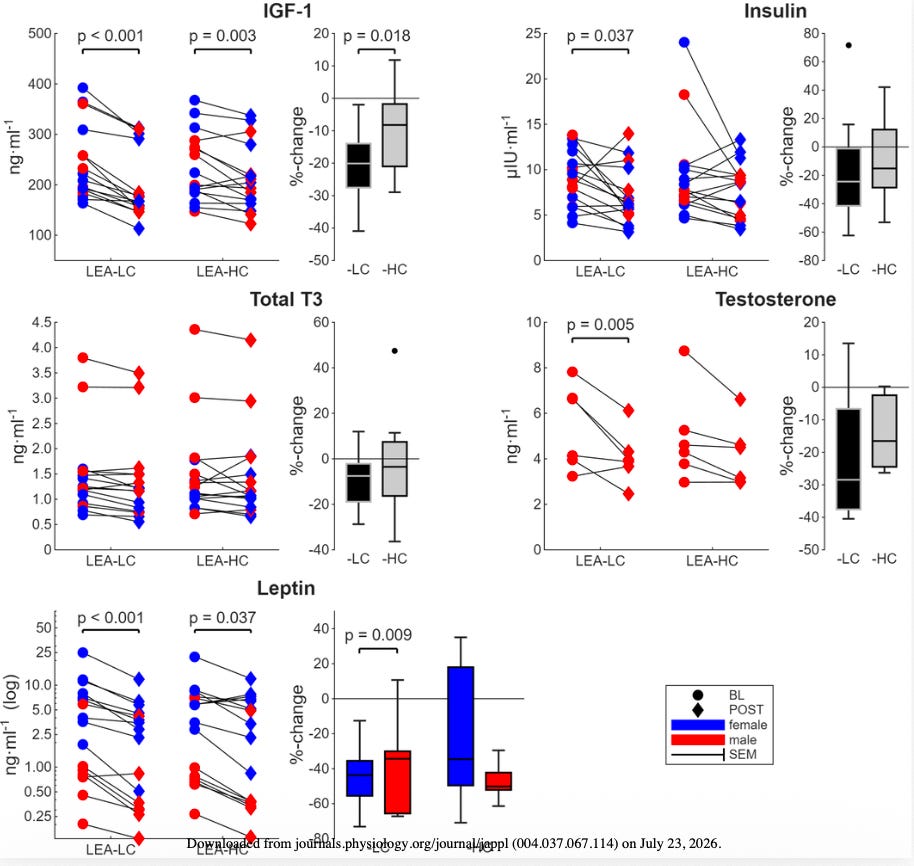
IGF-1 fell in both conditions, but the decline was roughly cut in half when carbohydrate availability was high.
IGF-1 declined by 20.2% during low carbohydrate availability and by 9.4% during high carbohydrate availability.
The higher-carbohydrate diet did not prevent endocrine suppression. But it meaningfully attenuated one of its clearest signals.
Insulin and testosterone both declined significantly during low carbohydrate availability but not during high carbohydrate availability. Leptin (sometimes referred to as the “hunger hormone” also appeared to fall less in women when more carbohydrate was available.
But this is where the statistics matter. When the researchers tested that difference directly, changes in insulin, testosterone, leptin, and T3 were not significant. In other words, they didn’t change. IGF-1 was the only measured hormone for which the evidence clearly showed a different response between the two diets.
Now onto the exercise data.
Maximal blood lactate during the max exercise test fell by 1.2 mmol/L after the low-carbohydrate condition and was essentially unchanged after the high-carbohydrate condition. The lactate curve also shifted to the right only when carbohydrate availability was low.
Odd, right? A given lactate concentration at a higher percentage of peak oxygen uptake might look like an improved lactate threshold. But after four days of under-fueling, that is probably not what happened. Rather, the decline in maximal lactate suggests that low carbohydrate availability reduced the ability to rapidly break down carbohydrate and produce lactate during hard exercise!
Keeping carbohydrate availability high appeared to preserve more of that glycolytic capacity.

That did not translate into a measurable performance difference. Peak oxygen uptake and maximal cycling power were unchanged in both conditions.
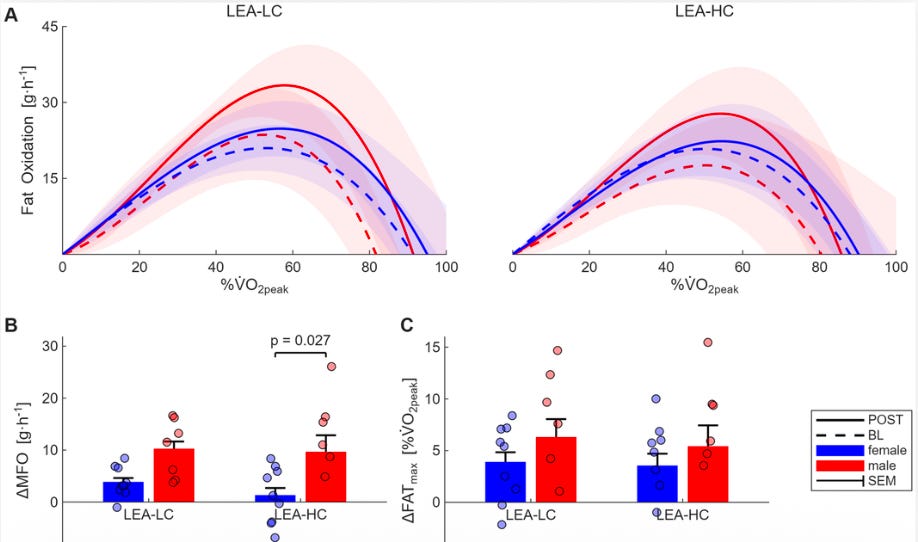
At rest and during exercise, low energy availability shifted the participants toward greater fat use, but higher carbohydrate availability did not clearly prevent that shift. Men generally showed larger increases in maximal fat oxidation and larger decreases in carbohydrate oxidation during submaximal exercise.
In other words, the calorie deficit still shifted resting and exercise metabolism in a meaningful way, even when carbohydrate intake was high.
So, is low energy availability partly a carbohydrate problem?
It appears to be—at least for some acute responses.
This study makes a strong case that the macronutrients inside a calorie deficit are not interchangeable. Two diets can produce the same energy availability while creating different hormonal and energy-use signals. Preserving carbohydrate availability cut the short-term IGF-1 decline roughly in half and prevented the reduction in maximal blood lactate. But otherwise, all else looked mostly the same after this four-day intervention.
Both groups were still in low energy availability. IGF-1 still fell in the higher-carbohydrate condition. Body mass fell to the same degree. Resting and exercise fuel use still shifted, and the researchers could not show clear between-diet differences for most of the other hormones.
Carbohydrate softened part of the response but did not make under-fueling physiologically harmless.
I think that this study cannot tell us a lot of things, but that doesn’t mean it isn’t practical. It doesn’t tell us that a change in fasting IGF-1 over four days leads to a noticeable health or performance outcome, nor does it tell us whether more carbohydrate prevents the long-term outcomes associated with REDs such as menstrual disturbances, impaired bone health, recurrent injury, or declining performance. Those questions require longer studies in athletes.
Here’s the use case.
If you’re temporarily entering an energy deficit, knowingly or unknowingly, such as might happen during a high-volume training block, a weight-making phase, or simply a few days when food intake isn’t keeping pace with your training… protect your carbohydrate intake!
In practice, that may mean really focusing on carbohydrate across high-demand training days and, at the micro level, optimizing the timing of carb intake around workouts (though this study did not test nutrient timing).
Eat enough to support the work you’re doing. Carbohydrates aren’t a shield against chronic under-fueling. But if you can’t restore a deficit immediately, the type of calories you preserve probably matter. The body appears to respond not only to how much energy remains, but also to which fuel remains available.
The best solution to low energy availability is still to restore energy availability.
Thanks for reading. See you next Friday.
~Brady~
Ketone-IQ is high-performance energy in a bottle. I use it for post-exercise recovery along with enhancing focus, mood, and cognition. Take 30% off your order.

Create is the first “modern creatine” brand. They sell a wide range of creatine monohydrate gummies, and just launched a new creatine + electrolyte mix product plus travel-size packets of creatine gummies. They’re giving my audience 20% off their order.

ProBio Nutrition—the all-in-one supplement that I use every single day—is offering 20% off. My preference is the tangy orange flavor, but they also sell an unflavored “smoothie booster” that’s great in a shake, smoothie, or juice.

Equip Foods makes some of the cleanest, best-tasting protein products around. I am absolutely obsessed with their Prime grass-fed protein bars (the peanut butter ones are to die for, but they also just released a new chocolate peanut butter flavor).

Nusser V, Teubner J, Buerger SA, Frodl A, Rainsberger K, Braunsperger A, Wasserfurth P, Hackney AC, Koehler K. Increased Carbohydrate Availability Partially Attenuates Endocrine Suppression in Response to Low Energy Availability. Journal of Applied Physiology. Published online Jul 16, 2026. https://doi.org/10.1152/japplphysiol.00207.2026
I am really glad to see that more studies are looking in depth at this issue and Brady, you are correct that long term studies and, I will add, monitoring, need to be done to fully elucidate trend of "Low Energy Availability". Coming from a metabolic perspective I view LEA as a very complex, individualized, contextual and dynamic paradigm. Unfortunately the current sport science has become so hyper focused around high carbohydrate dieting and fueling it has created a self-prophecy that supports a narrative over a discussion. Similarly, the keto/LC Camp won't admit that carbohydrates are necessary for performance (and I would submit that Carbs are necessary for optimal fat oxidation and metabolic performance, just not at the levels elite athletes are currently pushing). What is needed is a balance and a much broader examination of the factors going into LEA. We also need to examine how LEA develops which is, most often, a result of chronically consuming too many carbohydrates in the diet and fueling over time. I've worked with enough athletes at all levels to observe the current discussions on LEA are oversimplified and static with the simple answer most often being more CHO, more often in and out of physical activity. Usually there are a number of underlying metabolic shifts that precede LEA.
Excess adiposity lowers testosterone but so does an energy deficit. Humans are tricky!