

Greetings!
Welcome to the Physiology Friday newsletter.
Details about the sponsors of this newsletter and deals on products I love, including Ketone-IQ, Create creatine, Equip Foods, and ProBio Nutrition can be found at the end of the post.
Heat is, well, a hot topic right now—for lack of a better word.
And I mean that in a couple of different ways.
The first is an area near and dear to my heart. Athletes, myself included, are talking about (and increasingly embracing) deliberate heat training as a way to improve their performance.
That can take the form of passive heat exposure, such as using a sauna or soaking in a hot bath after training. Or it can be more active, such as deliberately exercising in the heat, wearing extra layers, or turning off the fan during an indoor workout (a decision that always sounds better before the workout begins).
The research coming out on heat training is fascinating. It’s the closest thing we have to altitude training. I think more athletes are realizing that heat doesn’t always have to be a stressor we avoid. When used deliberately, it can also be a training stimulus, so long as we don’t overdo it.
But heat is being discussed in another, much less voluntary context.
Without turning this into a discussion about climate change, the basic reality is that temperatures are extremely high in many parts of the world, including, currently, across large parts of the United States. That becomes an especially serious problem in places where homes and buildings aren’t equipped with air conditioning, or where people don’t have reliable access to cooling.
Whenever a heat wave arrives, the news coverage is filled with warnings about the dangers of excessive heat. One group is almost always singled out… older adults. They’re told to avoid the heat, stay hydrated, seek air conditioning, and use various cooling strategies to reduce their risk of heat exhaustion, heat stroke, and other forms of heat-related illness.
That advice exists for a good reason. It is generally accepted, and supported by a fair amount of physiology, that our ability to tolerate heat declines with age. Older adults tend to be less effective at dissipating heat and regulating their core temperature (the official word for this is thermoregulation).
Some of the reasons are already well known. Aging can alter the sweating response, reduce the body’s ability to move heat toward the skin, and narrow the overall margin available for coping with thermal stress.
What is less clear is when this decline actually begins. Is there a particular age at which we suddenly become less heat tolerant? (Almost certainly not.) Or does our ability to handle heat gradually decline across the adult lifespan?
Understanding when heat tolerance begins to deteriorate could help us identify risk earlier and develop better strategies for preserving that capacity as we age.
Because thermoregulation isn’t completely fixed. Our ability to handle heat can be trained. Repeated heat exposure produces adaptations that help the body dissipate heat more effectively, and aerobic fitness influences many of the same systems involved in that response.
That brings us to a separate but related question.
Could better cardiorespiratory fitness—or simply engaging in more physical activity—help preserve our ability to regulate temperature as we get older? Or does aging eventually win regardless?
A new study examined exactly these questions by exposing adults ranging from 20 to 79 years old to (a brutal!) six hours of extreme heat. The experiment gave the researchers a way to test whether staying fit and physically active could offset some of that age-related decline.1
The answer appears to be yes… but only partly.
The researchers recruited 61 healthy adults—27 women and 34 men—ranging from 20 to 79 years old. The sample included 25 younger adults, 16 middle-aged adults, and 20 older adults.
First, everyone completed a treadmill test to measure peak oxygen uptake, or VO₂ peak.
Participants wore an accelerometer for seven days to estimate their usual moderate-to-vigorous physical activity.
Then each participant spent six hours in an environmental chamber set to 109°F (43°C) and 25% relative humidity. Every hour consisted of 50 minutes of seated rest followed by 10 minutes of treadmill walking at three metabolic equivalents, roughly the intensity of light housework. In other words, they spent the hottest six hours of the day in a brutally hot room while occasionally getting up to do something. This was the researchers’ attempt to enhance something known as ecological validity (how well a study predicts real-world behavior and everyday life settings).
The researchers continuously measured rectal temperature (not glamorous, but very useful), skin temperature, and heart rate. They also measured whole-body sweat loss and local sweating at the back and forearm. Participants completed several cognitive tests before the exposure and again during the final 30 minutes, received 4 milliliters of water per kilogram of body mass every hour, with more available on request, and ate a meal.
Average core temperature was 98.4°F (36.9°C) after the first hour and 99.7°F (37.6°C) after six hours. By the end, it had risen by an average of about 2°F or 0.91°C. But individual responses ranged from only 0.60°F (0.33°C) to as much as ~3°F (1.62°C).
Age explained part of that difference. The older the participants were, the less they sweated.
Whole-body sweat rate declined by 6 grams per square meter of body surface area per hour with every additional decade of age.
For every additional decade of age, the rise in core temperature increased by 0.14°F (0.08°C). That sounds small. But across the study’s roughly six-decade span, that adds up to nearly one degree Fahrenheit or half a degree Celsius of additional core-temperature rise!
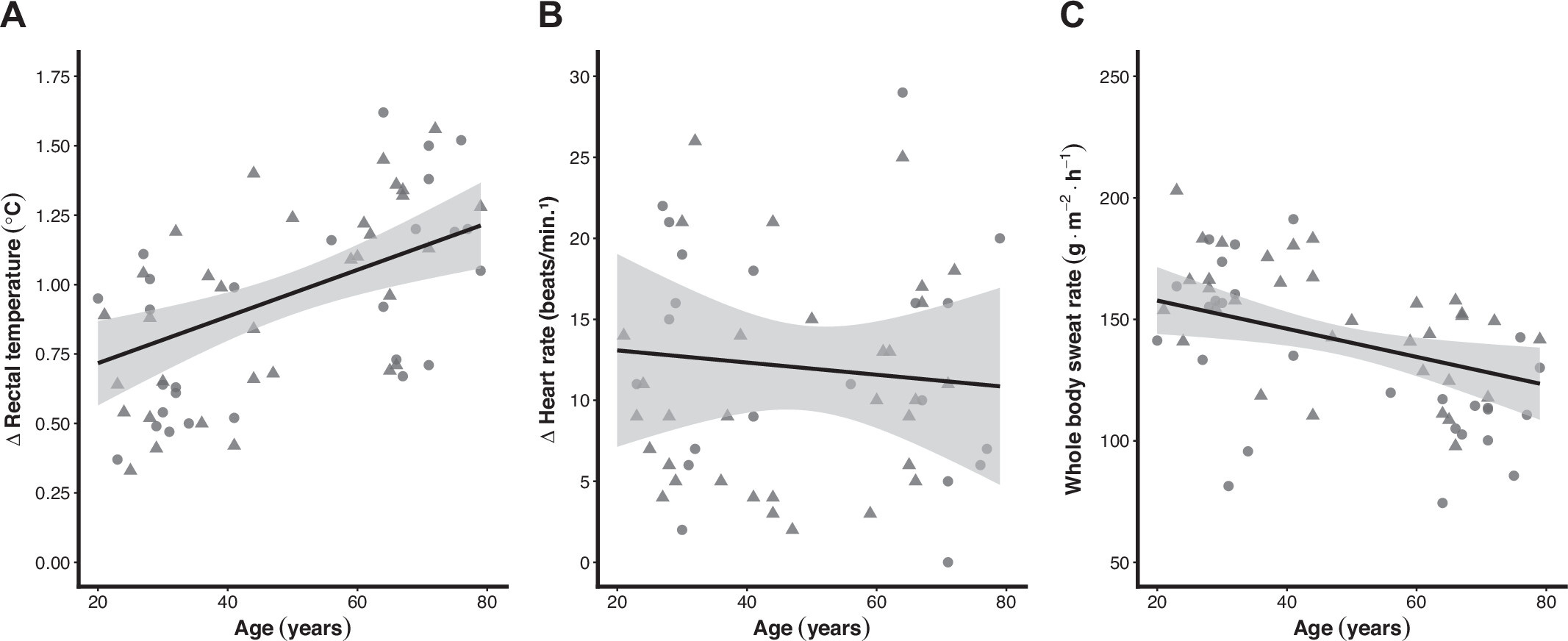
Another result I found interesting was that older adults did not show a larger heart rate increase during the exposure.
Their absolute heart rate was actually lower—by about 3 beats per minute per decade at rest and 4 beats per minute per decade at the end of the exposure. But the change in heart rate across the six hours was similar regardless of age.
As for fitness, it helped—but not quite how I expected.
For every 10 mL/kg/min increase in VO₂ peak, whole-body sweat rate was 11 grams per square meter per hour greater.
Resting heart rate was about 5 beats per minute lower, and heart rate at the end of the heat exposure was about 4 beats per minute lower for the same increase in cardiorespiratory fitness.
So we might assume that the fitter participants kept their core temperature lower.
Nope.
A 10 mL/kg/min difference in VO₂ peak was associated with essentially no difference in the rise in core temperature. The researchers also found no evidence that greater fitness changed the age-related temperature trajectory over the six hours.
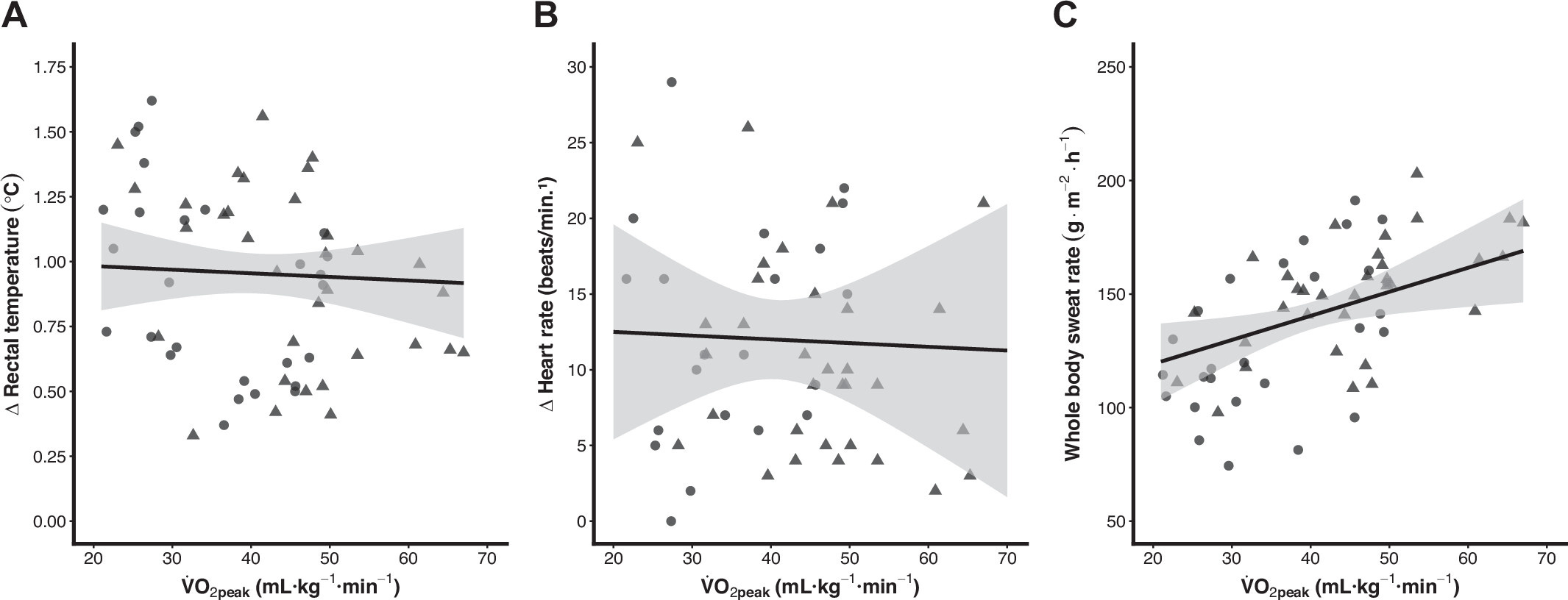
Fitness improved parts of the cooling machinery, but those advantages did not translate into a measurably smaller rise in core temperature. Weekly physical activity was even less predictive.
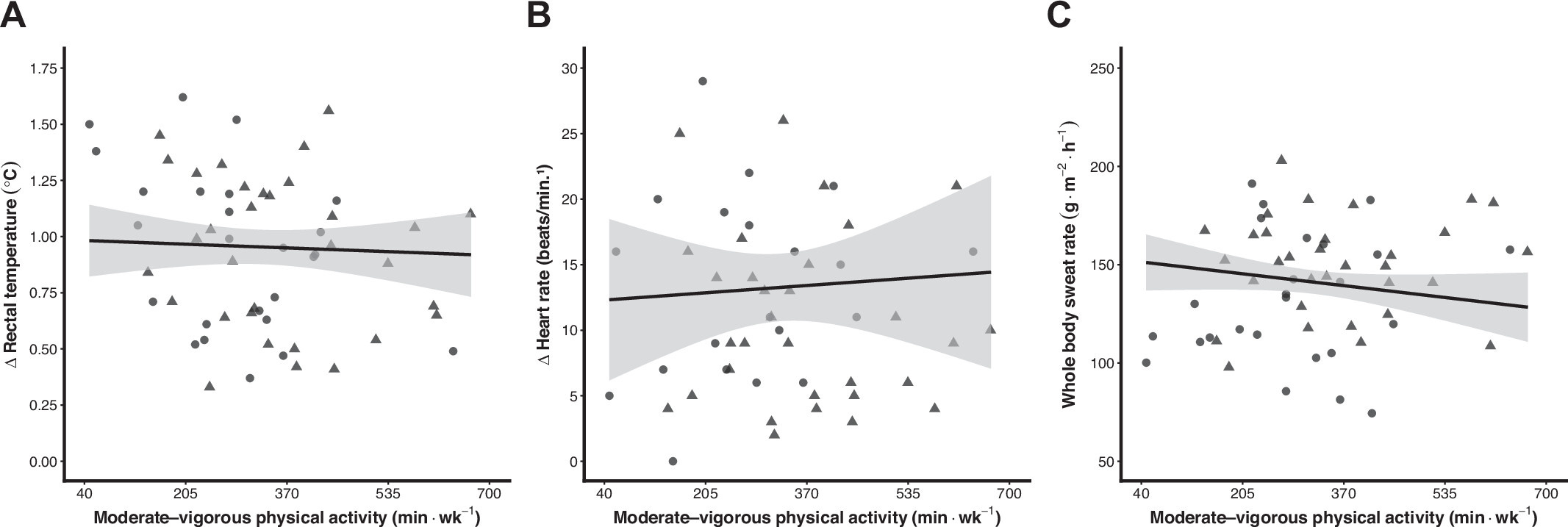
An additional 60 minutes of moderate-to-vigorous activity per week was not associated with core temperature, heart rate, or whole-body sweat rate.
I find this result less convincing as evidence of what physical activity can and cannot do. This was a remarkably active group—only six people fell below the activity guidelines for their age—so there may not have been enough inactive people to reveal a meaningful contrast. Not to mention that a seven-day activity snapshot is unlikely to tell us as much as a person’s cardiorespiratory fitness.
Did the heat make people worse at thinking?
Older age was associated with lower performance across all four cognitive domains, both before and after the heat exposure. But the six hours of heat did not worsen memory or visual reasoning. Attention and processing-speed scores actually improved.
No, I don’t think sitting in a 109°F room is a clever new brain-training strategy.
The likely explanations are less exciting and probably include practice effects, thermal strain that was not severe enough, or tests that were not sensitive enough to reveal subtle impairments. Participants also remained well hydrated (they lost only about 0.5% of their body mass during the six hours, whereas some research suggests cognitive impairment may emerge closer to a 2% loss).
Because heat did not clearly impair cognition, the researchers could not really test whether fitness or activity offered protection. Both were associated with better processing speed, but not with broad advantages across the other tests. (If you’re fitter, you appear to have a sharper brain. No breaking news there.)
Thus, I would consider cognition mostly a null finding, although an informative one. These healthy, hydrated adults maintained performance on the tests used here. I think that’s good news for us all.
This study does not recreate the full public-health problem of extreme heat.
But I do think it reveals something useful about the underlying physiology. Heat vulnerability appears to accumulate gradually across adulthood. It does not suddenly switch on when someone enters the “older adult” category.
If we take the results at face value, the age-related decline in thermoregulation looked gradual rather than catastrophic. That may partly reflect how active the participants were. The active sample is certainly a limitation for generalizability, but I also see it as a reminder that maintaining fitness and activity may preserve some physiological reserve.
Higher cardiorespiratory fitness appeared to provide some additional physiological reserve against the heat—especially as we get older. Cooling strategies still matter, but we should also be emphasizing that heat tolerance is trainable. I think exercise and deliberate heat exposure, including sauna use, could become useful tools in efforts to reduce heat-related illness. What would happen if every household had a sauna (I’m unaware of any heat illness statistics in sauna-using countries like Finland versus the U.S., but it would be interesting to compare!)
Fitness often works by widening our margin for error. It rarely makes the stressor disappear. I’m not immune to the heat because my VO₂max is in the mid-70s. But I sure as hell tolerate it better. This “reserve” concept extends far beyond heat, too.
Fitness cannot negotiate with thermodynamics. But if we can embrace the heat, it seems we can also become more resilient to it. Something about “what doesn’t kill you…”
You know the rest.
P.S.—If you’re interested in this topic, I highly recommend “Hotwired” by Bill Gifford. I just finished it, and it’s a wildly fun exploration of how to harness heat to live and perform better.
Thanks for reading. See you next Friday.
~Brady~
Ketone-IQ is high-performance energy in a bottle. I use it for post-exercise recovery along with enhancing focus, mood, and cognition. Take 30% off your order.

Create is the first “modern creatine” brand. They sell a wide range of creatine monohydrate gummies, and just launched a new creatine + electrolyte mix product plus travel-size packets of creatine gummies. They’re giving my audience 20% off their order.

ProBio Nutrition—the all-in-one supplement that I use every single day—is offering 20% off. My preference is the tangy orange flavor, but they also sell an unflavored “smoothie booster” that’s great in a shake, smoothie, or juice.

Equip Foods makes some of the cleanest, best-tasting protein products around. I am absolutely obsessed with their Prime grass-fed protein bars (the peanut butter ones are to die for, but they also just released a new chocolate peanut butter flavor).

Brown HA, John K, Elliott JD, et al. Impact of age, cardiorespiratory fitness, and regular physical activity on physiological strain and cognitive performance during a 6-h extreme heat exposure. Journal of Applied Physiology. 2026;140:1721–1731. doi:10.1152/japplphysiol.00105.2026
Where I am currently sitting the temperature is 100.6 with 33% humidity. A typical day where I will spend 8 hours. In addition, I ran for 90 minutes this morning. Correspondingly, heat is a very interesting topic. There are a few different modalities that are appealing. One a higher relative core temperature is a virus and bacteria fighter. Think of a fever when ill. Two, obvious training gains with increased tolerance to heat and increased blood plasma levels. It's an adaptation process. On the other hand, I've seen studies where exposure to heat is associated with increased mortality risk. Maybe, but I think that the heat load in an individual with poor health is an additional negative load so this would make sense. I'm not a fan of these small studies.
This is interesting. I'm from Canada (northern Ontario) but now leave in Florida. One extreme to the next. I stuggle with the heat in summer.