


Greetings!
Welcome to the Physiology Friday newsletter.
Details about the sponsors of this newsletter and deals on products I love, including Ketone-IQ, Create creatine, Equip Foods, and ProBio Nutrition can be found at the end of the post.
One of the funniest (and, come to think of it, most preposterous) arguments I’ve ever heard against running or other forms of aerobic exercise is that it will “use up all your heartbeats.”
(This isn’t exactly a common argument. But trust me, I’ve heard it).
The basic idea is that the heart can produce only a finite number of beats over a lifetime. Once you use them all up… well, that’s it. By this logic, anything that increases your heart rate spends those beats faster and moves you closer to the finish line of life.
This theory has an interesting history, but the best example of the origin of the idea that the heart has a specific number of beats is somewhat recent. In 1997, cardiologist Herbert J. Levine observed that mammals with faster resting heart rates generally have shorter lifespans, while those with slower heart rates tend to live longer. Multiplying heart rate by lifespan produced a surprisingly similar total across many species—an average of roughly 730 million lifetime beats—leading Levine to propose that mammals may possess something resembling a “predetermined heartbeat allotment.”
There are many problems with this idea, beginning with the fact that the heart does not come equipped with a predetermined lifetime allotment of beats. But even if we accept the premise for a moment, the math still doesn’t work. Bear with me as we go through a little arithmetic.
Let’s say I exercise for two hours every day from age 20 until age 80. During those two hours, my heart rate averages 130 beats per minute. As a result of all that chronic aerobic training, we’ll assume my heart rate averages 40 beats per minute during the other 22 hours of the day.
During exercise, my heart would beat:
130 beats per minute × 120 minutes = 15,600 times.
During the remaining 22 hours:
40 beats per minute × 1,320 minutes = 52,800 times.
That gives us 68,400 heartbeats per day—or approximately 1.50 billion heartbeats over 60 years.
Now consider someone who performs no exercise at all. They avoid those two hours of elevated heart rate, but their heart averages 70 beats per minute throughout the day.
Seventy beats per minute × 1,440 minutes gives us 100,800 heartbeats per day—or approximately 2.21 billion heartbeats over the same 60 years.
Despite exercising for two hours every single day, the trained person accumulates roughly 710 million fewer heartbeats. That’s about 32% fewer beats over 60 years.
OK… this is a deliberately simplified thought experiment. But it illustrates an important point that we spend far more of our lives not exercising than exercising. A lower heart rate during the other 22 hours of the day can easily outweigh the temporary increase produced during a workout.
So, if the heart really did have a limited number of beats, aerobic exercise might be one of the best ways to conserve them.
Thankfully, the heart is not a punch card. And exercise doesn’t merely slow it down at rest—it changes how the entire oxygen cascade functions.
Endurance training produces structural and functional changes in the heart. In trained athletes, stroke volume (the amount of blood pumped with each contraction) increases. Because every beat moves more blood, the heart can maintain a given cardiac output with fewer beats at rest and during submaximal exercise.
This also helps explain why endurance-trained people tend to have a higher maximal oxygen uptake, or VO₂ max. More blood delivered means more blood available to use for energy production.
But it’s not the entire explanation. The relationship is described by the Fick equation:
Oxygen consumption (VO₂) = cardiac output × arteriovenous oxygen difference
Cardiac output describes how much blood the heart pumps per minute, and it’s equal to heart rate × stroke volume.
The arteriovenous oxygen difference (or a-vO₂ difference) describes how much oxygen the working muscles extract from that blood. It is the difference between the oxygen content of arterial blood leaving the heart and venous blood returning to it.
These are often described as the central and peripheral components of VO₂ max, and they refer to how much oxygen the cardiovascular system can deliver and how much oxygen the muscles can extract and use, respectively.
When we think about why an endurance-trained person has a higher VO₂ max, we tend to emphasize the first half of this equation. The trained heart can pump more blood, deliver more oxygen, and support a higher rate of aerobic energy production. And in many highly trained endurance athletes, that is true. But the Fick equation gives us another possibility. If the muscles extract substantially more oxygen from every unit of blood, oxygen consumption can increase without a corresponding increase in cardiac output.
Someone could consume more oxygen while their heart pumps the same amount of blood—or even less.
A new study supports that premise. And not only does it give some great insight into what determines aerobic capacity in trained versus untrained people, but it also explains why endurance exercise might be so good for the heart.1
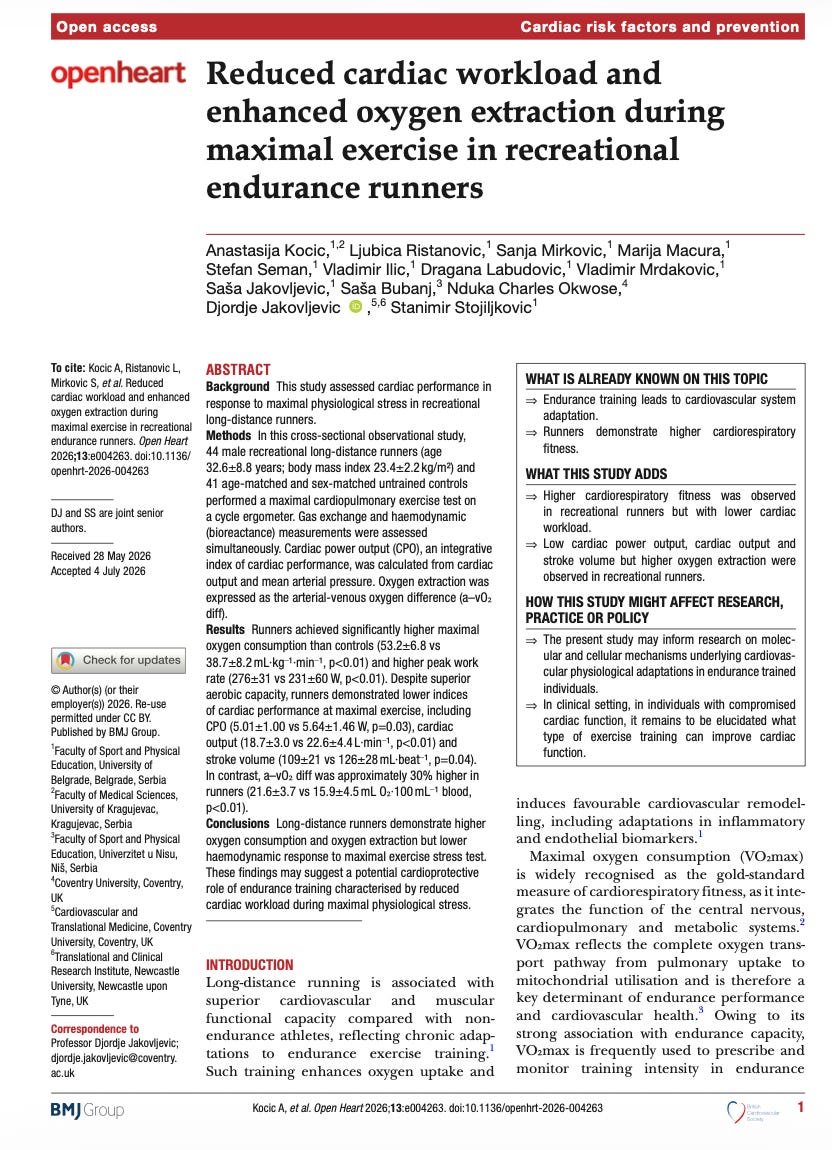
Researchers recruited 85 healthy men. Forty-four were recreational long-distance runners who participated in half-marathons or marathons. The other 41 were healthy but untrained controls. The runners were an average of 33 years old, while the controls averaged 29. The groups were similar in body weight, height, body mass index, and body surface area.
Everyone completed a maximal exercise test on a stationary bike, and throughout the test, the researchers measured oxygen consumption, cardiac output, and two especially important variables.
The first was cardiac power output, which combines cardiac output with mean arterial blood pressure. Cardiac output tells us how much blood the heart pumps, blood pressure reflects the force against which it must pump, and putting them together provides an integrated estimate of the heart’s pumping performance.
The second was the arteriovenous oxygen difference, or a-vO₂ difference (which I described above).
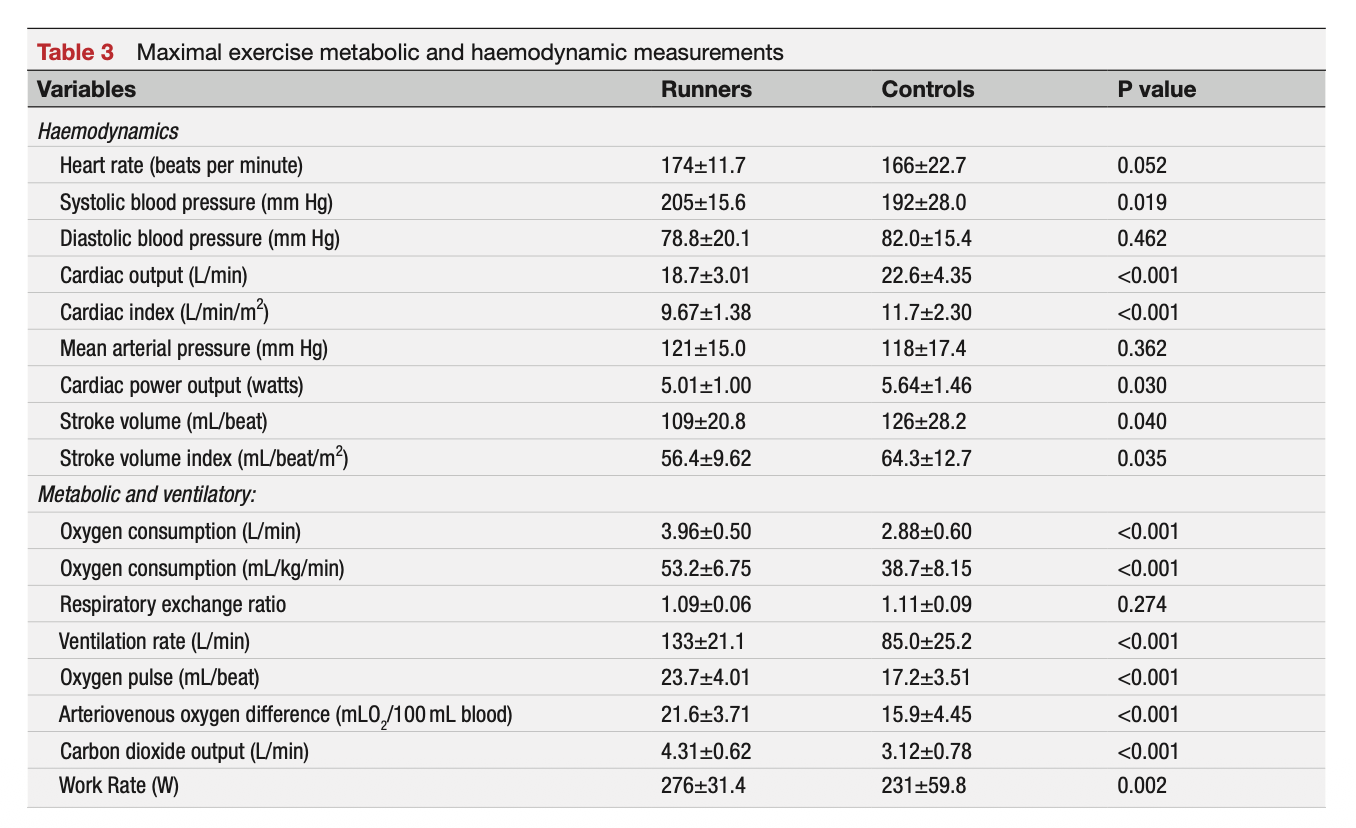
Obviously, the runners were much fitter. Their VO₂ max averaged 53.2 ml/kg/min, compared with 38.7 ml/kg/min in the untrained controls. That is a difference of approximately 37%. They reached a peak workload of 276 watts, compared with 231 watts in the controls. And they also reached a slightly higher maximal heart rate (174 versus 166 beats per minute) and a higher peak systolic blood pressure during exercise (205 versus 192 mmHg).
If we stopped there, we might reasonably assume that the runners achieved their higher VO₂ max by driving the heart harder. But that’s not what happened!
At maximal exercise, the runners’ cardiac output averaged only 18.7 liters per minute. In the untrained controls, it reached 22.6 liters per minute. The fitter runners were pumping nearly four fewer liters of blood per minute.
Their maximal stroke volume was also lower (109 versus 126 milliliters of blood per beat).
Cardiac power output (our measure of the heart’s pumping performance) followed the same pattern. It reached 5.01 watts in the runners and 5.64 watts in the controls—about 11% lower in the runners.
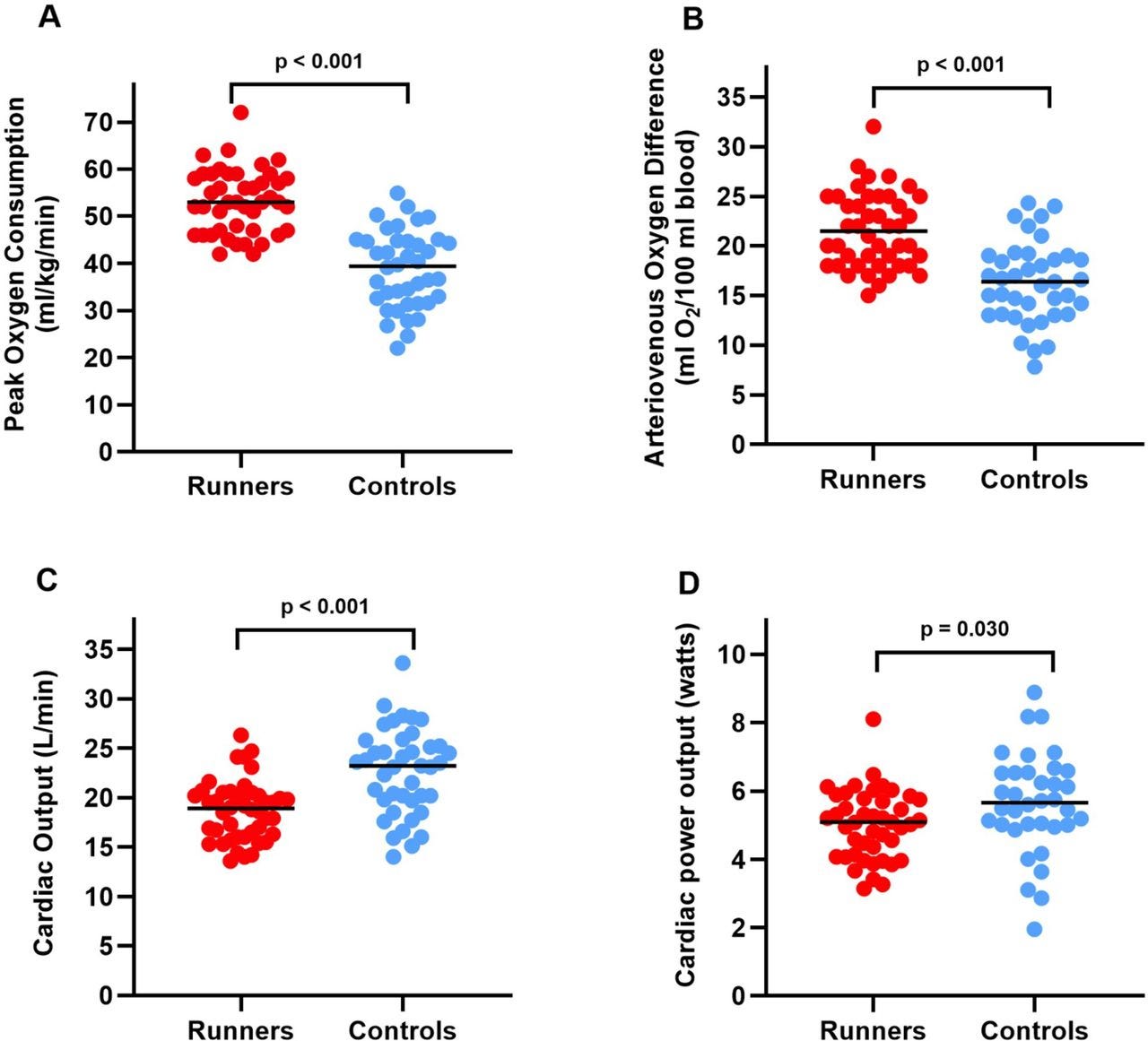
So, compared with the untrained participants, the runners reached a higher exercise workload and consumed considerably more oxygen despite a lower cardiac output, lower stroke volume, and lower cardiac power output.
To explain how, we need to look at the other side of the Fick equation.
The runners’ a-vO₂ difference reached 21.6 milliliters of oxygen per 100 milliliters of blood.
In the controls, it reached only 15.9 milliliters.
That represents roughly 36% greater oxygen extraction in the runners—their muscles removed substantially more oxygen from every unit of blood delivered to them, so they didn’t need their hearts to pump as much blood because they were making better use of the oxygen contained within that blood.
This is the central (no pun intended) finding of the study.
The untrained men moved more blood through the body, but extracted less oxygen from it. The runners moved less blood, but extracted much more oxygen. The result was a considerably higher VO₂ max with a lower cardiac “stress.”
Interestingly, the runners did not display the stereotypical resting cardiovascular profile we might expect from an endurance-trained group. Their resting heart rate was actually higher than that of the controls (70 versus 62 beats per minute) and their resting systolic and diastolic blood pressures were also higher, as was their absolute cardiac output.
This finding was odd to me. But these were recreational runners, not elite athletes, and the paper did not report enough detail about their training volume, training history, or recent exercise to determine why their resting measurements looked this way.
I published my book on VO₂ max a few years ago. Since then, I’ve continued to learn so much about aerobic fitness—what determines it, how it changes with age, and how it responds to training—that, at some point, an updated edition will be necessary! Today’s study updates my thinking in a few important ways.
Traditionally, I (and much of the field) have viewed the heart’s pumping capacity as the primary limiter of VO₂ max. This is known as a “central limitation,” and it appears to be especially important among highly trained endurance athletes. But newer evidence suggests that aging and inactivity may shift the bottleneck toward the periphery. The problem may not be how much oxygen the cardiovascular system can deliver, but how much of that oxygen the working muscles can actually extract and use.
This study reinforces the idea that aerobic fitness depends as much on oxygen utilization as oxygen delivery. Utilization is influenced by the amount of active muscle we have, the quantity and quality of its mitochondria, and its network of capillaries (the tiny blood vessels where oxygen moves from the circulation into the working tissues). If one or more of these components decline with aging or inactivity, aerobic capacity can fall even when the heart retains the ability to pump more blood.
But these findings may extend beyond simply explaining a lower VO₂ max. The poorer peripheral oxygen extraction in the untrained men required their cardiovascular systems to move more blood to meet a lower metabolic demand.
I don’t think this study proves that such compensation damages the heart over time. But if we look at rates of cardiovascular disease among chronic exercisers versus non-exercisers, the picture becomes quite clear. There are implications to this.
When the muscles become less capable of extracting and using oxygen, the heart may have to work harder. Our hearts may not contain a finite supply of beats. But that doesn’t mean the efficiency of each beat is irrelevant.
Exercise asks more of the heart during training so the entire body can, literally, accomplish more with each beat. Efficiency, it seems, may be the stuff of life. That’s true in sports and elsewhere.
Thanks for reading. See you next Friday.
~Brady~
Ketone-IQ is high-performance energy in a bottle. I use it for post-exercise recovery along with enhancing focus, mood, and cognition. Take 30% off your order.

Create is the first “modern creatine” brand. They sell a wide range of creatine monohydrate gummies, and just launched a new creatine + electrolyte mix product plus travel-size packets of creatine gummies. They’re giving my audience 20% off their order.

ProBio Nutrition—the all-in-one supplement that I use every single day—is offering 20% off. My preference is the tangy orange flavor, but they also sell an unflavored “smoothie booster” that’s great in a shake, smoothie, or juice.

Equip Foods makes some of the cleanest, best-tasting protein products around. I am absolutely obsessed with their Prime grass-fed protein bars (the peanut butter ones are to die for, but they also just released a new chocolate peanut butter flavor).

What is implied but not said definitively is that the delta pO2 is as a result of a more dense capillary bed in muscle tissue. Given the results at max power I really don’t understand the trained group having a higher RHR and lower stroke volume unless the amount of training is not sufficient to result in stroke volume increases and the first change is actually capillary bed volume. Does any of this make sense? Interesting article!
Great summary. What got me: runners' hearts pumped less blood but extracted more oxygen. Efficiency over raw output. This Changes how I think about VO2 max.