


Greetings!
Welcome to the Physiology Friday newsletter.
Details about the sponsors of this newsletter and deals on products I love, including Ketone-IQ, Create creatine, Equip Foods, and ProBio Nutrition can be found at the end of the post.
I’m often ravenous after finishing a long run. Even more so if I haven’t had breakfast beforehand or fueled aggressively during.
This lines up with a nice physiological story: I burned through a lot of carbs (glycogen), so now my body wants me to replace it!
(I’ve told myself some version of this story many times… usually while standing in front of the fridge).
The logic makes sense.
Our fat stores contain an enormous amount of energy (even the leanest people have enough fat to last them a few days), whereas our carbohydrate stores are limited. If exercise uses a meaningful chunk of that limited carbohydrate reserve, maybe the body responds by increasing appetite until the missing carbohydrate—and the energy that came with it—has been restored.
This idea is sometimes called the glucostatic theory of appetite. The basic premise is that carbohydrate availability helps regulate how much we eat. So for athletes burning through a lot of carbs, it seems intuitive that post-workout appetite would ramp up. But we also burn fat during exercise, with how much depending on the intensity and duration of that exercise. So the question becomes whether the type of fuel we burn during exercise has any influence on what, or how much, we eat after. Seems like an easy question to study, right?
The obvious way to make someone burn more carbohydrate (and hence less fat) during exercise is to give them carbohydrate. But that also changes calorie intake, insulin, gut hormones, and fuel availability.
So, is it the carbohydrate being burned that matters—or the carbohydrate being eaten?
A new study used a slightly unusual tool to pull those two factors apart: niacin.1
Niacin is vitamin B3. At high doses, niacin activates a receptor called GPR109A in adipose tissue and suppresses lipolysis—the release of fatty acids from stored body fat. With fewer fatty acids available to burn, the body is pushed toward greater carbohydrate oxidation even when no carbohydrate has been consumed.
Niacin allowed the researchers to change the fuel mix without adding fuel.
This was a really neat study with some surprising findings. Let’s dive in.
Fifteen healthy, recreationally active adults—10 men and five women, with an average age of 29—completed three trials:
FAST: Exercise after an overnight fast, with placebo drinks and tablets.
CARB: Carbohydrate before and during exercise (1.6 grams per kilogram of bodyweight given 1 hour before exercise followed by 0.2 grams per kilogram every 15 minutes during, which works out to 2.4 grams per kilogram total, or about 175 grams of carbohydrate for the average participants in the study).
NIACIN: Niacin before and during exercise, with a calorie-free placebo drink.
The participants cycled for 60 minutes at 95% of their first lactate threshold, an easy-to-moderate aerobic intensity chosen because fat oxidation should be relatively high at this intensity. The researchers calculated fat and carbohydrate oxidation, collected blood throughout the trial, and then—two hours after exercise—gave participants a large rice-and-cheese meal and told them to eat until they were comfortably full (sign me up).
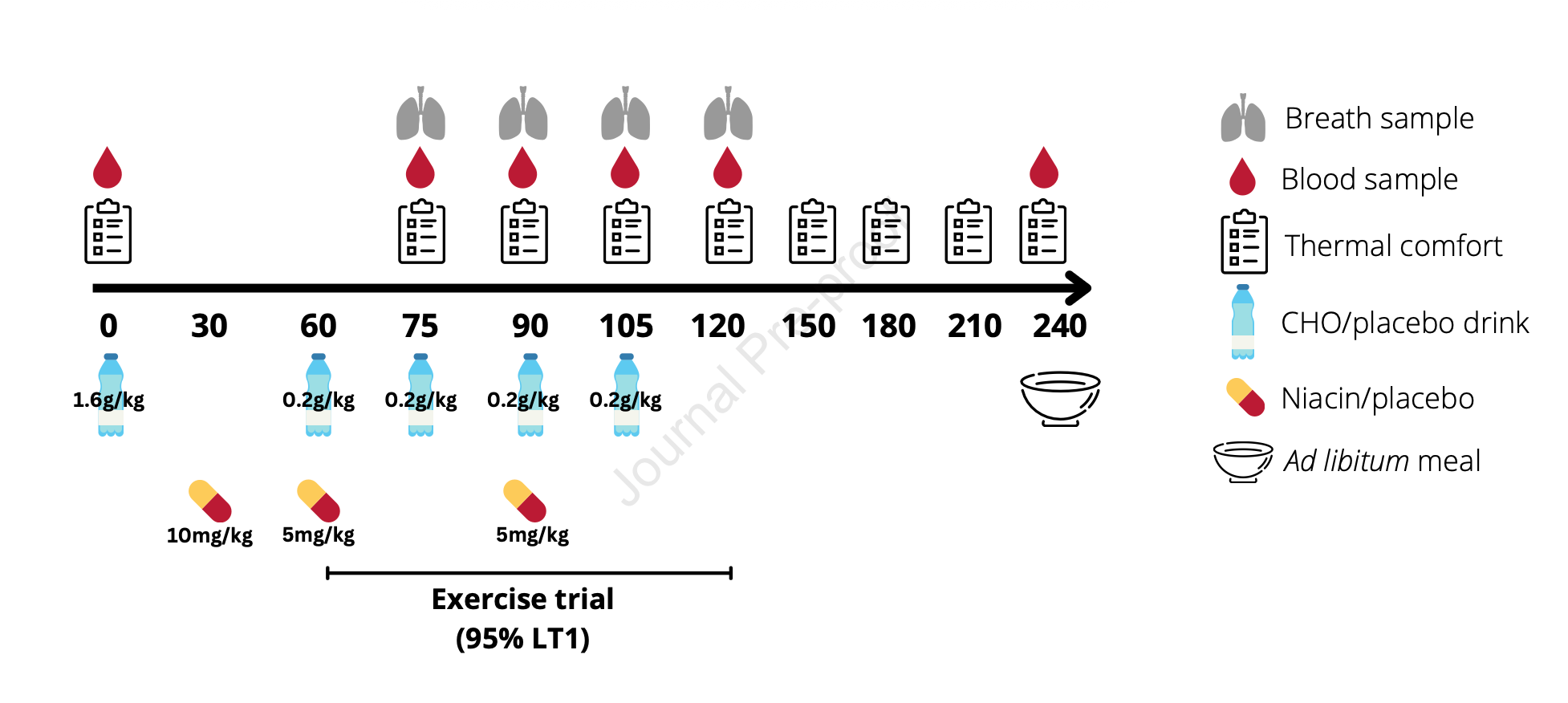
The important comparison here was between CARB and NIACIN. Both were expected to suppress fatty-acid availability and increase carbohydrate oxidation, but only one supplied carbohydrate and calories.
The interventions worked almost exactly as intended.
During the fasted trial, participants oxidized an average of 21 grams of fat during the hour of cycling.
Fat oxidation fell to 11 grams with carbohydrate and 13 grams with niacin… so about half as much.
Carbohydrate oxidation moved in the opposite direction. Participants oxidized:
75 grams of carbs during the fasted exercise.
97 grams during exercise with carbs.
94 grams during exercise with niacin.
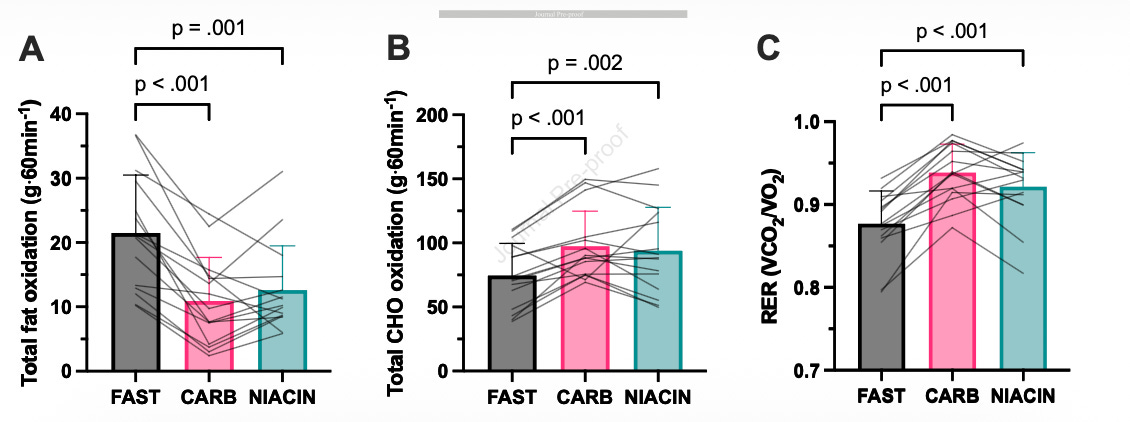
That’s not a subtle metabolic nudge. Niacin increased carbohydrate oxidation nearly as much as actually consuming carbohydrate, despite providing no carbohydrate and producing no comparable rise in insulin. Both carbohydrate and niacin lowered circulating non-esterified fatty acids. But insulin and glucose rose most clearly with carbohydrate. Branched-chain amino acids fell with carbohydrate but not niacin, while ketones were highest after fasted exercise, lower with niacin, and lowest with carbohydrate.
If greater carbohydrate oxidation creates a carbohydrate debt that rapidly drives us to eat, the niacin condition should have produced the largest post-workout meal, because the participants burned considerably more carbohydrate than they did while fasted, but they had not consumed any carbohydrate to offset it.
That did not happen.
Two hours after exercise, average energy intake was:
833 calories in the fasted condition.
786 calories in the carbohydrate condition.
780 calories in the niacin condition.
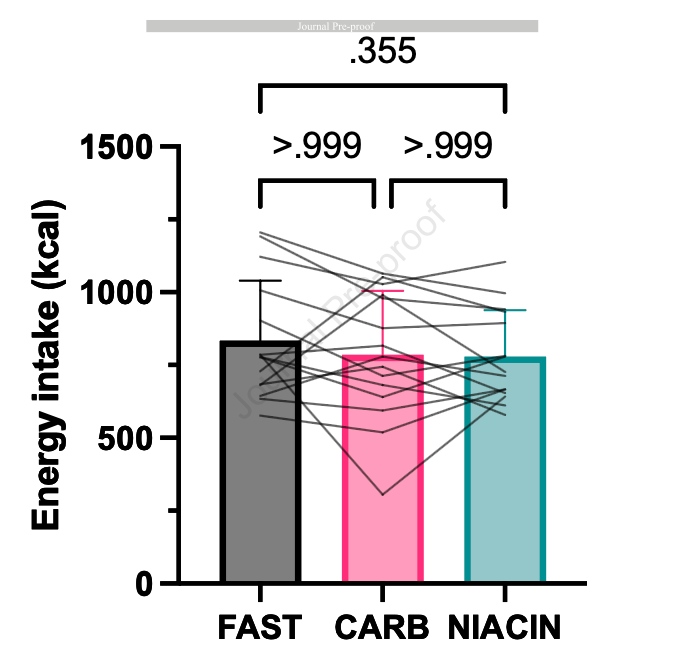
There was no difference among conditions. If anything, the numerical direction was opposite the researchers’ hypothesis: participants ate about 53 fewer calories after niacin than after fasted exercise.
The carbohydrate trial is interesting for a second reason. The average participant consumed roughly 700 calories of carbohydrate before and during exercise, yet ate only about 47 fewer calories at the later meal than in the fasted condition! Within the few hours captured by this experiment, people did not automatically compensate for the calories they drank during exercise by eating less afterward.
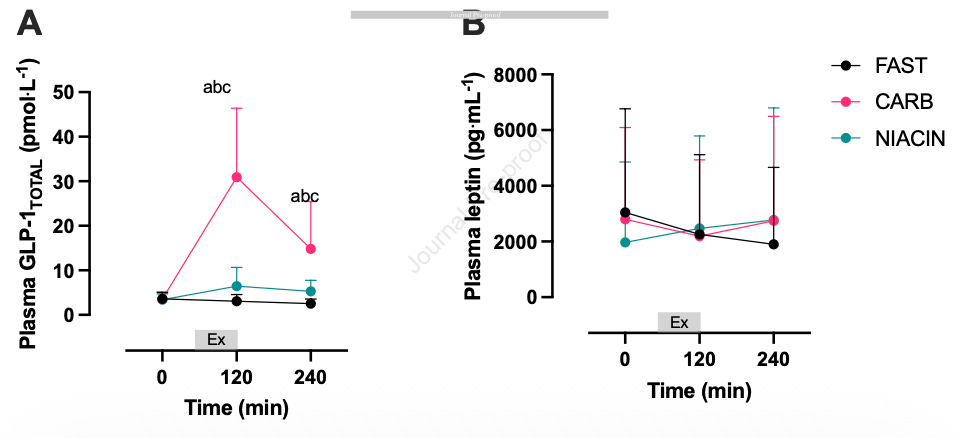
Glucagon-like peptide-1 (GLP-1), a gut-derived appetite hormone involved in satiety and glucose regulation (and the target of the ultra-popular GLP-1 agonist drugs being used for weight loss), was highest with carbohydrate, intermediate with niacin, and lowest in the fasted trial—both immediately after exercise and two hours later. Yet meal intake was still essentially the same.
This is one of those studies that might seem counterintuitive to your own personal experience.
I certainly “feel” a difference in my appetite depending on whether I’ve worked out fasted or fueled with carbohydrates. Do I necessarily eat more because of that change in appetite? Perhaps not. That would line up with what this study found, and I think it supports the broader idea that how much/what we eat is likely influenced more by our own habits, eating preferences, and what we “think” we need to do versus what our body is “telling us” via appetite. We are creatures of habit, after all, and I’m going to eat my post-workout bowl of yogurt and granola no matter what.
The first thing this study emphasizes is that acute fuel use and longer-term energy balance are not the same thing.
Burning more fat during a workout does not necessarily mean losing more body fat, just as burning more carbohydrate does not necessarily mean becoming hungrier immediately afterward. The substrate mixture used during one hour of exercise is one variable in a much larger, longer-running energy ledger.
The second is that calories consumed during training may not be automatically “eaten back” in reverse.
What was a pretty substantial carbohydrate intake during exercise (about ~700 calories worth in the carbohydrate trial) did not produce a meaningful reduction in the subsequent meal. For an athlete using carbohydrate to preserve performance, increase training quality, or accelerate recovery, that is not inherently a problem—the calories are serving a purpose. But it is worth remembering that appetite does not always perform exact calorie accounting on our behalf. And for those exercising for the purpose of weight or fat loss, it’s an important practical point. You need to be aware of energy intake because the body isn’t going to do it for you.
Finally, I think this study is a nice example of how physiology resists single-signal explanations. Carbohydrate oxidation changed. Fatty-acid availability changed. GLP-1 changed. Ketones and lipoproteins changed. But the amount of food people ate did not. It’s a friendly reminder that the body is, in fact, not a simple ledger keeping track of inputs and outputs. That seems to be a running theme among many of the studies I choose to write about in this newsletter.
Physiology often starts with a clean story. In this case: use more carbohydrate, create a carbohydrate debt, get hungrier.
The more realistic story is that appetite integrates many imperfect signals over time, and the fuel mixture used during one workout is not a single instruction to eat.
Thanks for reading. See you next Friday.
~Brady~
Ketone-IQ is high-performance energy in a bottle. I use it for post-exercise recovery along with enhancing focus, mood, and cognition. Take 30% off your order.

Create is the first “modern creatine” brand. They sell a wide range of creatine monohydrate gummies, and just launched a new creatine + electrolyte mix product plus travel-size packets of creatine gummies. They’re giving my audience 20% off their order.

ProBio Nutrition—the all-in-one supplement that I use every single day—is offering 20% off. My preference is the tangy orange flavor, but they also sell an unflavored “smoothie booster” that’s great in a shake, smoothie, or juice.

Equip Foods makes some of the cleanest, best-tasting protein products around. I am absolutely obsessed with their Prime grass-fed protein bars (the peanut butter ones are to die for, but they also just released a new chocolate peanut butter flavor).

Bradshaw L, Moreno-Cabañas A, Spellanzon B, et al. Metabolic, endocrine and appetite responses to carbohydrate versus niacin ingestion during exercise in healthy females and males. The Journal of Nutrition. Journal pre-proof. 2026. doi:10.1016/j.tjnut.2026.101773
Great post....especially the final 3 paragraphs which I hope will not only be read but fully understood in a world that seems to have become ever more fixated upon Academic Publications as the 'source' of 'Truth'....people need to understand that the scientific methodology used in Academia has serious limitations for actual real world application in biological systems because scientific methodology / hypothesis focuses on one aspect of a biological system and attempts to control all the other variables to set parameters or assumes a set parameter. By definition this does not apply to application in the real world because the real world is fraught with variables, often dynamic variables, and confounders . . . . sure, we can learn from studies and they give us insights but they are not the absolute solution they are often purported to be.
Fascinating data on fuel dynamics vs. appetite response. In midlife protocols, improving substrate switching efficiency—so the body easily toggles between beta-oxidation and carbohydrate metabolism without triggering compensatory hypoglycemic cravings—is one of the most reliable markers of metabolic health.