

Greetings!
Welcome to the Physiology Friday newsletter.
Details about the sponsors of this newsletter and deals on products I love, including Ketone-IQ, Create creatine, Equip Foods, and ProBio Nutrition can be found at the end of the post.
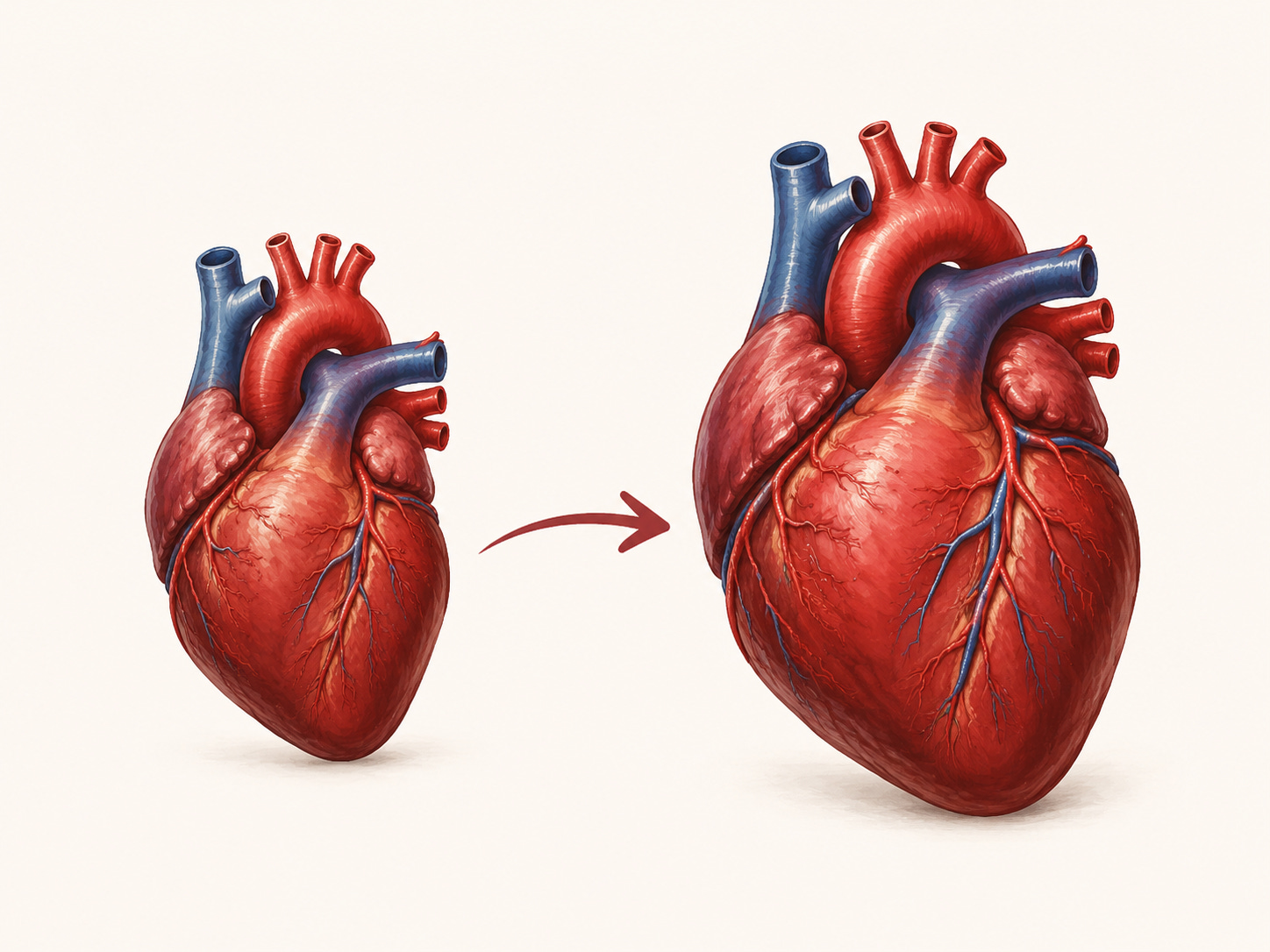
Exercise makes the heart a little larger and more compliant (think “stretchier”). A larger, more compliant heart fills with more blood, meaning more blood leaves with each beat, and maximal oxygen uptake—or VO2 max—goes up.
This is one reason endurance athletes tend to have large, compliant hearts and high VO2 max values.
The relationship also works in the other direction.
Sedentary aging is associated with a smaller, stiffer left ventricle (the heart’s largest chamber). Maximal heart rate falls, the arteries stiffen, the heart fills with less blood, stroke volume drops, and VO2 max declines. Some of that decline occurs even in people who remain active (but inactivity accelerates it).
Exercise can push back against this process at almost any age. But the cardiovascular system does not appear to retain the same plasticity forever.
Studies in previously sedentary adults suggest that training begun in middle age can enlarge the left ventricle and improve its compliance, whereas starting the same sort of intensive training later in life may improve VO2 max without fully reversing the stiffness that has accumulated over decades.
Middle age, then, may be a particularly important window—not because the heart becomes untrainable afterward, but because some adaptations become harder to recover.
Sex adds another layer. Women generally have smaller left ventricles than men. They also tend to have less fat-free mass and lower hemoglobin concentrations, which reduces the amount of oxygen that can be carried in a given volume of blood. None of these differences is inherently pathological. But together, they help explain why women generally have lower absolute cardiac outputs and VO2 max values than men. They may also influence how the cardiovascular system adapts to training.
Several longitudinal studies have reported smaller increases in VO2 max, stroke volume, or cardiac output in women than men following the same endurance program. The difference seems to become more pronounced with age: young women can show robust cardiovascular adaptations, while older women show… less robust ones.
Why?
One possibility is that a smaller heart is also a less trainable heart. A small ventricle may have less filling capacity, greater relative stiffness, and more constraint during maximal exercise. If that means less capacity to remodel, it could place a ceiling on the improvement in stroke volume and VO2 max—especially as the heart ages.
But there is another possibility: heart size and heart trainability are not the same thing. A smaller heart could have just as much capacity to remodel, or perhaps even more room to change. And sex differences in VO2 max could emerge even when the resting heart adapts similarly, because VO2 max depends on far more than cardiac factors!
That is the physiological puzzle behind a new study in The Journal of Physiology.1
The researchers put previously sedentary, middle-aged men and women through two full years of structured endurance training to ask so questions:
Do women experience smaller fitness gains because their hearts remodel less?
Does beginning with a smaller heart limit how much cardiac remodeling is possible?
They got one answer they expected—and one that they didn’t.
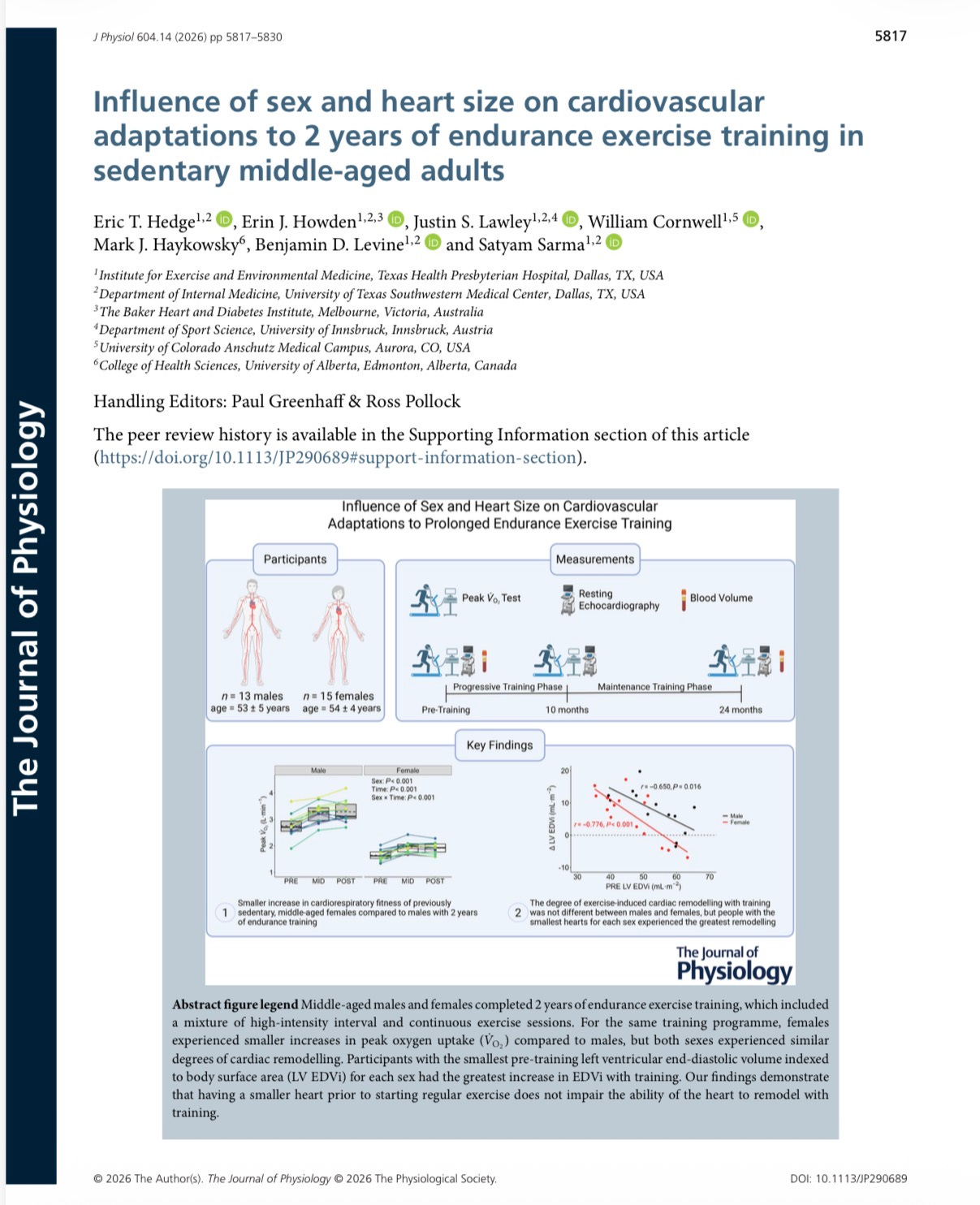
The study included 28 healthy but sedentary adults: 13 men and 15 women, with an average age of about 54.
The first 10 months were progressive. Participants began with three 30-minute base sessions per week. The researchers then gradually added training sessions near the ventilatory threshold (right around the top of an “zone 2” intensity) and 4 × 4-minute intervals performed at about 95% of their peak heart rate. By month six, the participants were training roughly five to six hours per week and completing two interval sessions. They also performed two strength sessions each week.
After month 10, the program shifted into a 14-month maintenance phase. Total training load was kept relatively stable, but one weekly interval session was replaced with more lower-intensity exercise.
VO2 max increased in both men and women, mostly during the first 10 months of progressive training.
In absolute terms:
The men increased VO2 max by 0.53 liters per minute.
The women increased by 0.27 liters per minute—about half as much.
When VO2 max was expressed relative to body mass, the difference narrowed.
Men improved by 6.5 milliliters per kilogram per minute, compared with 4.2 in women.
Across the full two years, that amounted to an average increase of 20.1% in men and 16.6% in women.
Interestingly, when changes were expressed relative to fat-free mass, the sex difference mostly disappeared!
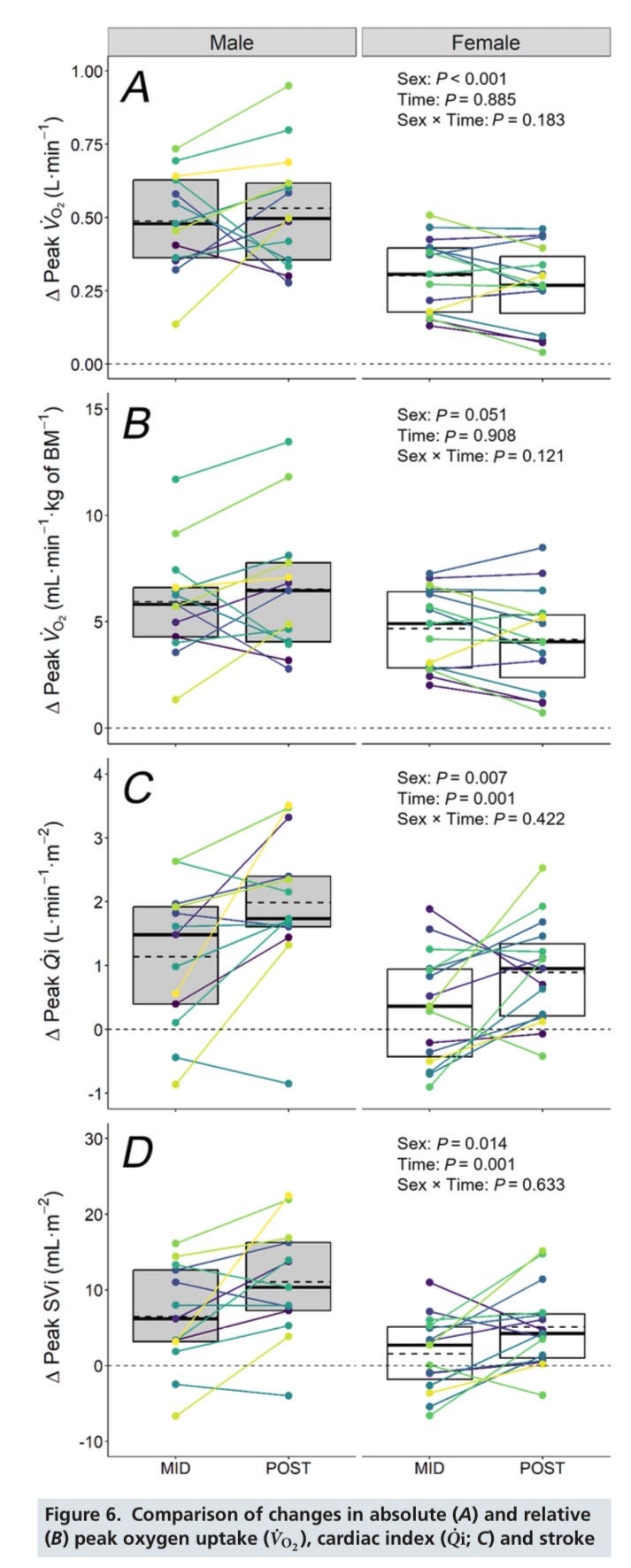
Were the men just training harder? Not apparently. The women actually accumulated a higher training load during the first 10 months and at least as much across the entire study. So a smaller response in the women could not easily be dismissed as less training.
Instead, the differences appeared to come not from cardiac adaptations at rest, but when the heart was pushed to its limit.
VO2 max is governed by the Fick equation. In plain language, maximal oxygen use depends on how much blood the heart can pump (heart rate x stroke volume) and how much oxygen the tissues can remove from that blood.
Peak heart rate barely changed in either group. The major sex difference was in how much blood the heart ejected with each beat.
In men, peak stroke volume increased from 98 to 120 milliliters. In women, it increased from 72 to 81 milliliters. Peak cardiac output rose from 16.8 to 20.8 liters per minute in men, compared with 12.4 to 14.0 liters per minute in women.
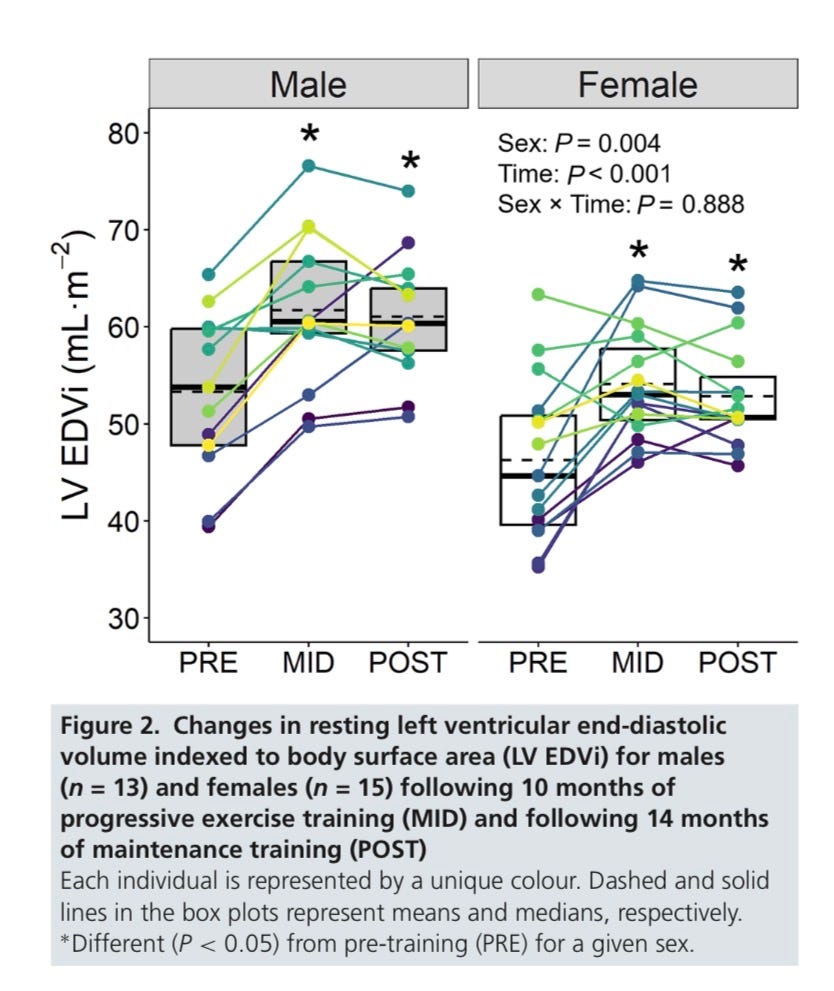
So the women’s smaller gain in absolute VO2 max was explained largely by a smaller increase in peak stroke volume and cardiac output. That makes it sound as if the women’s hearts simply failed to remodel as much. But they didn’t! The amount of blood the heart could fill with increased during the first 10 months by a similar magnitude in men and women, and heart chamber stiffness also fell (improved) in both groups.
The women still had smaller and stiffer hearts on average at the end of the study, but their hearts were not less capable of structural remodeling. They enlarged and became more compliant, even though their improvement in peak pumping capacity was smaller.
The smallest hearts did not have the smallest response
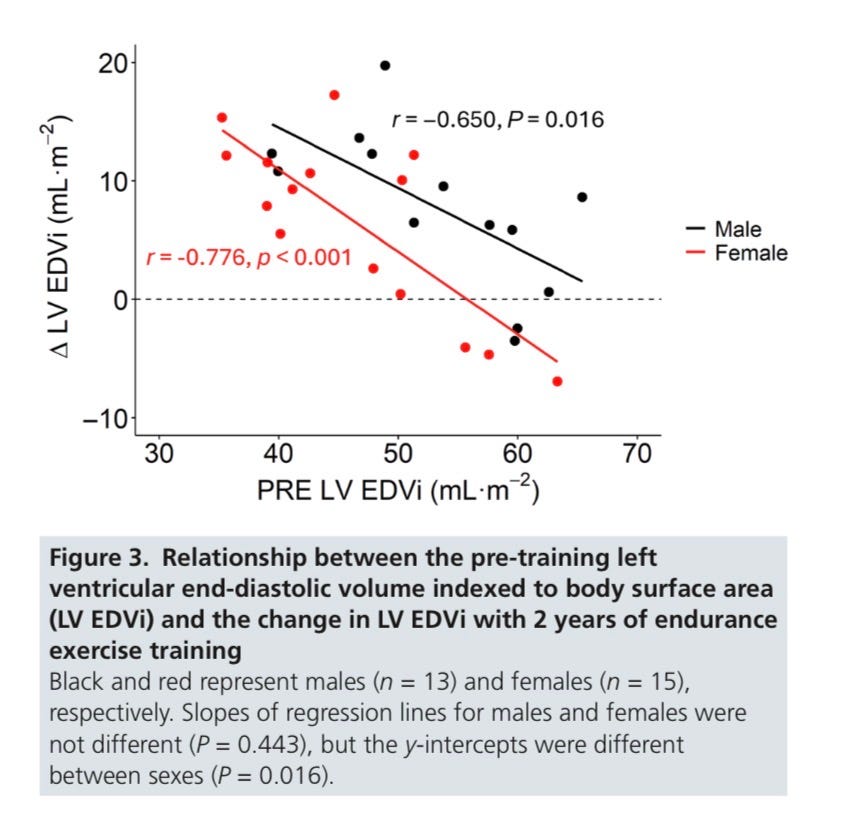
The researchers expected participants with the smallest hearts at baseline to show the least remodeling. But the opposite happened.
Within each sex, a smaller starting left ventricular volume was associated with a larger increase after training.
One plausible explanation here is that the smallest hearts had more room to move toward the “trained” phenotype. Which makes sense—we’d expect a smaller (and perhaps a stiffer or less compliant) heart to respond more to the stress of endurance exercise than a larger heart that’s already compliant. Especially in a group of people who are more or less “naive” to exercise.
Central and peripheral adaptations moved on different time courses
There was one more result buried in the two-year design that I found especially interesting.
During the progressive phase—when participants were doing two interval sessions per week—the amount of oxygen extracted from the blood at maximal exercise increased in both sexes. During the maintenance phase—when researchers removed one interval session and replaced it with more lower-intensity work while keeping the calculated training load similar—oxygen extraction then returned to approximately baseline. Meanwhile, peak stroke volume and cardiac output continued to rise, and VO2 max stayed essentially flat.
So the peripheral and central sides of the Fick equation changed in opposite directions and canceled each other out at the level of VO2 max, which suggests that exercise intensity and volume may preferentially support different adaptations: high-intensity favors improvements in your ability to take up and use oxygen, while lower-intensity favors oxygen delivery.
This is not evidence that dropping exactly one interval session reverses peripheral adaptations, but it does show that an unchanged VO2 max can conceal a lot of physiological movement underneath it.
The big takeaway here isn’t earth-shattering. An aggressive exercise training stimulus will cause the heart to adapt, and that’s true regardless of whether you’re male or female, old or young, or have a smaller or larger heart.
Middle age is not too late for meaningful cardiac remodeling. The research group who published this study has several other papers showing the same thing. The heart can adapt at any age and fitness level, provided you work out hard enough! These participants were in their early-to-mid 50s, had been sedentary, and still enlarged and made their left ventricle “stretchier” over the first 10 months of training.
The study also adds to the ongoing conversation about whether men and women respond similarly to exercise. Yes, sex influenced the response, but not in one simple, universal way. Men had larger gains in absolute VO2 max, peak stroke volume, and cardiac output. Yet men and women showed similar remodeling at rest, and the difference in VO2 max improvement disappeared when scaled to fat-free mass. “Trainability” depends partly on which adaptation we choose to call the response, in this case. And it would be foolish to conclude “men responded more” or “women responded less.”
Women should not expect disappointing gains, nor do they (or people with small hearts) need a special endurance training protocol.
We often talk about “the training response” as though it were one thing. It isn’t. VO2 max is an integrated outcome. Heart size, compliance, stroke volume, cardiac output, hemoglobin, blood flow distribution, muscle oxygen extraction, and body composition all contribute—and they do not necessarily adapt at the same rate. Changes in these factors can also “mask” themselves underneath a flattened VO2 max response, which is why I often tell people not to worry if their training progresses but their (smartwatch-estimated) VO2 max does not.
If this study shows is anything, it’s that we should be quick to question blanket statements like “women don’t respond to training like men” or “smaller hearts may be less adaptable.” Physiologically speaking, it’s never that black and white.
Thanks for reading. See you next Friday.
~Brady~
Ketone-IQ is high-performance energy in a bottle. I use it for post-exercise recovery along with enhancing focus, mood, and cognition. Take 30% off your order.

Create is the first “modern creatine” brand. They sell a wide range of creatine monohydrate gummies, and just launched a new creatine + electrolyte mix product plus travel-size packets of creatine gummies. They’re giving my audience 20% off their order.

ProBio Nutrition—the all-in-one supplement that I use every single day—is offering 20% off. My preference is the tangy orange flavor, but they also sell an unflavored “smoothie booster” that’s great in a shake, smoothie, or juice.

Equip Foods makes some of the cleanest, best-tasting protein products around. I am absolutely obsessed with their Prime grass-fed protein bars (the peanut butter ones are to die for, but they also just released a new chocolate peanut butter flavor).

Hedge, E. T., Howden, E. J., Lawley, J. S., Cornwell, W., Haykowsky, M. J., Levine, B. D., & Sarma, S. (2026). Influence of sex and heart size on cardiovascular adaptations to 2 years of endurance exercise training in sedentary middle-aged adults. The Journal of Physiology, 604(14), 5817-5830. https://doi.org/10.1113/JP290689
"The study included 28 healthy but sedentary adults: 13 men and 15 women, with an average age of about 54."
Impressive that they could get that many to start and maintain ai nexercise program for two years.