

Greetings!
Welcome to the Physiology Friday newsletter.
Quick promo for a new partner of this newsletter: Wild Roman. They’re an all-natural skincare brand for men who want a simple, effective routine designed to strengthen skin with modern formulas and wild-sourced ingredients. The company was started by my friend Sahil Bloom, and it’s the only skincare brand I’ve enjoyed using. Their biggest seller is the complete face routine, and I’m partial to the bar soap (seriously… it’s incredible stuff). Get it for yourself, or gift it to a guy who needs it!
Shop through my link to get the $99 Face Routine, free Bar Soap, and free shipping, plus 15% off regularly priced items.

(Details about the other sponsors of this newsletter and deals on products I love, including Ketone-IQ, Create creatine, Equip Foods, and ProBio Nutrition can be found at the end of the post.)
Cold exposure and sauna are usually treated as a punctuation mark at the end of a workout.
But they’re used for different reasons.
When it comes to cold, the basic idea is recovery—cool the body, reduce soreness and inflammation, and perhaps feel a little more prepared to train again tomorrow. That mechanism is fairly well-established, and athletes have been using ice baths in this regard for decades.
Cold water has a complicated relationship with exercise, though. Used regularly after resistance training, it may dampen some of the signals that help muscle adapt, with recent studies showing that post-exercise cold water immersion reduces muscle protein synthesis in the short term and strength/hypertrophy gains in the long term. The story isn’t as clear for using cold after endurance exercise… where the effects don’t appear to be detrimental and may sometimes even be helpful.
For heat—sauna or hot water immersion being the most common forms—the goal is usually enhancing the cardiovascular adaptations to exercise by providing an additional stimulus. Heat promotes blood flow, sweating, and cardiac output, essentially mimicking low-intensity cardiovascular exercise. Combining 20–30 minutes of sauna after a run has become one of my favorite training techniques.
But what if, instead of viewing these thermal stressors as “add-ons” to a productive workout, we moved them to the beginning? At that point, they become no longer just a recovery tool, but a primer—a short, deliberate stressor intended to alter the physiological state in which you begin exercising.
A new study tested exactly that idea. And I think the findings will redefine how we think of a “warmup.”1
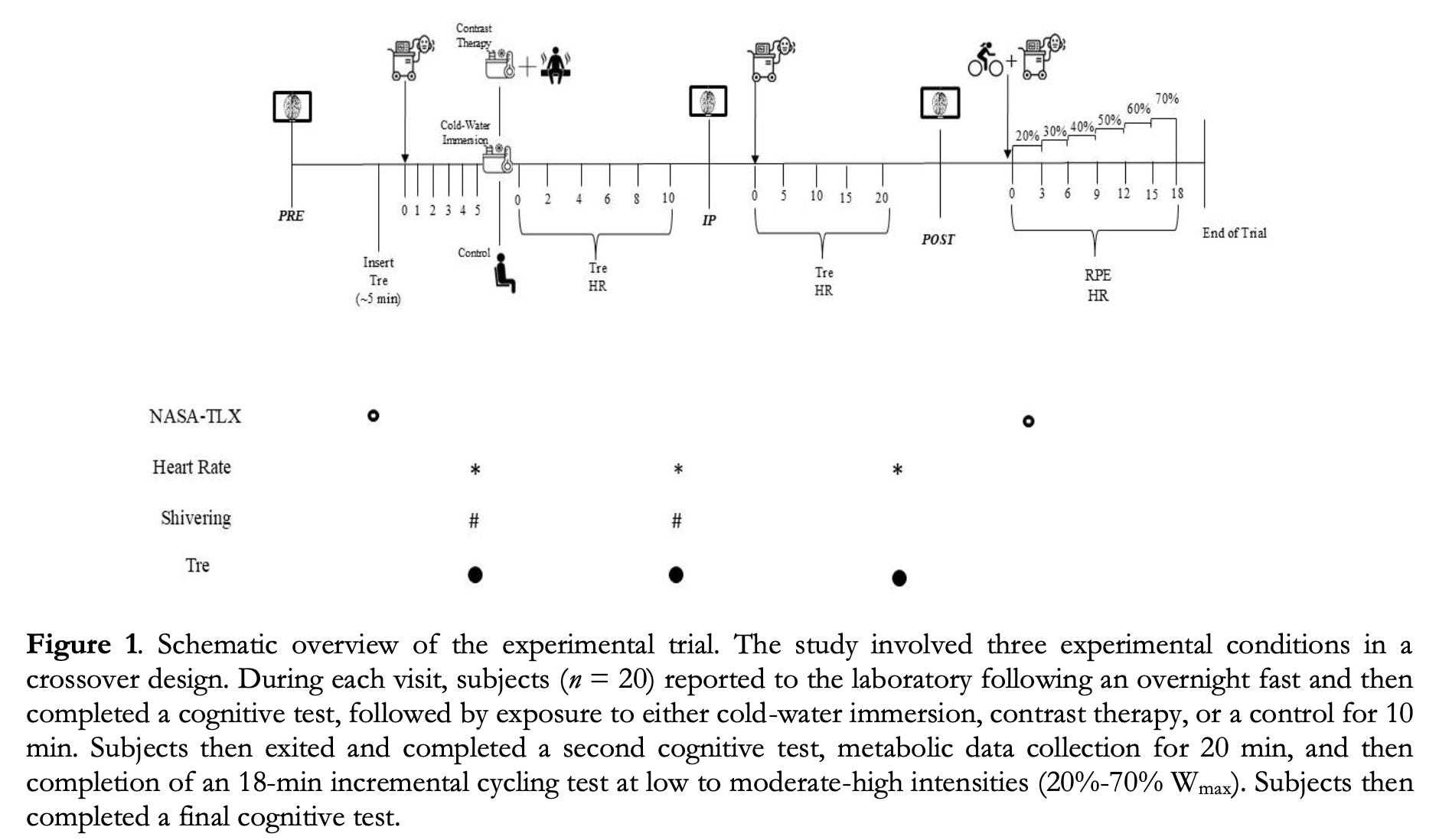
The study included 20 healthy, active adults: 12 men and eight women, with an average age of 24. Each participant completed three experimental conditions in a randomized order:
Cold-water immersion: 10 minutes immersed to the base of the neck in 50°F (10°C) water (respectfully, I’ll pass).
Contrast therapy: alternating two minutes in the same cold water with two minutes in a 180°F (82°C) sauna for 10 minutes total, beginning and ending in the cold.
Control: 10 minutes seated in a thermoneutral room at 75°F (24°C).
Immediately after each condition, the participants completed a 90-second test of their reaction time (a measure of cognitive performance). They then sat for 20 minutes while the researchers measured oxygen consumption and carbon dioxide production, which allowed them to estimate fat oxidation at rest. Then, they completed an 18-minute cycling test that progressed from 20% to 70% of their maximal cycling power. Each stage lasted three minutes. Heart rate, perceived exertion, and fat oxidation were recorded along the way, followed by one final reaction-time test.
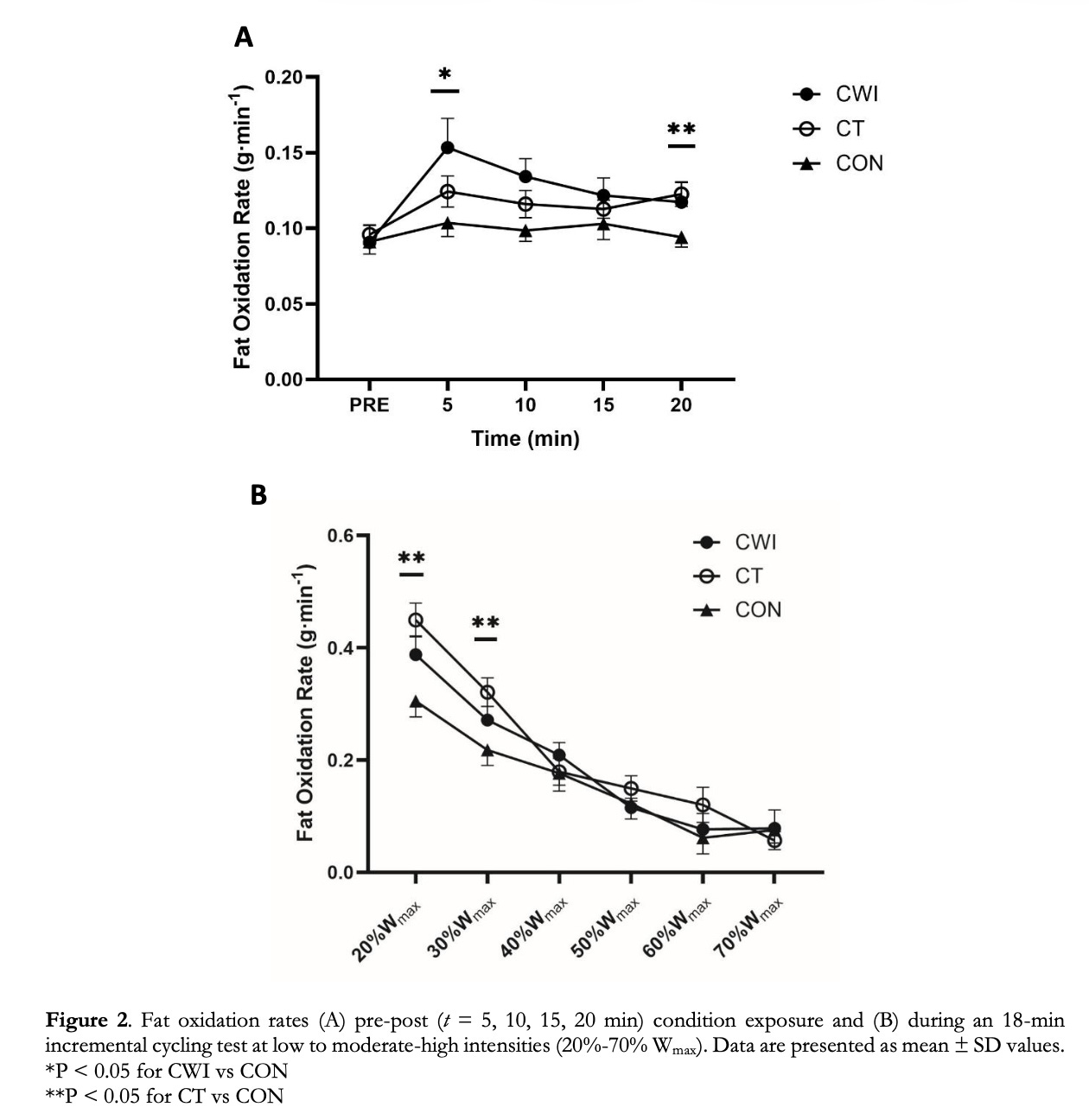
Five minutes after the exposures ended, fat oxidation was highest after continuous cold-water immersion (0.17 grams per minute) and nearly double the fat-oxidation rate measured in the control condition (0.09 grams per minute) at that time point. Fat oxidation was 0.11 grams per minute at that time point following contrast therapy.
The effect was brief. By 20 minutes after exposure, fat oxidation after continuous cold was no longer significantly different from control. However, fat oxidation was now higher in the contrast condition at 20 minutes—0.12 grams per minute versus 0.08 grams per minute after the control. These metabolic effects of contrast therapy carried into exercise.
At 20% of maximal cycling power, fat oxidation averaged 0.45 grams per minute after contrast therapy and 0.30 grams per minute after control.
At 30% of maximal power, the corresponding rates were 0.33 and 0.20 grams per minute.
Above those two lowest workloads, the differences disappeared.
Heart rate followed a similar intensity-dependent pattern. After contrast therapy, it was approximately 9 to 13 beats per minute lower than control during the 20%, 30%, and 40% stages. Yet perceived exertion was the same, and heart rate no longer differed significantly at the higher intensities.
It’s tempting to interpret the lower heart rate as evidence that the same workload had become easier. I don’t think we can say that. Heart rate is only one part of the cardiovascular equation during exercise. A lower heart rate at a fixed workload could reflect a larger stroke volume, a change in autonomic nervous system tone, or some other blood flow adjustment. The study measured none of those variables. Perceived effort also did not improve. So the most we can say is that the contrast condition changed the cardiovascular response to gentle cycling. Whether it improved efficiency or performance remains unanswered.
Did the cold plunge sharpen the brain?
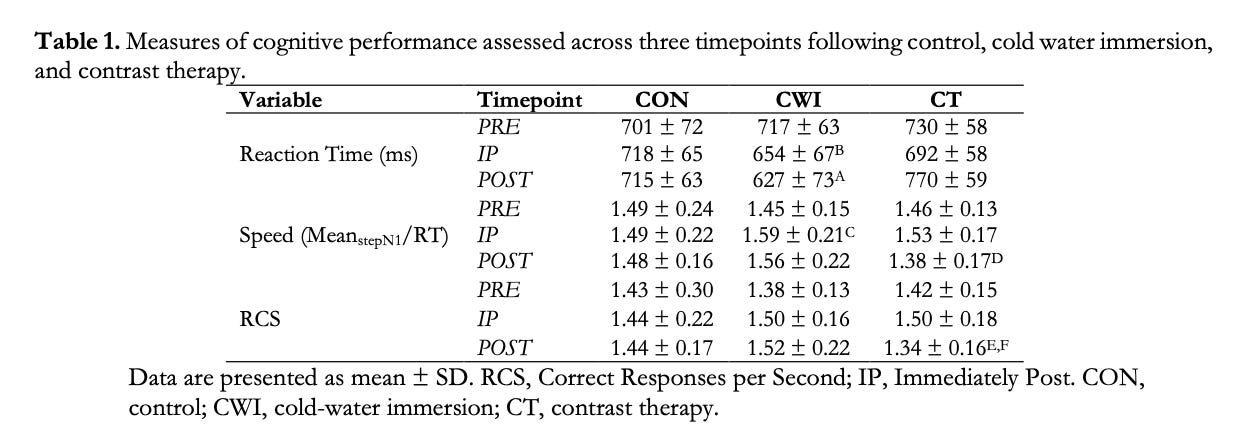
Immediately after exposure, reaction time was significantly faster after cold than after contrast therapy (654 versus 692 milliseconds), but it was not significantly faster than the control condition. The cold condition also improved significantly from its own baseline to the final test.
So the data hint at an alerting effect of brief cold exposure, even if they don’t establish that cold exposure reliably improves cognition compared with doing nothing, at least within the limits of this particular study.
Anyone who has stepped into very cold water knows that sleepiness is not the immediate problem. In fact, this is probably one of the most reliable effects of acute cold exposure. It turns you ON!
Something I found interesting (even a bit odd) was that some outcomes on the cognitive function test were worse after contrast therapy. Maybe the energetic and cognitive load of switching from extreme cold to extreme heat multiple times imposes too much stress on the brain. I think that’s reasonable—it takes a lot of energy to heat up and cool down the body.
Would I do this before training? Maybe.
This study makes pre-exercise thermal exposure scientifically interesting. Whether it’s practically convincing is another story.
Ten minutes of neck-deep immersion in extremely cold water is a substantial cold stress. The contrast condition also required moving every two minutes between very cold water and a very hot sauna. And participants did not begin cycling immediately afterward; they first completed cognitive testing and a 20-minute seated recovery. That is a substantial (and time-consuming) pre-workout routine, and it’s not something many of us will (or can) do before every workout. We probably don’t need to. Though I think there’s a case for strategic use of it.
Continuous cold and contrast therapy can acutely change the state in which exercise begins. Continuous cold may create a brief arousal response. So if your goal is to enhance alertness before a workout—or even before a meeting, presentation, or other cognitively demanding task—it’s an effective tool. On the other hand, alternating cold and sauna may shift fuel selection and lower heart rate during easy exercise. So if your goal is optimizing metabolic responses to or adaptations from a lower-intensity cardiovascular workout, contrast therapy may be an effective pre-workout strategy.
What we do not know is whether either response helps you train harder, perform better, adapt more, or lose more fat. Those are the outcomes that would make the extra suffering (and the elaborate pre-workout choreography) worth it, in my opinion.
I think there are certainly ways that we can scale down the protocol used in this study into a more “bite-sized” priming routine for a workout. Maybe that means completing a few rounds of alternating cold and hot water in a shower before you get dressed for a workout. Maybe you do have access to a cold plunge or sauna that you can utilize for a few minutes before completing a “real” warm-up involving dynamic stretching and some plyometrics.
My conclusion is not that everyone should cold plunge before exercising. Instead, I think the broader theme here is that temperature is not merely recovery scenery. It is a physiological input that belongs in the larger architecture of our workout. My interest is certainly piqued… even though you probably won’t catch me dunking my head under freezing cold water any time soon.
Thanks for reading. See you next Friday.
~Brady~
Ketone-IQ is high-performance energy in a bottle. I use it for post-exercise recovery along with enhancing focus, mood, and cognition. Take 30% off your order.

Create is the first “modern creatine” brand. They sell a wide range of creatine monohydrate gummies, and just launched a new creatine + electrolyte mix product plus travel-size packets of creatine gummies. They’re giving my audience 20% off their order.

ProBio Nutrition—the all-in-one supplement that I use every single day—is offering 20% off. My preference is the tangy orange flavor, but they also sell an unflavored “smoothie booster” that’s great in a shake, smoothie, or juice.

Equip Foods makes some of the cleanest, best-tasting protein products around. I am absolutely obsessed with their Prime grass-fed protein bars (the peanut butter ones are to die for, but they also just released a new chocolate peanut butter flavor).

Waldman HS, Skutnik BC, Roca GM, et al. Effects of Whole-Body Cold-Water Immersion, With and Without Sauna, on Cognitive and Metabolic Markers in Healthy, Active Adults. Research in Strength and Performance. 2026;6(1). https://doi.org/10.53520/rsp2026.105229
If the goal is to perform better, adapt more, and/or lose more fat wouldn't that 30 minutes be better spent running?
This flips the warmup/recovery framing. The heart rate drop during easy cycling after contrast therapy is interesting. Makes me want to try alternating hot/cold in my shower before an easy run day just to see what happens.