

Greetings!
Welcome to the Physiology Friday newsletter.
Details about the sponsors of this newsletter and deals on products I love, including Wild Roman skincare, Ketone-IQ, Equip Foods, and ProBio Nutrition can be found at the end of the post.
When I wake up and check my sleep score or overnight resting heart rate, it’s mostly out of curiosity. I don’t (usually) use it to inform how I’ll train, act, or feel today.
And I certainly don’t think an unusual change in any number is a reason to proactively visit the emergency room.
That’s likely true for most people who use a wearable device. It’s a dense source of information, not a diagnostic tool. Of course, there are some who obsess over the numbers to a fault (a term I’ve heard referred to as ‘orthometria’), treating high sleep scores as a badge of honor and low ones as a reason to avoid anything strenuous during the day.
A lot of this is due to the fact that currently, most of us just don’t know how to act on the data, or whether doing so improves our health or performance beyond a number on the screen. It has many questioning the utility of these devices, and others ditching them altogether and “going analog.”
I don’t think that’s the correct approach—there’s a lot of valuable information to be gleaned from the watches, rings, and bands some of us wear daily. Maybe it’s not information you or I can directly interpret and act upon, but it’s something that AI algorithms increasingly can. And for one man—the subject of today’s newsletter—the data told a meaningful (and unfortunately fatal) story.1
At 7:46 p.m. on March 21, 2025, the 76-year-old man finished a hard, 30-minute indoor cycling workout—his 530th recorded Peloton ride.
Three minutes later, his Apple Watch detected a fall.
His wife, who was a physician, heard the impact from another room. She found him unresponsive and without a pulse, began CPR, and used his watch to call for help. Despite 39 minutes of advanced cardiac life support and multiple defibrillation attempts, he died.
It’s a tragic story. But what makes the case scientifically intriguing is what happened before that evening.
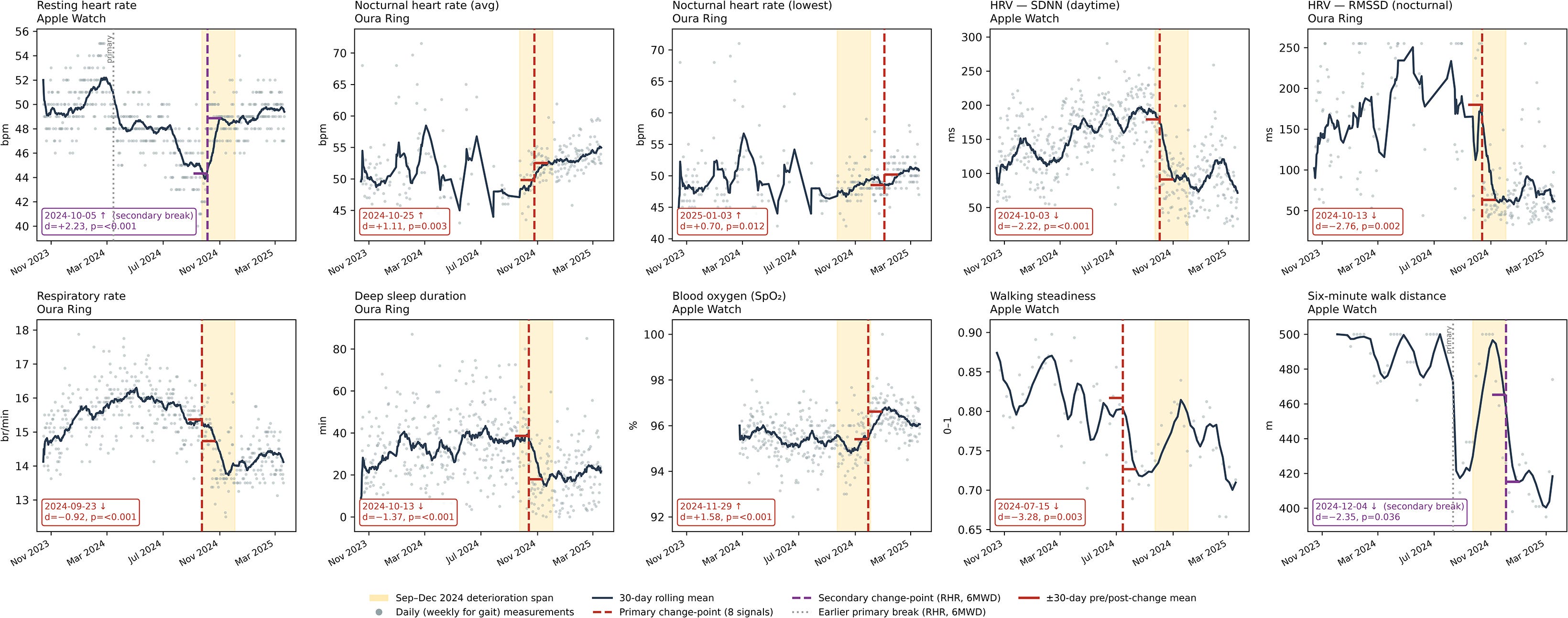
His heart rate variability (HRV) fell by more than half, his resting and overnight heart rate increased, his deep sleep was cut by more than half, and an estimate of six-minute walking distance fell by 50 meters.
Most of these changes clustered four to six months before his death.
This was a retrospective case study involving one person, so it doesn’t show that wearables can predict sudden cardiac death. The authors explicitly say they cannot make that claim. But it does raise a fascinating question about whether the most useful information from a wearable isn’t a single “abnormal” number, but a body (and biometrics) that is gradually—and coherently—becoming different from its normal self.
After reading this one, you’ll either want to throw out your wearable device or invest in a second one. I’ll let you decide which.
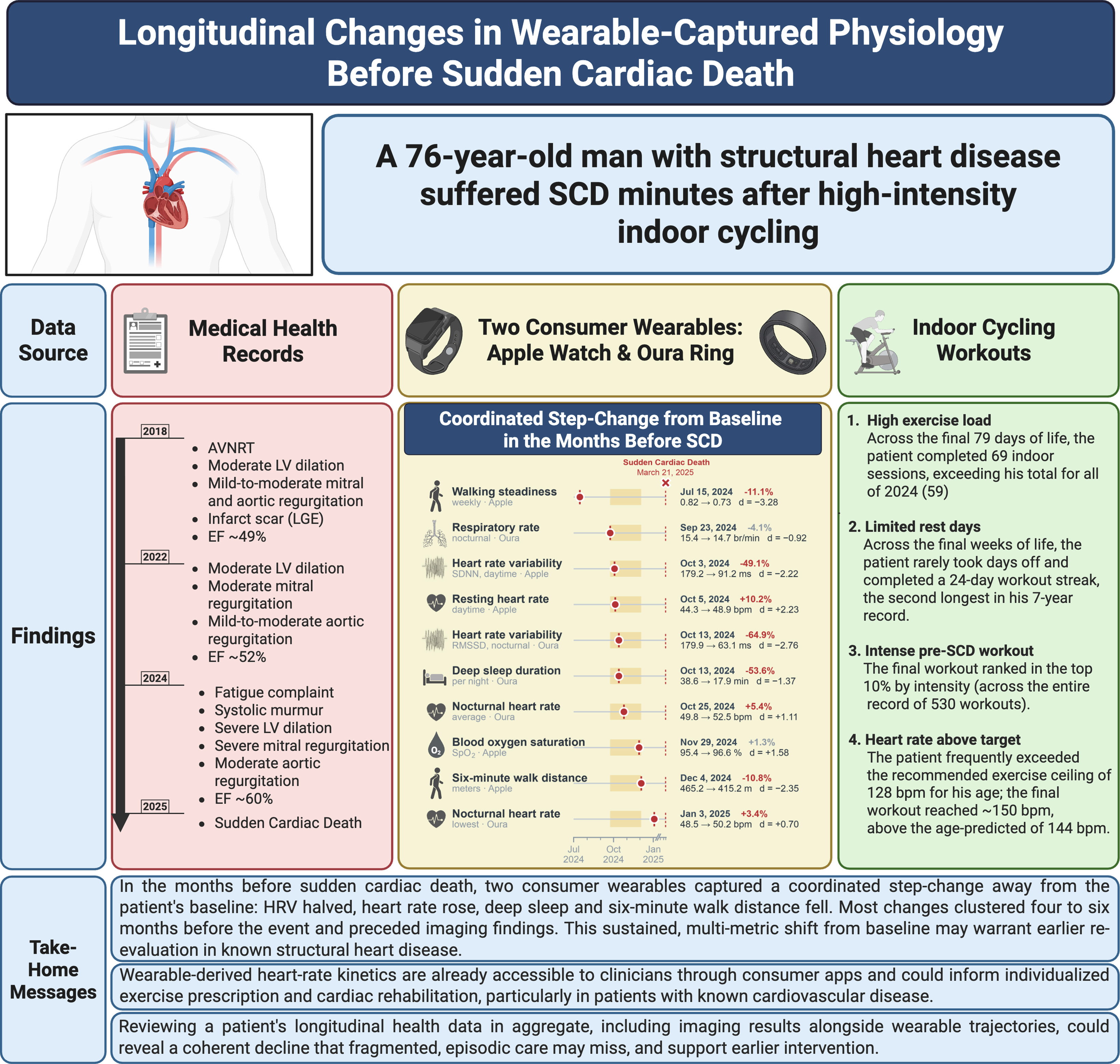
Some important context—this wasn’t an otherwise healthy older man whose wearable data suddenly went haywire, and this wasn’t “death by Peloton.” He had a long history of heart problems, including an enlarged left ventricle, abnormal heart rhythms, valve disease, and evidence of an earlier heart attack.
He even had a cardiology appointment scheduled…
It would have occurred 11 days after his death.
So the wearable changes weren’t emerging from a healthy baseline. They were unfolding in a heart that was already vulnerable—which is essential context for everything that follows.
After his death, researchers integrated four unusually rich sources of long-term data, including approximately:
seven years of medical records.
seven years and 530 workouts from a Peloton bike.
five years of Apple Watch data.
two years of nightly Oura Ring data.
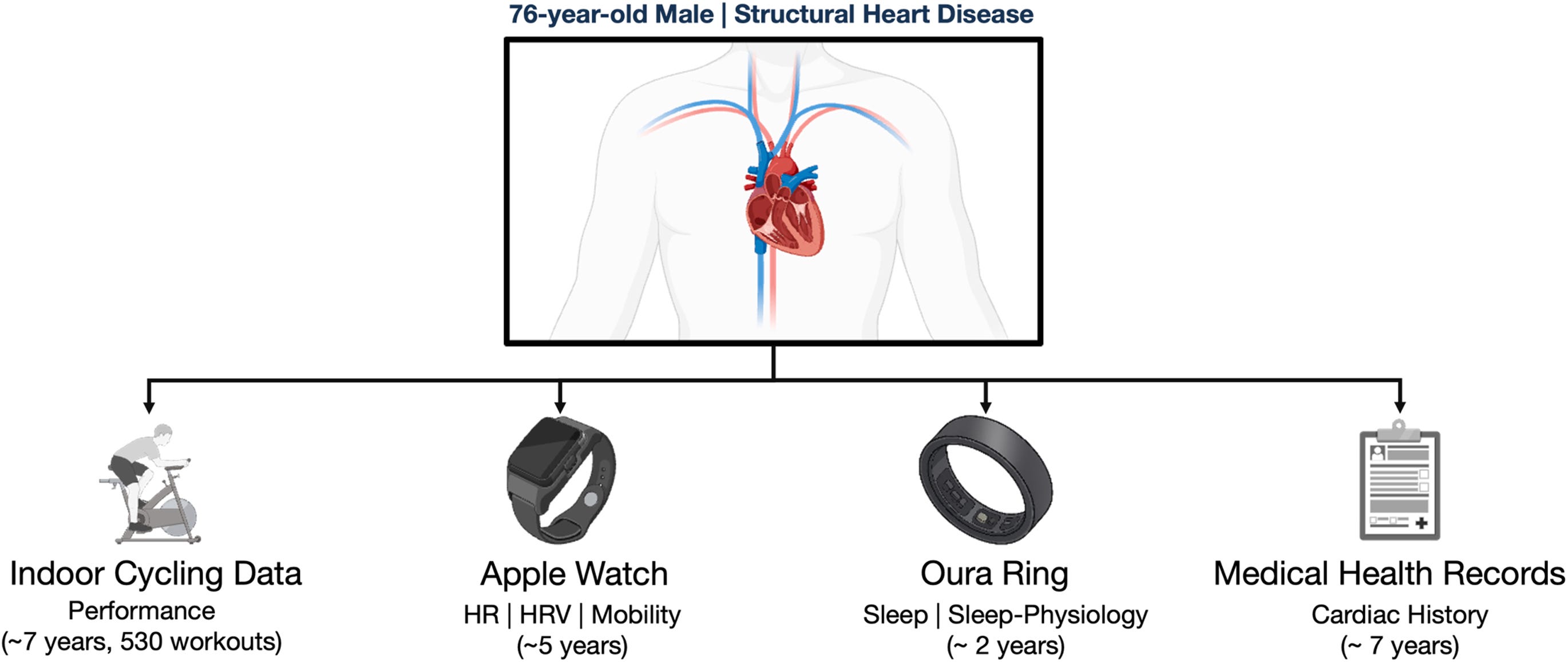
The densest overlapping period began in October 2023, when both the watch and ring were collecting continual data.
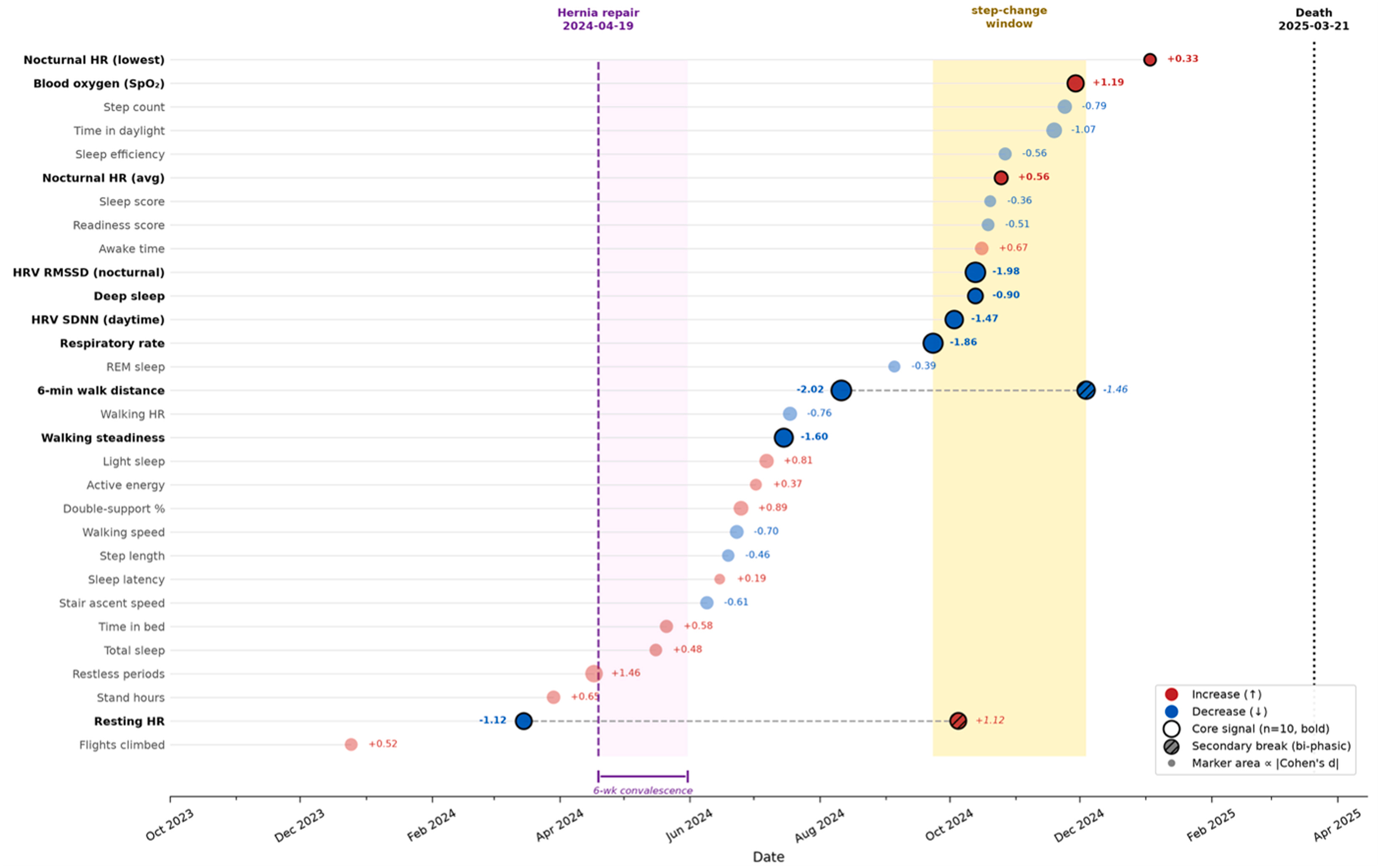
Of 39 wearable-derived signals, 30 showed a significant change point—a moment when the values shifted away from their previous pattern. But those changes didn’t occur randomly. Rather, they formed two distinct clusters.
The first appeared between April and July 2024, around the man’s hernia operation and six-week recovery. It primarily involved walking, physical activity, and sleep duration.
The second cluster looked different.
Beginning in late September and continuing through early December, signals spanning autonomic function, heart rate, sleep, respiration, and walking capacity shifted within a relatively narrow window. The researchers described it as an “abrupt, synchronized shift.” And unlike the post-surgery changes, several of these metrics never returned to their earlier baseline!
The clearest changes appeared in heart rate variability, or HRV, which measures the variation in the time between heartbeats. It’s influenced by the autonomic nervous system—the network that continually adjusts heart rate in response to sleep, stress, exercise, recovery, breathing, and disease.
(Side note: A single HRV reading isn’t especially informative. People have very different normal values, and even within one person, HRV can bounce around considerably from day to day, which is why I recommend most people don’t overthink this one.)
This guy’s pattern was harder to dismiss. Both of his devices recorded a large decline relative to his own baseline.
Daytime HRV measured by the Apple Watch fell from 179 to 91 milliseconds.
Nocturnal HRV measured by the Oura Ring fell from 180 to 63 milliseconds.
At roughly the same time, his resting heart rate increased from 44 to 49 beats per minute, and his average overnight heart rate rose from 50 to 53 beats per minute and continued climbing, averaging 55 beats per minute during the final 30 days of his life. So his heart was beating faster at rest but showing less beat-to-beat variation. That tells me something in his autonomic nervous system had shifted.
His sleep and physical function changed too.
Estimated deep sleep fell from 39 to 18 minutes per night (a reduction of more than 50%).
His Apple-Watch-estimated six-minute walk distance declined from 465 to 415 meters, along with a decline in “walking steadiness.”
Overnight respiratory rate decreased from 15.4 to 14.7 breaths per minute, and blood oxygen saturation increased from 95.4% to 96.6% (the researchers acknowledged that neither of these changes has a straightforward interpretation as physiological deterioration).
This collection of wearable metrics actually makes this case more believable, not less. Real physiology rarely arranges every variable into a perfect red-and-green dashboard. The more important feature (in general and in this specific case) is a convergence—large, durable changes across several physiological domains captured by two independent wearable devices.
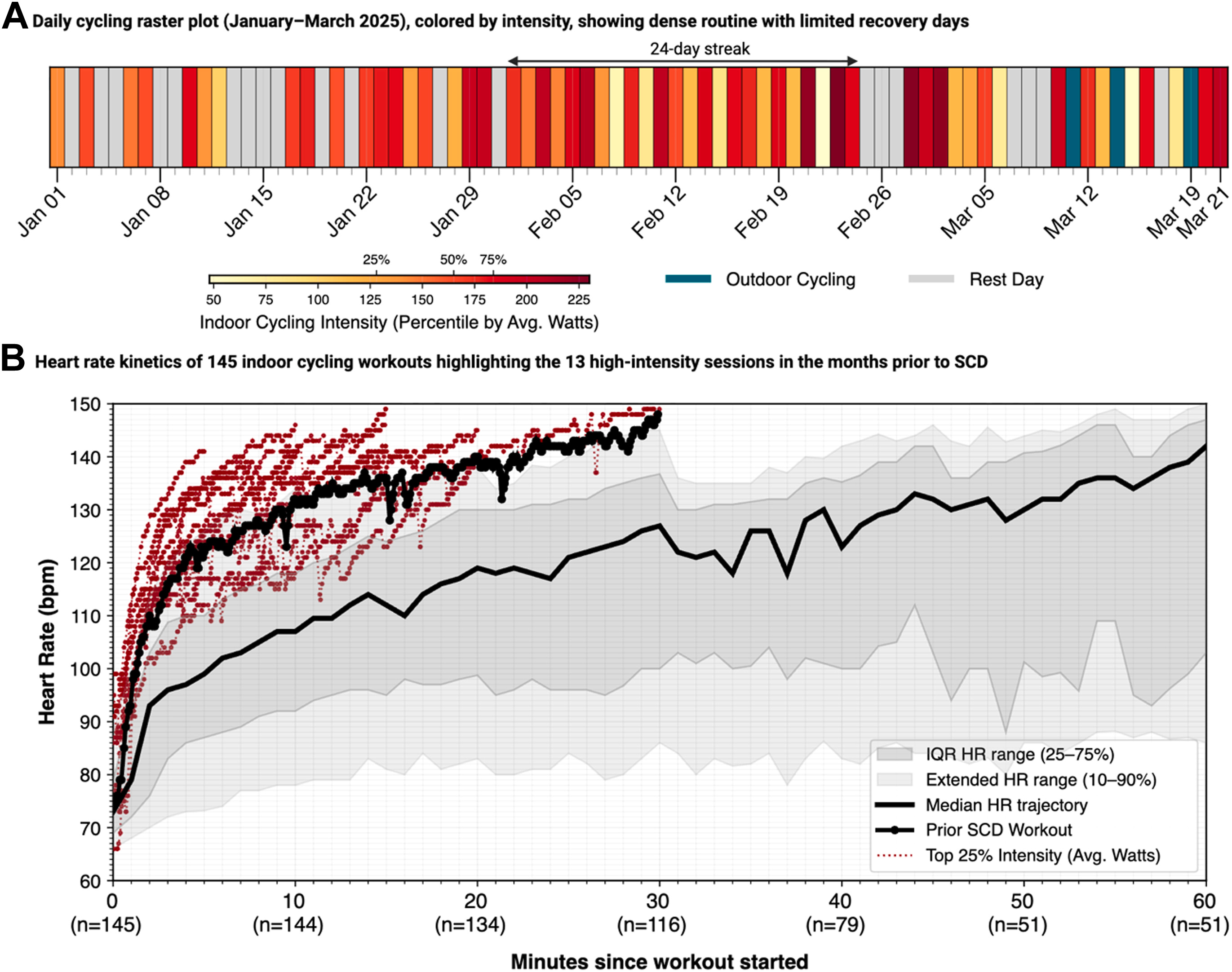
While these signals were changing, the man dramatically increased his cycling.
During the final 79 days of his life, he completed 69 indoor cycling workouts, which was 20 more than the 59 he had completed during all of 2024. That included a 24-day streak with few rest days. Thirteen of those final rides ranked in the top 25% of all of his “hardest” workouts, and eight ranked in the top 10%! The final workout (the one that killed him) also ranked in his top 10% for intensity. It followed a moderate-intensity ride the previous day, which had itself followed an outdoor ride two days earlier.
Across those sessions, his typical heart-rate trajectory approached—and during longer rides exceeded—his age-based upper target of 128 beats per minute, and during several of his hardest workouts, his heart rate surpassed 140 beats per minute and even approached 150 beats per minute during his final ride. (For those keeping track, his predicted max heart rate would be ~144 based on his age of 76.) If true, these workouts were “near maximal” for him.
Pair an older man with heart disease and declining functional markers with an abrupt increase in training frequency and intensity, and the context of all of this seems to make sense, physiologically speaking. That final “nail in the coffin” workout may have acted as a trigger on top of an already vulnerable situation. Or maybe the timing was coincidental.
If your or my resting heart rate increases by 5 beats per minute from one day to the next, it probably doesn’t mean much.
The same is true for one low HRV score, one poor night of sleep, or one unusually low VO2 max estimate. Wearables are noisy. Human physiology is also noisy. Checking a recovery score every morning can occasionally generate more anxiety than insight. And I don’t think this study suggests we should hyper-obsess over numbers lest we miss a crucial warning sign.
But that isn’t what happened here.
The authors argue that the relevant question isn’t whether one HRV value falls inside a universal “normal” range. It’s whether someone’s physiology has “stepped away from its own baseline, coherently and durably.”
I think that may be the most important idea in the entire paper.
Wearables are particularly good at establishing personal baselines. Your normal resting heart rate may be different from mine. Your HRV may be dramatically different from mine. Comparing the two tells us very little. But if several of your metrics depart from their established ranges at the same time—and remain there—that may contain valuable information.
This is where the applications come in.
If I know my newsletter audience well enough, I think it’s safe to say that you have a wearable device (maybe several) that’s constantly tracking your biometric data.
Technology is at the point where it’s easy for these devices or AI to spot trends, departures from normal patterns, and extreme outliers in our data that warrant investigation. That’s especially true if you have years and years of data (sometimes, more is better).
This idea is similar to the “biological passport” used in elite athletics to detect doping or the use of performance-enhancing substances. If an athlete produces a result that falls way outside their baseline—whether that be a performance or a measure of their red blood cell count or testosterone level—it’s a red flag. It’s comparing apples (you) to apples (you)—not apples to oranges (me).
Most of us are wearing “biological passports” on our fingers and wrists.
While it’s tempting to read this paper as evidence that an Apple Watch and Oura Ring saw a cardiac death coming, they didn’t. The analysis was performed postmortem, after the outcome was known. Researchers could examine hundreds of days of data with the benefit of hindsight and identify where the most important changes occurred. There was no prospectively defined “alert.” No clinician was receiving these trajectories in real time, and no validated algorithm indicated that a dangerous event was approaching. Nor do we know if acting on the wearable data would have changed the outcome.
These data shouldn’t be treated as a do-it-yourself diagnostic system.
The paper’s authors call these continuously generated data “among the largest untapped inputs in cardiovascular medicine.” I think that’s right. But unlocking their value will require more than increasingly polished readiness scores. It will require systems that can identify sustained deviations from personal baselines, combine signals across physiological domains, incorporate symptoms and medical history, and present that information to clinicians in a usable form.
We’re getting close to this reality. In fact, my Oura ring’s “symptom radar” feature is precisely designed for that—identifying when things like my breathing rate, HRV, or body temperature deviate from my averages.
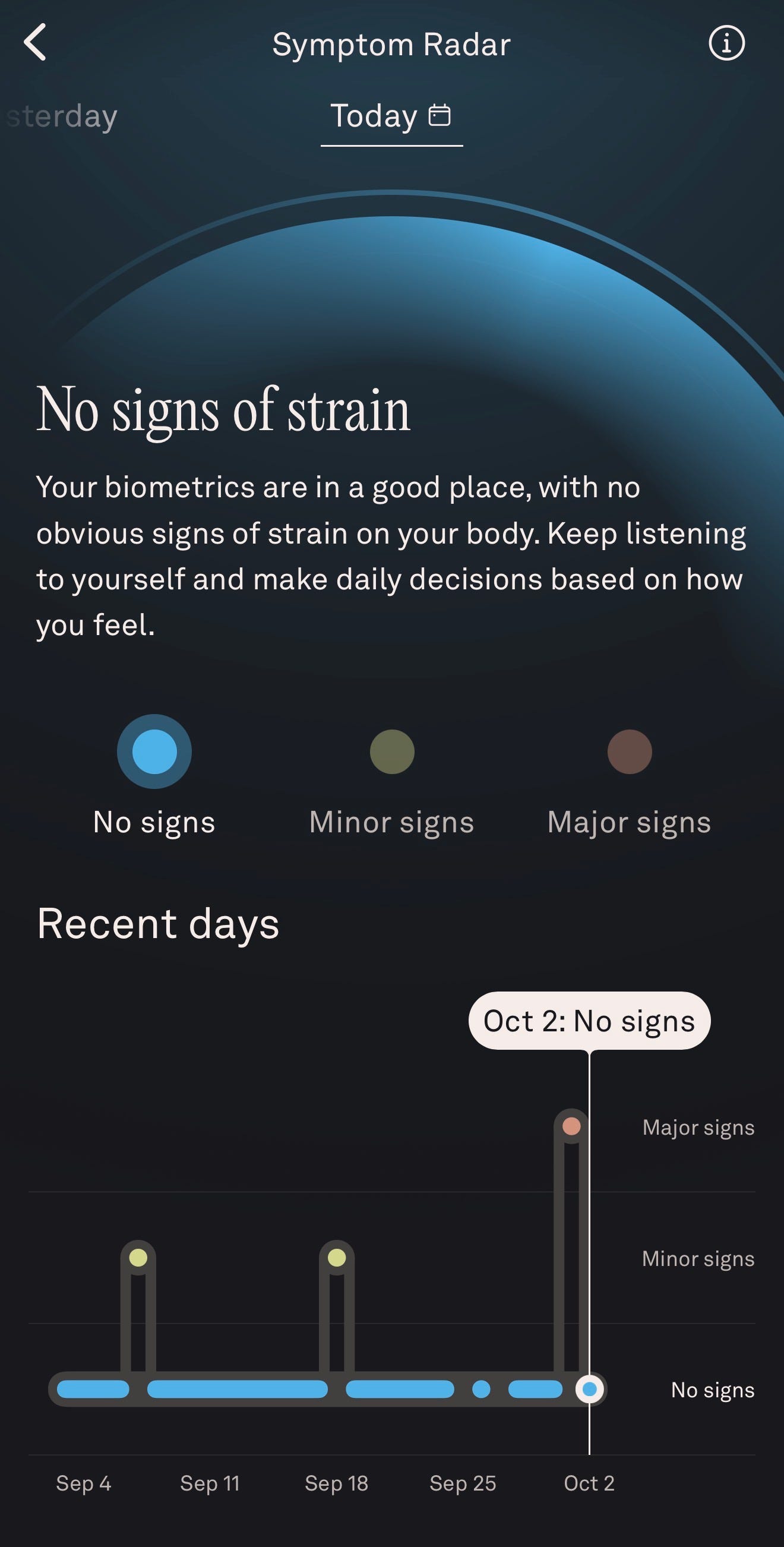
A single wearable value is easy to dismiss… and often should be! But if your sleep, resting heart rate, symptoms, and exercise response all begin telling the same story, the noise could start to become a signal.
Wearables are a double-edged sword. Harmful when they create anxiety, are treated as a diagnosis, or become your primary source of gauging how you feel (versus, you know, your own feelings).
But they’re an incredibly useful tool when used correctly. I think we’re still learning what “used correctly” means, but we’re getting there.
Thanks for reading. See you next Friday.
~Brady~
Ketone-IQ is high-performance energy in a bottle. I use it for post-exercise recovery along with enhancing focus, mood, and cognition. Take 30% off your order.

ProBio Nutrition—the all-in-one supplement that I use every single day—is offering 20% off with the code HOLMER20 at checkout. My preference is the tangy orange flavor, but they also sell an unflavored “smoothie booster” that’s great in a shake, smoothie, or juice.

Equip Foods makes some of the cleanest, best-tasting protein products around. I am absolutely obsessed with their Prime grass-fed protein bars (the peanut butter ones are to die for, but they also just released a new chocolate peanut butter flavor).

Wild Roman is an all-natural skincare brand for men who want a simple, effective routine designed to strengthen skin with modern formulas and wild-sourced ingredients. The company was started by my friend Sahil Bloom, and it’s the only skincare brand I’ve enjoyed using. Their biggest seller is the complete face routine, and I’m partial to the bar soap (seriously… it’s incredible stuff).
Shop through my link to get the $99 Face Routine, free Bar Soap, and free shipping, plus 15% off regularly priced items.
