


Greetings!
Welcome to the Physiology Friday newsletter.
Details about the sponsors of this newsletter and deals on products I love, including Wild Roman skincare, Ketone-IQ, Equip Foods, and ProBio Nutrition can be found at the end of the post.
As an endurance athlete, I find the concept of durability, also known as “physiological resilience,” fascinating.
Durability refers to when, and by how much, your physiological capabilities (e.g., running economy or lactate threshold) deteriorate during prolonged exercise. We spend months, sometimes years, improving our fitness, but we also need to think about what allows us to preserve it as exercise duration increases.
Carbohydrate availability appears to be part of that story. Three recent studies approach the question from different directions, and together they bring some clarity to why (I think) high-carb fueling works its magic.
The basic idea is that eating carbs during exercise gives us an additional source of fuel and helps us keep going. It’s tempting to extend that into a simple sequence of: eat more carbohydrates, spare more of the carbohydrate stored in your muscles (glycogen), and perform better.
But the results don’t line up that clearly!
To see why, we need to separate three things that often get treated as interchangeable.
Carbohydrate intake is what you consume.
Exogenous carbohydrate oxidation is how much of that incoming carbohydrate you burn for energy.
Whole-body carbohydrate oxidation includes both incoming fuel and carbohydrate supplied by your body, including its glycogen stores.
Those distinctions sound technical, but they matter, because it means that a larger number on your fueling plan doesn’t automatically tell us how much fuel you’ll burn, how much glycogen you’ll spare, or even how well you’ll perform.
The first study, led by Ed Maunder and colleagues, began with the carbohydrate already inside the body. What happens to durability if you make athletes burn through that supply faster?
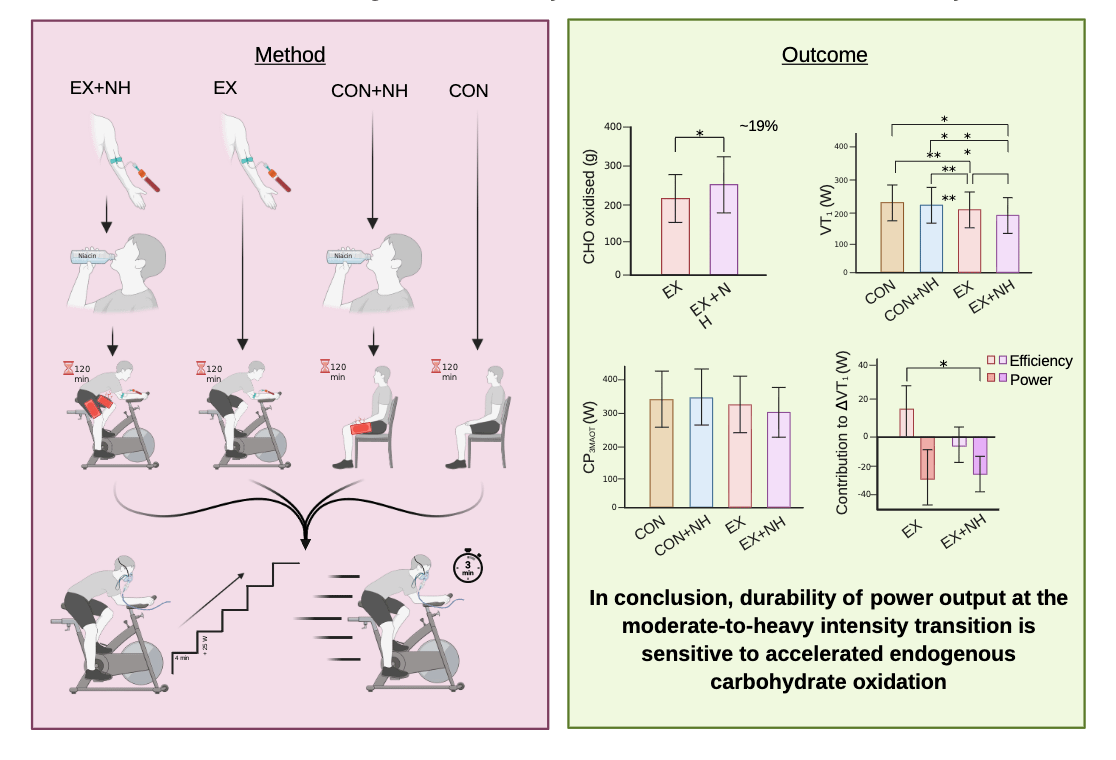
Eleven trained cyclists—eight men and three women—completed exercise tests when fresh and after two hours of cycling. They repeated those conditions with an unusual intervention: niacin combined with mild heating of their thighs. Niacin suppresses the release of fat from adipose tissue, reducing its availability as fuel for the body. Warming the muscles can accelerate glycogen breakdown. Together, the interventions increased estimated endogenous carbohydrate oxidation during the ride by about 19%.
The cyclists rode at the same intensity in both exercise conditions: 90% of their power at the first ventilatory threshold, or VT1. This is a breathing-based marker used to identify the transition from moderate to heavy exercise. They ate a carbohydrate-containing meal beforehand but drank only water during the rides.
After ordinary cycling, power at their ventilatory threshold fell by approximately 7%. When carbohydrate use was accelerated, it fell a further 7% relative to the ordinary exercise condition—roughly 13% below the fresh condition overall! Burning through more of their own carbohydrate roughly doubled the deterioration in this measure of durability.
The difference was attributed to a change in metabolic efficiency— how effectively the cyclists converted the energy they expended into power at the pedals. After ordinary cycling, efficiency improved, partly offsetting the reduction in threshold power. That improvement was absent when carbohydrate use was accelerated.
The authors proposed that greater glycogen depletion in slow-twitch muscle fibers might have forced the cyclists to recruit more of their less-efficient fast-twitch fibers.
On the other hand, critical power, the higher boundary between heavy and severe exercise, didn’t differ significantly between conditions. Here, it was estimated using a three-minute all-out test performed before and after the 2-hour ride. So the effect depended on which physiological capability the researchers examined (durability isn’t one single quality that every test captures equally well).
This experiment is useful because it tells us that accelerating the use of internal carbohydrates made one important physiological boundary less durable. What it doesn’t tell us is whether eating carbs would prevent that decline—or how much athletes need to eat.
For that, the next study gets closer to a decision…
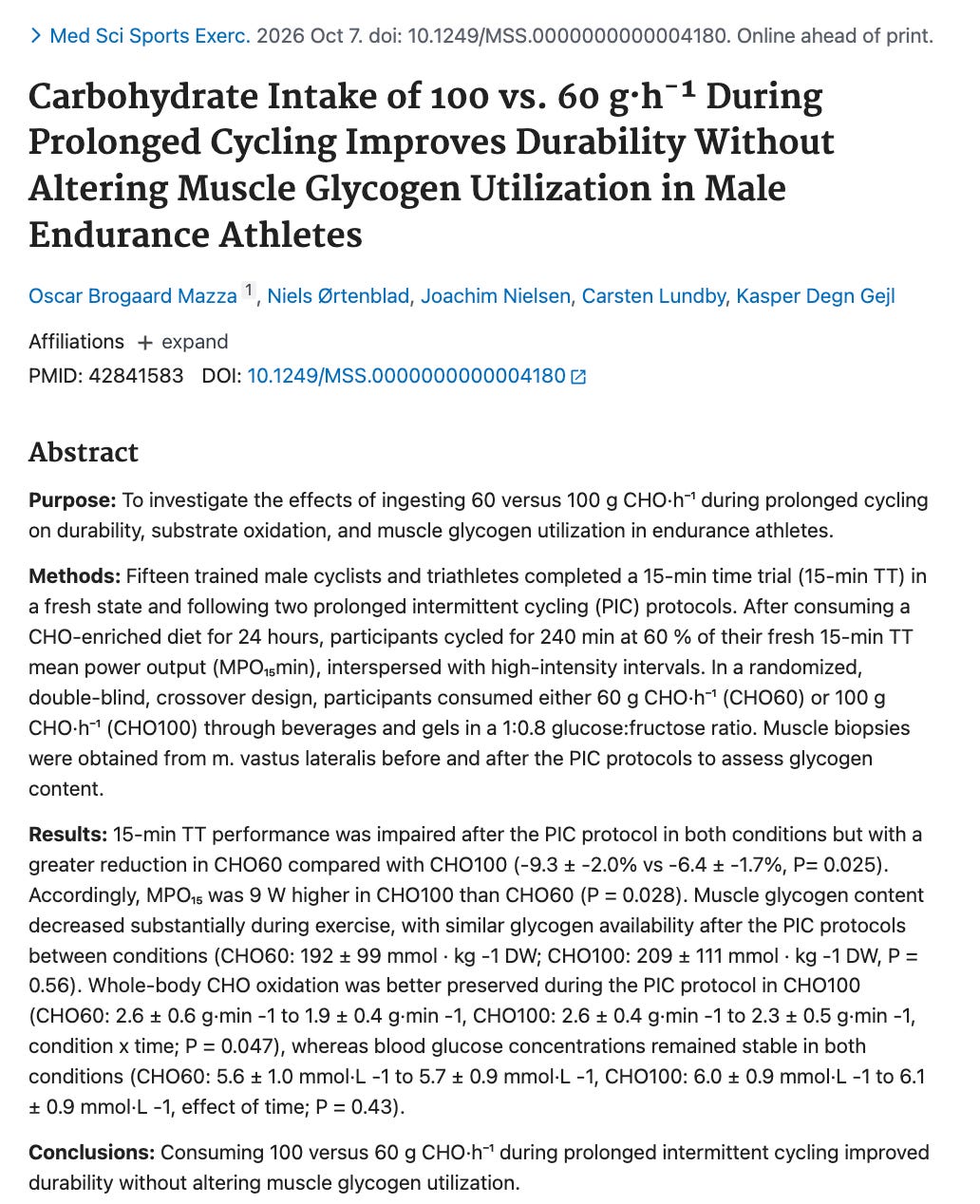
Oscar Brogaard Mazza and colleagues studied 15 trained male cyclists and triathletes consuming either 60 or 100 grams of carbohydrate per hour during four hours of cycling with high-intensity intervals. They also ate a carbohydrate-rich diet for the preceding 24 hours—a “mini carb load,” if you will.
After the four-hour ride, participants completed a 15-minute time trial. The researchers compared that performance with a time trial completed when fresh.
Average power declined by 9.3% with 60 grams per hour and 6.4% with 100 grams per hour. The higher intake preserved an additional 9 watts, on average. So both conditions still produced a decline. More carbohydrate reduced the performance loss, but it didn’t eliminate it.
The more interesting result came from the muscle biopsies. Muscle glycogen declined substantially during both rides, with no detectable difference between the two intake conditions. The athletes performed better with more carbohydrate, but this wasn’t due to the fact that eating more carbs “spared” muscle glycogen.
Meanwhile, whole-body carbohydrate oxidation was better maintained with the higher intake, and blood glucose remained stable in both conditions.
That doesn’t make glycogen unimportant. But this study should make us more careful about the explanations we attach to a particular performance result. To say that “more carbs preserved more muscle glycogen” goes beyond what these data show.
There’s still one practical question that’s unanswered. This study compared 60 with 100 grams per hour. It didn’t establish whether 80 or 90 would have produced the same benefit, or whether pushing intake even higher would help even more.
The third study takes on that last question.
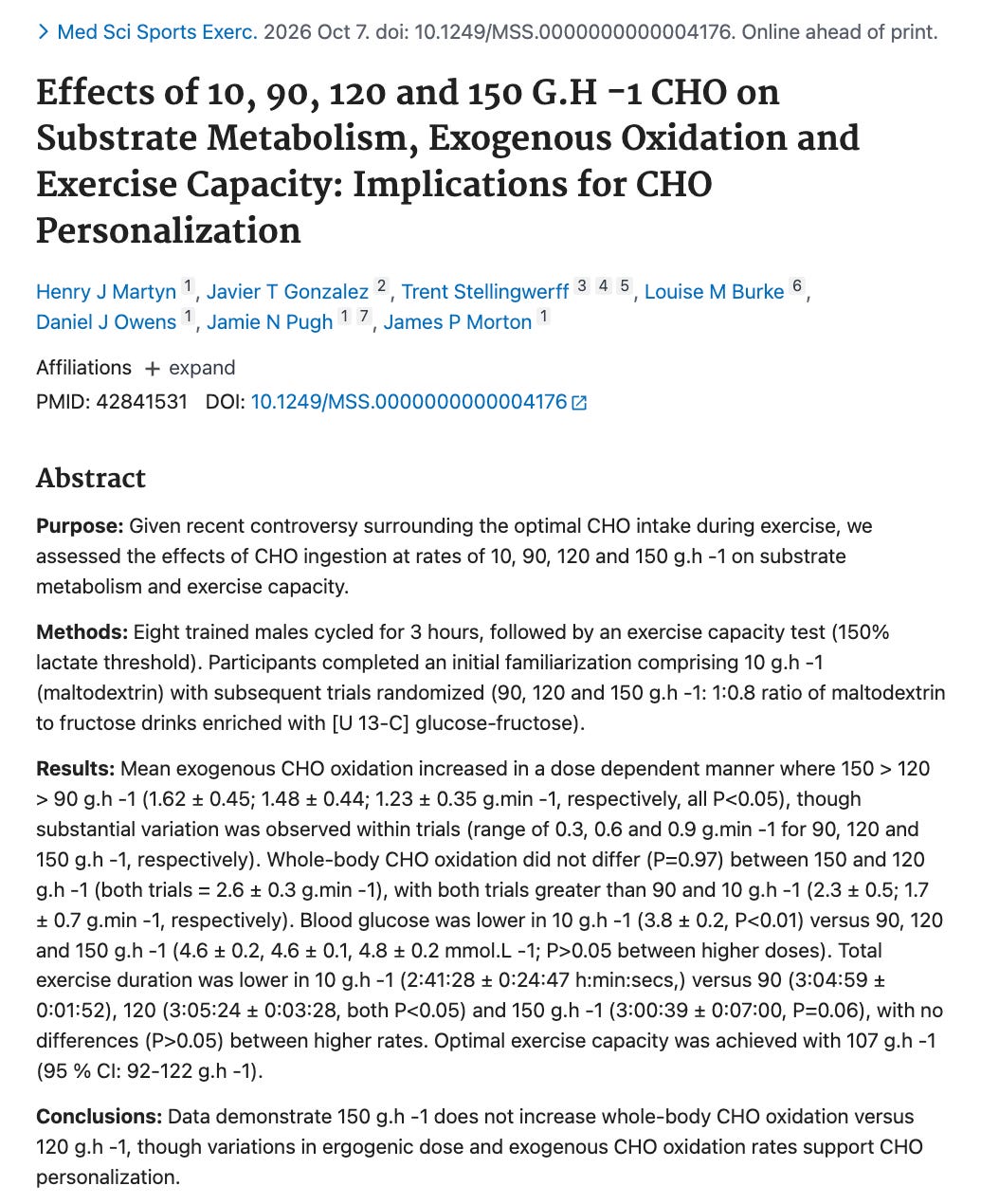
Henry Martyn and colleagues studied eight trained men using a protocol of three hours of cycling followed by an exercise-capacity test at 150% of their lactate threshold. That final test involved riding at a demanding fixed workload for as long as possible.
The first visit used 10 grams of carbohydrate per hour as familiarization. The subsequent trials tested 90, 120, and 150 grams per hour (that’s a LOT of carbs).
As intake increased from 90 to 120 to 150 grams per hour, average exogenous carbohydrate oxidation rose from 1.23 to 1.48 to 1.62 grams per minute. The athletes were burning more of the carbohydrate they consumed. Yet whole-body carbohydrate oxidation was identical at 120 and 150 grams per hour, and exercise capacity didn’t differ significantly among the three higher intakes.
The researchers estimated an optimal intake of 107 grams per hour. Use that information for what you will!
(I’ll plan to do a deeper dive into this study in a future newsletter… so stay tuned!)
In a discussion I had several months ago on a podcast, I mentioned how I currently think about carbs and performance—they won’t allow someone to run or ride faster than they are capable of (they’re not a “performance-enhancing drug”), but they will allow someone to realize their full potential.
In other words, adequate fueling lets you use the fitness you have built. It makes you more durable.

It pains me sometimes to think about all of the fitness I left on the table by not fueling (or hydrating) adequately. I’d reach the end of a long run or workout having not taken in any source of fuel the entire time. And while not completely ravaged, I certainly wasn’t performing as well (or as durably) as I could have. The more I’ve embraced fueling, the better and more enjoyable my training and racing have become.
I do think that high-carb fueling is the reason we are seeing athletes push the limits of performance across the board in the endurance sports world. And the crazy thing is… we don’t entirely know how. The familiar explanations such as sparing muscle glycogen and “burning more carbs” are incomplete. The studies I discussed today illustrate that idea clearly. So what’s going on?
There’s certainly a role of the brain and nervous system that we don’t yet fully understand. And I believe that this “central” component likely ties into the concept of durability. When the body senses that there’s adequate fuel available, it allows us to push our bodies for longer at a higher intensity.
So maybe everything just comes down to resilience.
Thanks for reading. See you next Friday.
~Brady~
Ketone-IQ is high-performance energy in a bottle. I use it for post-exercise recovery along with enhancing focus, mood, and cognition. Take 30% off your order.

ProBio Nutrition—the all-in-one supplement that I use every single day—is offering 20% off with the code HOLMER20 at checkout. My preference is the tangy orange flavor, but they also sell an unflavored “smoothie booster” that’s great in a shake, smoothie, or juice.

Equip Foods makes some of the cleanest, best-tasting protein products around. I am absolutely obsessed with their Prime grass-fed protein bars (the peanut butter ones are to die for, but they also just released a new chocolate peanut butter flavor).

Wild Roman is an all-natural skincare brand for men who want a simple, effective routine designed to strengthen skin with modern formulas and wild-sourced ingredients. The company was started by my friend Sahil Bloom, and it’s the only skincare brand I’ve enjoyed using. Their biggest seller is the complete face routine, and I’m partial to the bar soap (seriously… it’s incredible stuff).
Shop through my link to get the $99 Face Routine, free Bar Soap, and free shipping, plus 15% off regularly priced items.

As a pharmacist, I know niacin best as the flushing lipid drug that suppresses lipolysis — so seeing Maunder's team pair it with thigh warming to force 19% faster internal carb burn was a delightfully weird detail. It paid off: threshold power fell twice as far, and the efficiency gain the control group earned vanished. The 120 vs 150 g/hr plateau is the takeaway I'll borrow — fueling has a ceiling, so 'more carbs' isn't a limitless strategy. It reframes your 'unlocks your potential' line beautifully: fueling doesn't add fitness, it protects it. Your confession about years of under-fueled runs stung a little, too. Do you think that ceiling is a gut-transport limit — and would mixing carb sources actually push it?