


Welcome to the Physiology Friday newsletter.
A few short (and fun) notes:
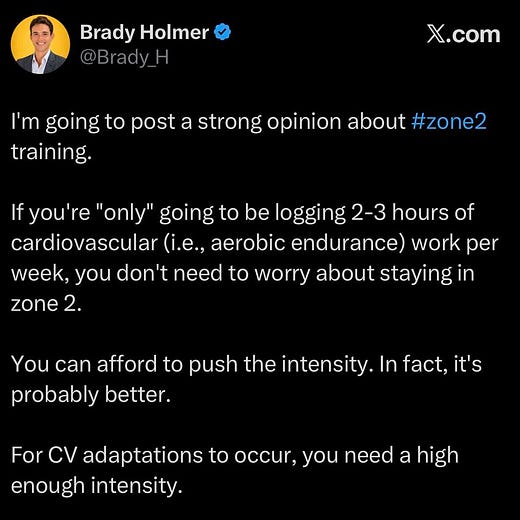
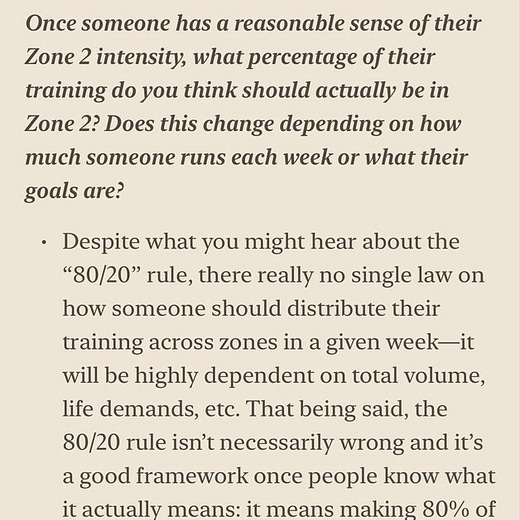
Everyone is freaking out about Peter Attia “changing his mind” on Zone 2. I provided some thoughts on that here:
 Brady Holmer@Brady_HThis is why you listen to the exercise guys (me). Also… A man is allowed to change his mind. In fact, he should when presented with newer data that runs counter to his strong- but loosely held beliefs. But let’s face it, P.A. did this with keto, fasting, rapamycin, etc. Zone…
 BarryRoland19 @BarryRoland19Peter Attia takes a one year hiatus and the first thing he says when he came back was “Zone 2 is overrated my bad lol.” My bad? Do you know how many boring ass hours of stationary bike I’ve done in the last two years?10:58 PM · Nov 2, 2026 · 20.6K Views19 Replies · 8 Reposts · 171 Likes
If you’re looking for some kick-ass, comfortable, and high-performance socks, you need to check out Hollow Alpaca socks. Josh (the CEO) sent me some from their latest performance line, and I’m not sure I can ever wear anything else. You can find them here.
I thought this New Yorker cartoon was funny.
Brady Holmer@Brady_HOh, that’s funny. 👏 7:57 PM · Oct 31, 2026 · 5.25K Views2 Replies · 2 Reposts · 117 Likes


Details about the sponsors of this newsletter and deals on products I love, including Wild Roman skincare, Ketone-IQ, Equip Foods, and ProBio Nutrition can be found at the end of the post.
Periodized nutrition, and the related idea of training fasted or “training low”, has largely fallen out of favor with elite athletes. It’s not really a strategy I’m completely enamored with anymore either.
That makes sense if the only thing you care about is race day. When performance is the priority, carbohydrate availability usually wins, and there’s little benefit in purposefully depriving or depleting the body of its high-octane fuel source.
For people who are less focused on peak performance and more interested in, say, optimizing mitochondria or metabolic health, these techniques are not useless! Used strategically (and with some prudence), train-low approaches can still be a useful stressor—a way to change the fuel mix used during exercise, raise fatty-acid availability, and nudge metabolism toward fat.
But the real question is what actually changes when glycogen is low. Is it the mitochondria themselves… or just the fuel sitting upstream of them? This is an important question, because one of the key selling points of fasted training or “train-low” strategies is that they’ll somehow upgrade our body’s metabolic machinery in a way that ordinary training won’t.
That brings us to today’s study.1
Peak fat oxidation is the highest rate at which your body burns fat during exercise, usually in grams per minute. Fatmax is the intensity—often as a percent of VO₂ peak—where that peak occurs. Both sit under the “crossover” idea: as intensity rises, carbohydrate contributes more and fat contributes less, and absolute fat oxidation looks like a bell curve.
Diet clearly pushes that curve around. Low-carbohydrate diets, ketogenic diets, and fasting tend to raise whole-body peak fat oxidation; carbohydrate feeding suppresses it. Muscle glycogen is an obvious candidate regulator.
What has been murkier is whether glycogen also changes the intrinsic behavior of mitochondria—how tightly they couple oxygen use to ATP production (what’s known as mitochondrial coupling control and efficiency, or MCCE). The authors hypothesized that low glycogen would raise peak fat oxidation and Fatmax and reduce mitochondrial coupling and efficiency.
That hypothesis wasn’t entirely correct.
To test this, they conducted a randomized crossover study with two interventions of two consecutive lab days each, separated by 7–14 days. Ten healthy trained men (average age of 26, a VO₂ peak above 55, and regular endurance sports participation) were included. Baseline VO₂ peak was actually about 60, so these guys were solidly trained.
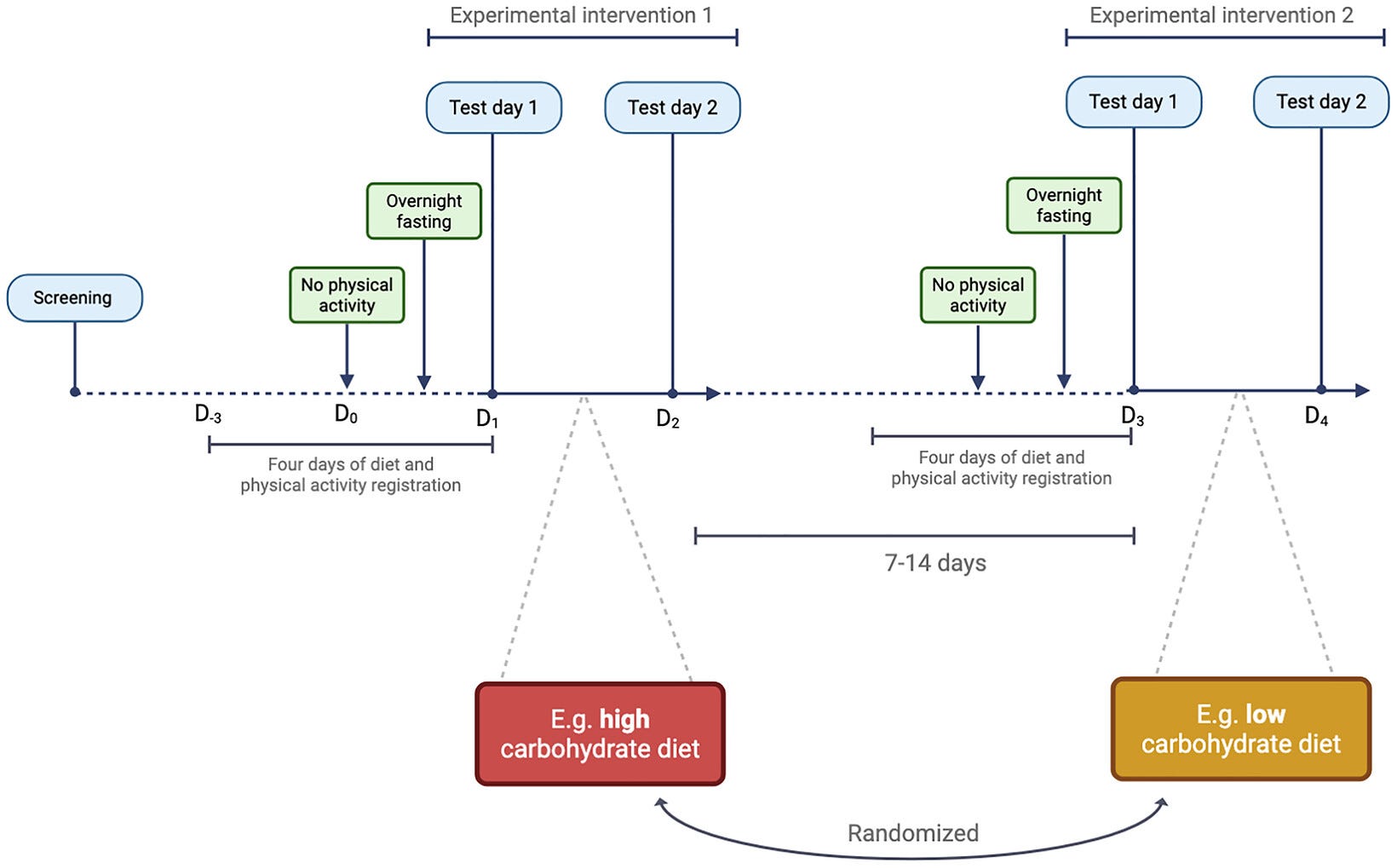
On day 1 of each intervention, they completed a morning blood draw and a leg muscle biopsy, a graded cycling test for peak fat oxidation, Fatmax, and VO₂ peak, then a 2.5–3 hour glycogen-depletion protocol including 45 minutes at 70% of their maximal power output, high-intensity intervals starting at 95% of their maximal power output, combined arm-crank + leg cycling, then a time trial to exhaustion.
I do not envy these participants! This is a brutal protocol, but it was designed with a purpose—to deplete their muscle glycogen content.
After depletion, participants ate either a high-carbohydrate or low-carbohydrate diet for the rest of the day in four meals. High carb averaged about 72% of their calories from carbs, 15% from fat, and 12% from protein. Low carb averaged about 9% of their calories from carbs, 75% from fat, and 16% from protein.
On day 2, everyone came back after an overnight fast for blood draws, a muscle biopsy, and the same exercise tests.
One useful quirk of the study is that the high-carb arm did not fully restore glycogen overnight. That created three glycogen levels rather than a simple full-versus-empty contrast.
Baseline
Partially restored (30% lower than baseline levels in the high-carb group)
Truly low (70% lower than baseline levels in the low-carb group)
Nevertheless, muscle glycogen levels on day 2 (before the second round of testing) were 56% lower in the low-carb group compared to the high-carb group.
Peak fat oxidation rose after both interventions—by 24% after the high-carb day and by a massive 90% after the low-carb day (so 61% higher after the low-carb day). Within people, muscle glycogen and peak fat oxidation were strongly negatively related, meaning the lower their glycogen stores before beginning the exercise test, the higher their peak fat oxidation during the test.
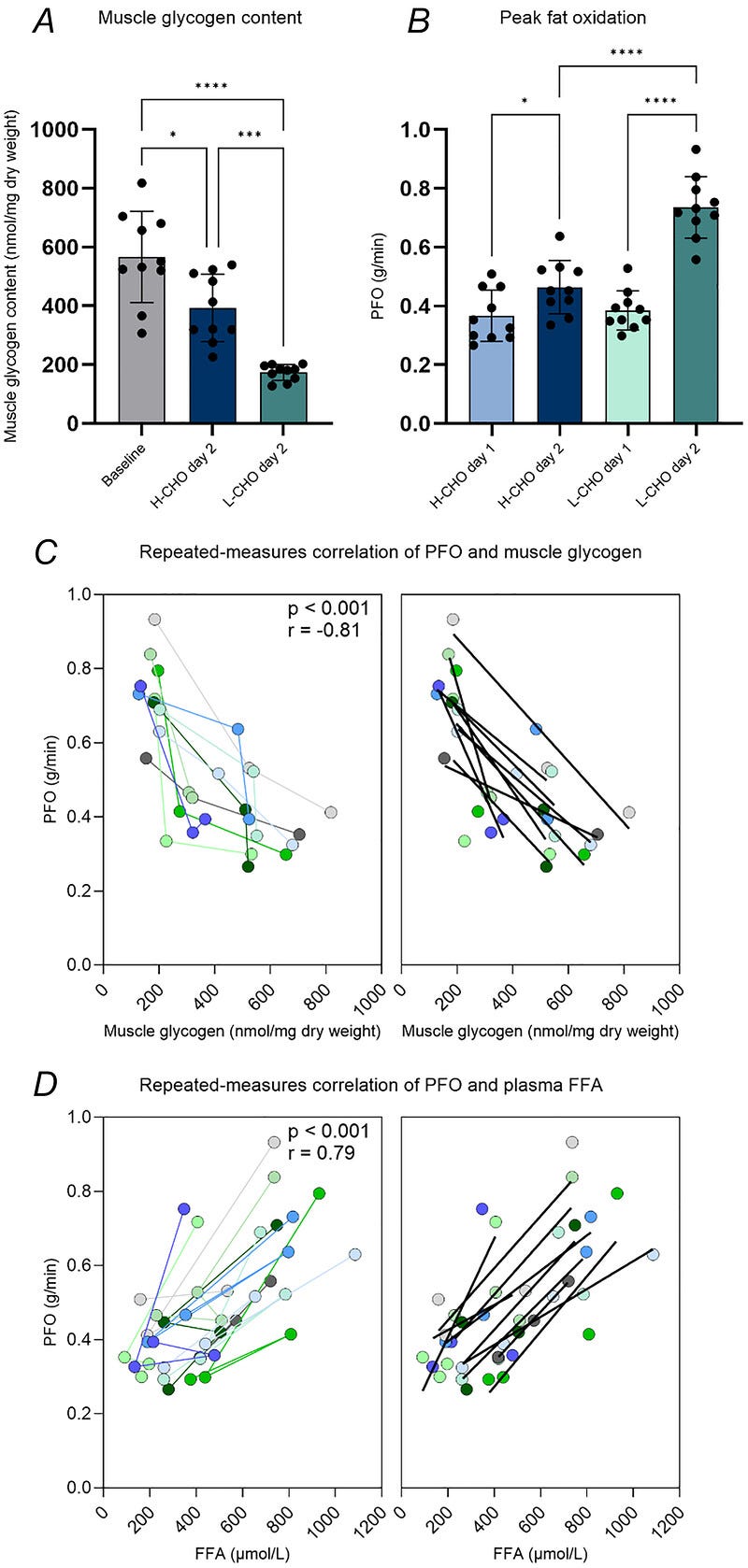
Fatmax was more selective. It rose only after low carb: from 41% to 56% of VO₂ peak (a 37% rise from day 1). After high carb, it was unchanged.
So low glycogen didn’t just raise the height of the fat-oxidation peak. It shoved the peak to the right to a higher relative intensity.
But that didn’t come without a cost. On the day 2 exercise test, participants on the low-carb diet had about a 7% lower maximal power output than they did on day 1 and reported a higher effort compared to baseline and compared to the high-carb group. None of this is inconsistent with reports of what happens to performance, even on a short-term, low-carb diet.
The big twist was what happened (or didn’t) to the participants’ mitochondria.
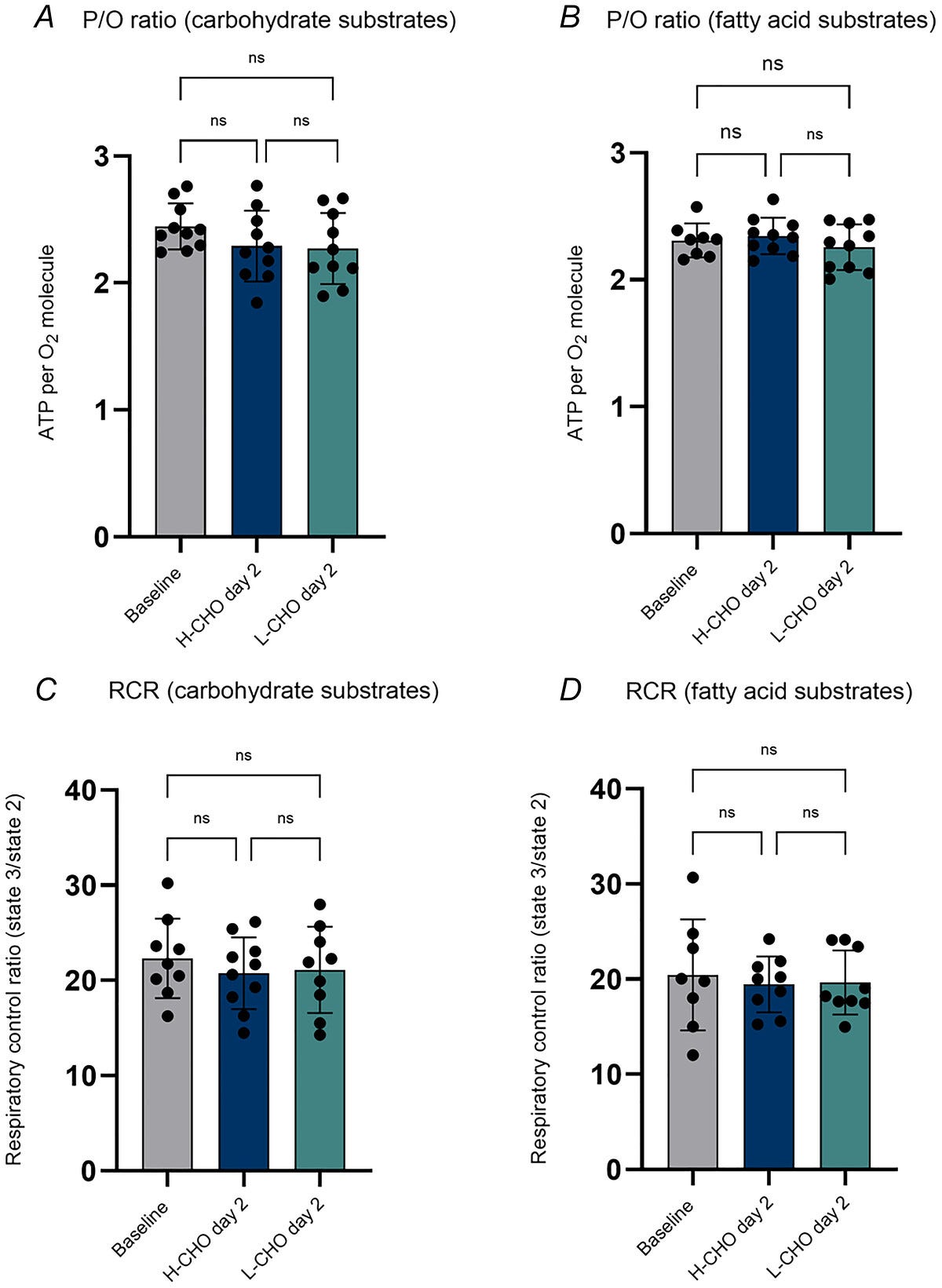
Let’s quickly refresh on a term we introduced earlier—mitochondrial coupling and efficiency. It’s essentially a readout of how “good” mitochondria are at taking fuel sources like fats and carbs and turning them into ATP (“energy”).
They did not change from baseline to day 2 in either diet arm, and they did not differ between high- and low-glycogen day 2! The mitochondria did not suddenly become better or worse ATP factories because glycogen was low, yet whole-body fat oxidation still nearly doubled.
That cracks the clean story. If you see a huge acute rise in fat oxidation after depleting glycogen and restricting carbohydrate, it is tempting to call it “mitochondrial adaptation.” This study points somewhere else…
It’s simply that substrate supply and upstream selection changed.
If your goal is simply to observe a high peak fat oxidation number on a lab test, the recipe is not mysterious—reduce muscle glycogen and raise fatty-acid availability. Depletion plus a day of very low carbohydrate will do it… dramatically.
But if your goal is durable metabolic fitness, your strategy should probably be a bit different. And I don’t think it necessarily involves any sort of deliberate carbohydrate restriction.
As this study shows us, higher fat oxidation after an overnight low-glycogen state is not the same thing as mitochondria remodeled by months of training. One is a snapshot of fuel partitioning. The other is a change in cellular machinery.
That should cool two overheated narratives.
First, that a single low-carb day “upgrades” your fat-burning hardware. It can change the readout, though (how much fat you burn during a single workout).
Second, that Fatmax is a fixed personal fingerprint. In these men it sat around 41% of VO₂ peak when glycogen was more available and jumped to 56% when it was not. These were the same athletes, but depending on their fuel status, the intensity at which they maxed out their fat burning was drastically different!
This means that if you’re prescribing zones or setting a workout intensity from Fatmax, glycogen status and diet are not footnotes. Same goes for if you plan on testing your peak fat oxidation or Fatmax in a lab. Your fuel conditions going into that test matter, a lot!
And this brings us back to periodized nutrition. Train-low is not a magic mitochondrial makeover. It is also not worthless. Used strategically, it can still be a tool for people who care about metabolic flexibility more than a time on the clock. If you are trying to burn more fat during a workout, then fasted training or a low-carb diet leading up to (or following) a session is certainly the way to go.
However, when it comes to building the body’s metabolic machinery, that bit comes from consistent, hard, productive training—dietary manipulation doesn’t come close in terms of what it can do for your mitochondria.
And in that sense, properly fueled training is what’s going to really nudge you in the right direction.
Thanks for reading. See you next Friday.
~Brady~

Ketone-IQ is high-performance energy in a bottle. I use it for post-exercise recovery along with enhancing focus, mood, and cognition. Take 30% off your order.

ProBio Nutrition—the all-in-one supplement that I use every single day—is offering 20% off with the code HOLMER20 at checkout. My preference is the tangy orange flavor, but they also sell an unflavored “smoothie booster” that’s great in a shake, smoothie, or juice.

Equip Foods makes some of the cleanest, best-tasting protein products around. I am absolutely obsessed with their Prime grass-fed protein bars (the peanut butter ones are to die for, but they also just released a new chocolate peanut butter flavor).

Wild Roman is an all-natural skincare brand for men who want a simple, effective routine designed to strengthen skin with modern formulas and wild-sourced ingredients. The company was started by my friend Sahil Bloom, and it’s the only skincare brand I’ve enjoyed using. Their biggest seller is the complete face routine, and I’m partial to the bar soap (seriously… it’s incredible stuff).
Shop through my link to get the $99 Face Routine, free Bar Soap, and free shipping, plus 15% off regularly priced items.
1. Lange KK, Becker L, Rømer T, Hassing M, Høybye ST, Smailes N, Pardo P, Danisman B, Andersen PF, Larsen S, Helge JW. Effects of exercise followed by a low-carbohydrate diet on peak fat oxidation and mitochondrial coupling control and efficiency in healthy trained men. The Journal of Physiology. 2026. doi:10.1113/JP291697
This is the kind of study that should make everyone selling metabolic testing slightly nervous — in a good way. The headline numbers are dramatic: peak fat oxidation up 90% after the low-carb day, Fatmax shifting from 41% to 56% of VO2 peak in the same ten men. But the mitochondria themselves didn't change at all, and maximal power output actually dropped about 7%. So what moved was the fuel mix, not the machinery. The practical implication I keep coming back to is about testing conditions: Fatmax is increasingly sold as a personal fingerprint, something you measure once and build zones around, yet here it swung by 15 percentage points of VO2 peak depending on what the athletes ate the day before. Anyone booking a lab test — or prescribing training zones from one — really needs to standardize carbohydrate intake beforehand, or the numbers aren't comparable between visits. A snapshot of fuel partitioning is useful, but only if we stop dressing it up as a measure of metabolic fitness.
Great write up! That is a nasty test.