

Welcome to the Physiology Friday newsletter.
A few short notes:
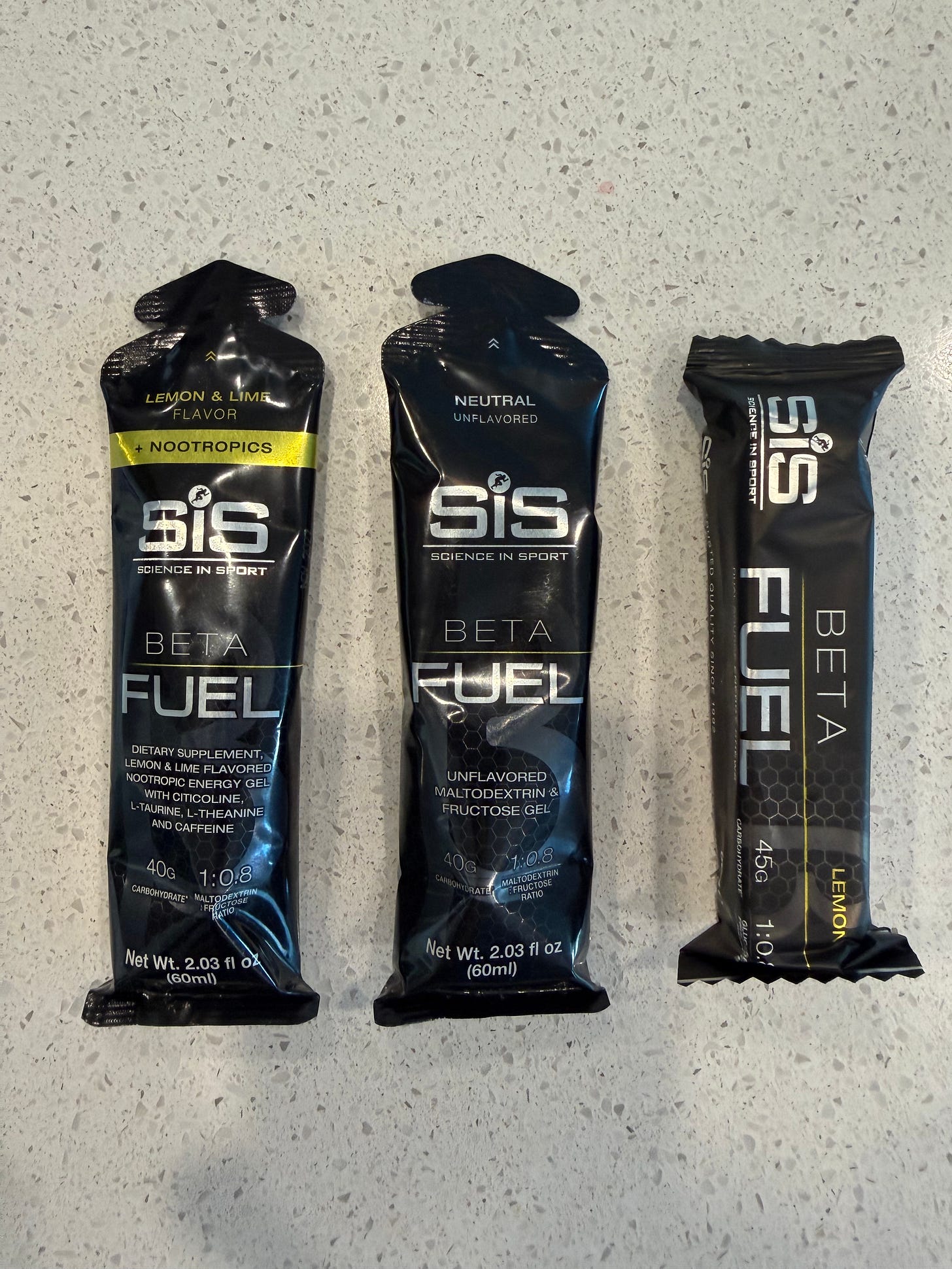
Today’s study is all about carbs, and by far my favorite carbs for training and racing are the Science in Sport beta fuel gels. My friend and sports scientist Jonah Rosner just sent me a huge shipment of their stuff to try, including some energy chews which have been great for indoor riding.
I really enjoyed Dr. Rhonda Patrick’s latest podcast episode with nutrition researcher Dr. Dariush Mozaffarian. They talk about the origins of our fear around saturated fat, seed oils, and a bunch of other stuff you probably need to know about what you eat.
Guys are taking “doping” to the next level…
 Brady Holmer@Brady_H“I thought it was creatine.”
 5:31 PM · Nov 11, 2026 · 46.8K Views19 Replies · 8 Reposts · 182 Likes
Details about the sponsors of this newsletter and deals on products I love, including Wild Roman skincare, Ketone-IQ, Equip Foods, and ProBio Nutrition can be found at the end of the post.
I posted about this study yesterday, and the second sentence is the one I cannot stop turning over (and find a bit depressing, to be honest).


Glucose oxidation drops by about 27% during exercise in the heat.
But the crazy twist is what happens (or rather, what doesn’t) after you acclimate. Heat acclimation is supposed to be the fix for hard work in the heat. Your heart rate comes down, your core temperature comes down, your plasma volume goes up… you just feel and perform better! The question is whether those adaptations also restore your ability to burn the carbohydrate you ingest.
It turns out, they don’t.
Exogenous carbohydrate, here, means the carbohydrate in your bottles. Endogenous carbohydrate means what you already have stored, mainly as glycogen (the storage form of carbohydrate) in muscle and liver. In temperate conditions, drinking carbohydrate during long exercise helps by keeping that fuel available. In the heat, that strategy becomes less effective.
We already knew the heat problem existed. Older work has shown that oxidation of ingested carbohydrate is suppressed when you exercise in hot conditions. So the open questions were why, and whether becoming heat-acclimated would fix it.
A new study in The Journal of Physiology, set out to answer both.1
When you exercise in the heat, more of your blood is sent to the skin so you can dump heat. That may steal blood flow from the gut (the splanchnic circulation), which includes the intestines and liver, and make it harder to absorb the carbohydrate you just drank. At the same time, heat can speed up the breakdown of muscle glycogen, which can put the brakes on taking up glucose from the blood.
Heat acclimation, in that story, should help on both ends. You sweat more, your plasma volume expands, and you rely less on skin blood flow to stay cool. Some earlier work also suggested that acclimation can reduce carbohydrate oxidation and muscle glycogen use. If those changes preserve gut blood flow and ease the brake on muscle glucose uptake, you might expect exogenous oxidation to bounce back.
That is exactly what the authors hypothesized. And here’s how they tested it.
Seventeen endurance-trained adults (10 men and 7 women) with an average age of 24 years and a VO₂ peak of 52 ml/kg/min completed the study.
Each experimental trial was 90 minutes of continuous cycling at 45% of peak power (maximal Watts) in an environmental chamber, after an overnight fast, with a carbohydrate-rich diet standardized for two days beforehand. They drank glucose at 90 grams per hour.
They did this once in temperate, dry conditions (68°F/20°C, 20% relative humidity) and once in the heat (104°F/40°C, 20% relative humidity). Then came nine days of exercise-heat acclimation over a 10-day period, where the session intensity was adjusted to reach and then hold a core temperature of around 102°F/38.5°C. Each session lasted 95 minutes at 104°F/40°C and 20% relative humidity (ouch).
Three days after the last session, they repeated the 90-minute hot trial (POST).
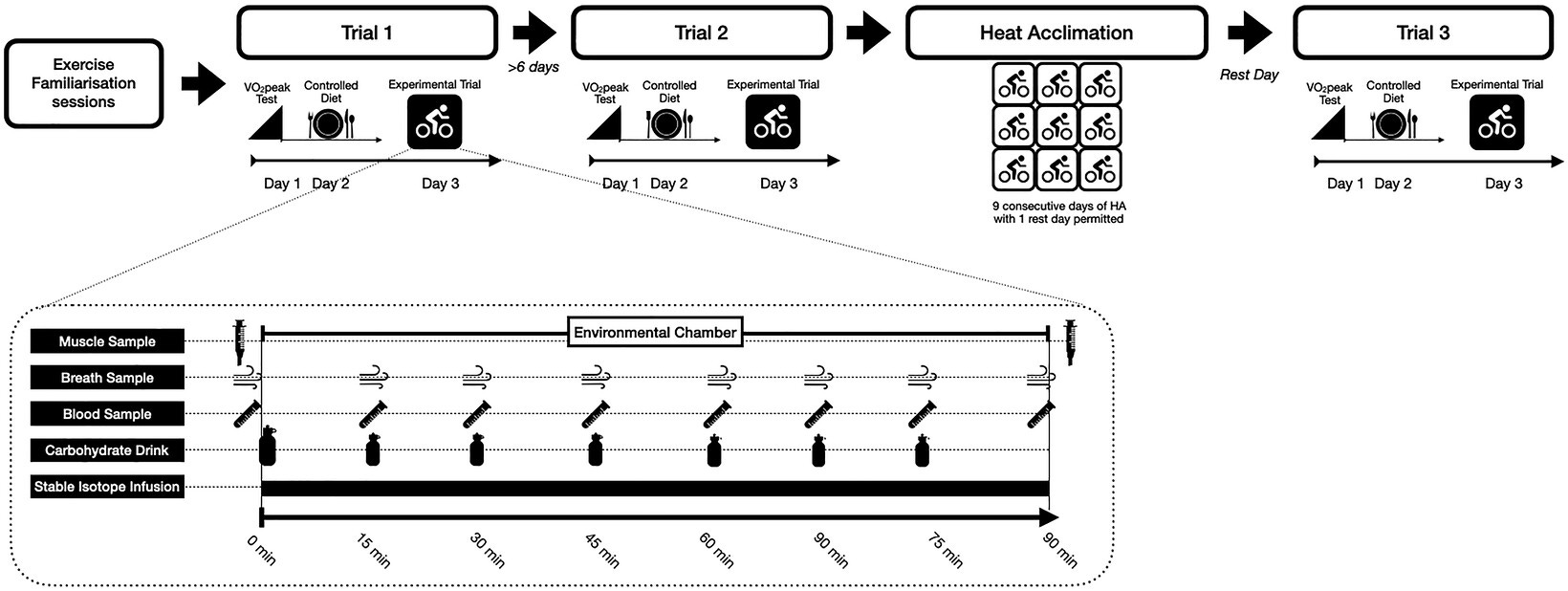
To track the fate of the carbs in the drink, the researchers used dual stable isotope tracers (stable isotopes are non-radioactive labels that let you follow a molecule through the body). This allowed them to measure how fast glucose appeared and disappeared from the blood.
The first thing to confirm is that the acclimation worked. And the answer there was yes.
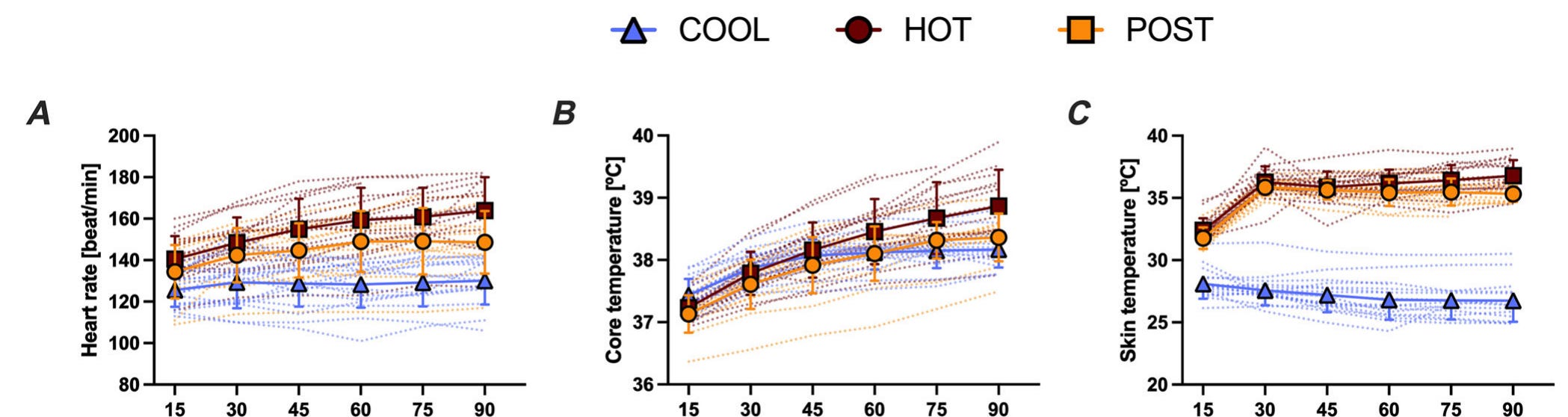
During the hot exercise trial after acclimation, heart rate, core temperature, and skin temperature all came down relative to the pre-acclimation heat trial, and the riders felt better, with lower ratings of perceived exertion and less thermal discomfort. VO₂ peak and peak power did not meaningfully change, which is useful because it means the adaptations look like heat acclimation, not a short-term bump in fitness.
And still, exogenous glucose oxidation stayed down.
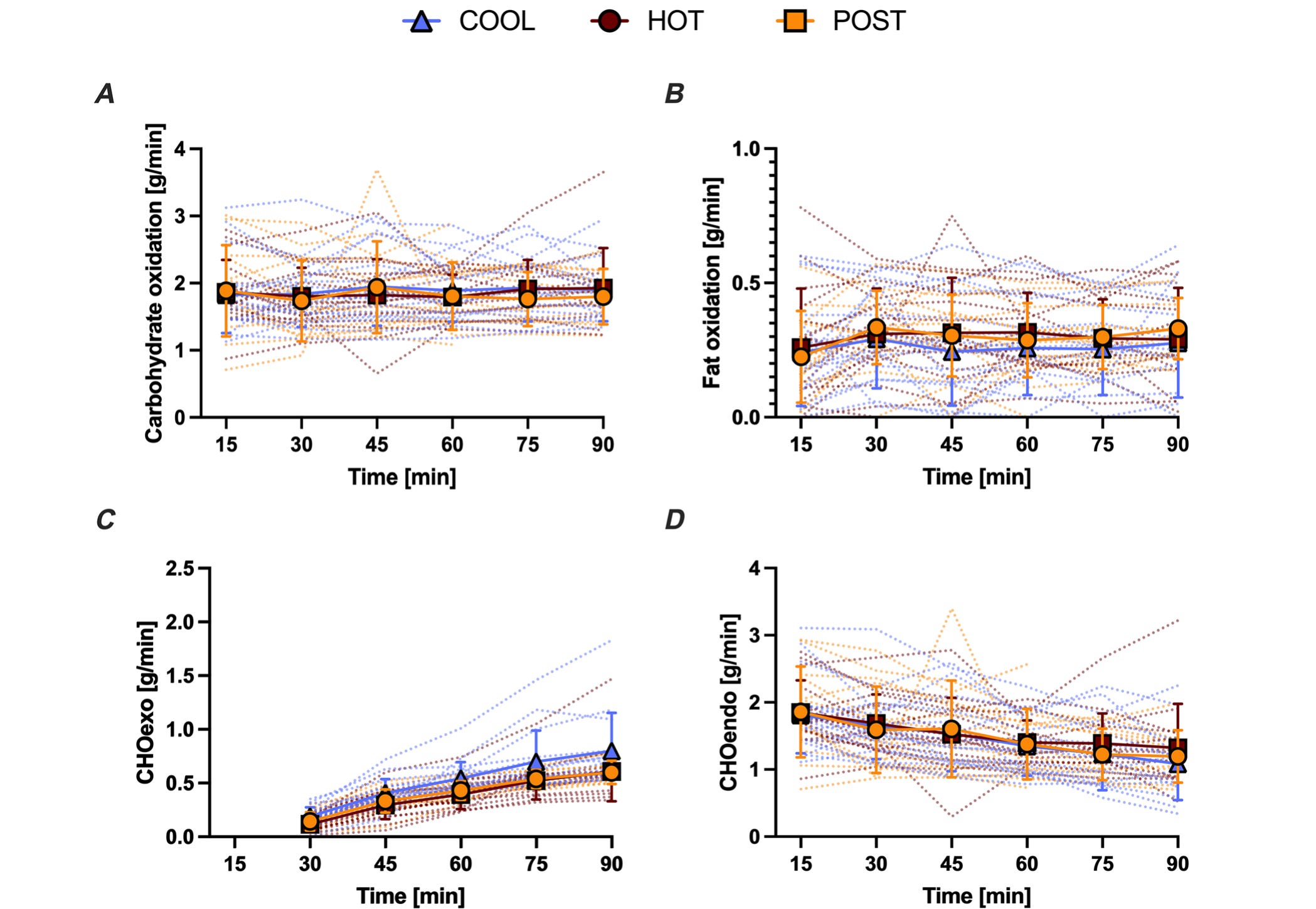
Over minutes 30 to 90 of exercise, exogenous oxidation was:
0.51 g/min in the cool trial
0.37 g/min in the hot trial
0.38 g/min in the hot trial after acclimation
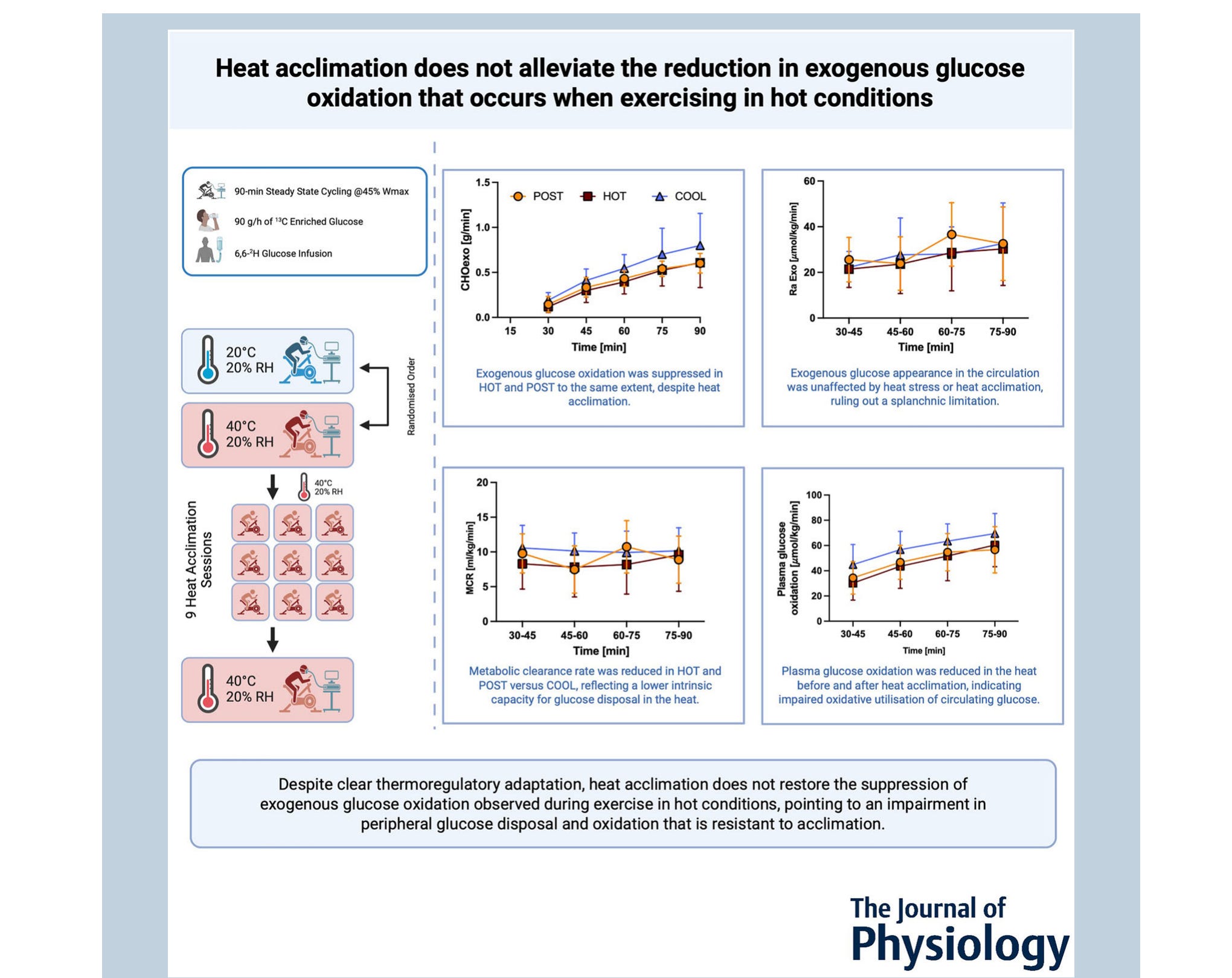
That is a ~27% reduction in the heat, and it was not restored after acclimation. The suppression relative to cool conditions was almost identical in hot and hot post-acclimation.
What’s interesting is that total carbohydrate oxidation did not differ significantly across conditions. Fat oxidation was slightly higher in hot than in cool, and endogenous carbohydrate oxidation was numerically a bit higher in the heat. Oxygen uptake was also higher in the heat than in the cool conditions, but it came back down after acclimation (a useful and optimistic finding).
So why is exogenous oxidation lower?
This is the part of the study I think is coolest, because the authors actually tested the two big candidate explanations instead of guessing.
The first candidate is a splanchnic bottleneck: the drink does not get through the gut and liver and into the blood as effectively in the heat.
That is not what they found.
The rate of appearance of ingested glucose in the circulation, or how fast drink-derived glucose showed up in the blood, was not different across cool, hot, and post-hot. Total glucose rate of appearance and disappearance were also unaffected. In other words, at this glucose dose, in these cyclists, the drink was still getting into the bloodstream. The problem was not digestion or absorption!
The second candidate is peripheral: the tissues, especially working muscle, are worse at taking up and oxidizing the glucose that is already in the blood.
That is where the data point.
Metabolic clearance rate, a measure of how effectively tissues clear glucose from the blood, was reduced in hot and post-hot compared with cool. In fact, plasma glucose itself was higher in the heat. So glucose was arriving, and there was more of it circulating, but less of it was being cleared and burned.
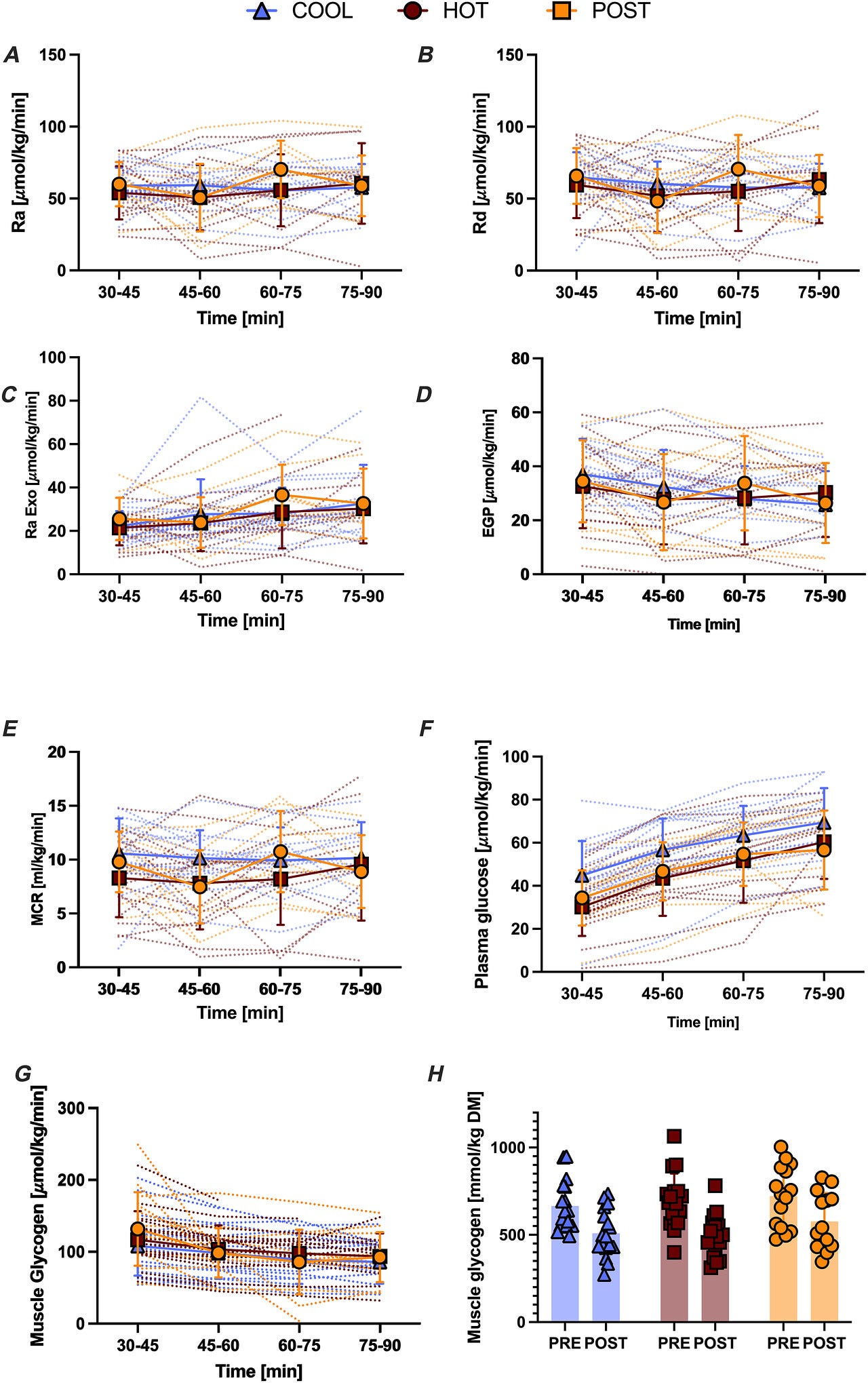
What the authors propose is that a decreased capacity for plasma glucose disposal and utilization—in peripheral tissues, not at the gut—underpins the reduction.
Why would that happen?
One possibility is a redistribution of blood flow, with more going to the skin for cooling, which could change the distribution and metabolic fate of circulating glucose even if gut absorption doesn’t change. Another is a direct effect of heat stress on how muscle uses circulating glucose. Elevated stress hormones could lower insulin sensitivity and thereby reduce clearance. Accelerated muscle glycogen breakdown could also inhibit glucose uptake.
Dehydration is another plausible contributor they could not quantify cleanly. Sweat losses are higher in the heat, and other recent work has shown that low fluid intake can reduce exogenous glucose oxidation even in temperate conditions, while heat stress can impair it by about 20% even when hydration is maintained. Both probably matter here, but they weren’t measured.
What this means for fueling in the heat
I’ve been trying to wrap my head around the practical applications of this study ever since reading it. Because I don’t want the conclusions to be “I guess when it’s hot, we’re just screwed.” There has to be something we can do to offset the carb-burning deficit caused by the heat. Here’s what I think.
First, do not count on heat acclimation to restore your ability to oxidize the carbohydrate you ingest in the heat. Acclimation is still worth doing, of course! It lowered heart rate, core and skin temperature, and perceived strain in this study, which is exactly why people acclimate before a hot event. What will improve your ability to burn more carbs, in general, is gut training!
Second, at this glucose dose, the bottleneck was not the gut. The drink still appeared in the blood. Gastrointestinal symptoms were minimal. So if you have been assuming that poorer absorption in the heat explains reduced performance or GI distress, this study does not support that as the primary limitation.
Third, I would also not assume that the same fueling plan covers you in the heat the way it does in cooler temperatures. Does this mean you should add 30% more carbs to your fueling strategy? Probably not, because I don’t think we can say you’d actually use those extra carbs! Especially if there truly is a heat-induced cap on glucose uptake in the muscles. Based on this study, altering a fueling plan doesn’t seem to be the practical takeaway.
The authors’ own translational take is the one I would hang onto:
Carbohydrate-feeding strategies for exercise in the heat should focus on optimizing carbohydrate delivery while maintaining hydration and minimizing gastrointestinal symptoms. Hydration is not just a heat-illness issue here. It may matter for oxidation itself.
I’m nothing if not an apostle for heat training. It’s truly miraculous, not only in improving endurance performance (in ways that mimic and often exceed altitude training), but also for the incredible cardiovascular health benefits it has.
So this study was a humbling reminder that, physiologically speaking, we can’t out smart the body. Sometimes the environment is just going to put a limit on what we can do, and no amount of acclimation can overcome that.
Thanks for reading. See you next Friday.
~Brady~

Ketone-IQ is high-performance energy in a bottle. I use it for post-exercise recovery along with enhancing focus, mood, and cognition. Take 30% off your order.
ProBio Nutrition—the all-in-one supplement that I use every single day—is offering 20% off with the code HOLMER20 at checkout. My preference is the tangy orange flavor, but they also sell an unflavored “smoothie booster” that’s great in a shake, smoothie, or juice.

Equip Foods makes some of the cleanest, best-tasting protein products around. I am absolutely obsessed with their Prime grass-fed protein bars (the peanut butter ones are to die for, but they also just released a new chocolate peanut butter flavor).

Wild Roman is an all-natural skincare brand for men who want a simple, effective routine designed to strengthen skin with modern formulas and wild-sourced ingredients. The company was started by my friend Sahil Bloom, and it’s the only skincare brand I’ve enjoyed using. Their biggest seller is the complete face routine, and I’m partial to the bar soap (seriously… it’s incredible stuff).
Shop through my link to get the $99 Face Routine, free Bar Soap, and free shipping, plus 15% off regularly priced items.
Podlogar T, Gifford RE, Thomas J, Civil R, Malik S, Lucas RAI, Young AJ, Pasiakos SM, Margolis LM, Wallis GA. Heat acclimation does not alleviate the reduction in exogenous glucose oxidation that occurs when exercising in hot conditions. The Journal of Physiology. 2026. doi:10.1113/JP289304
What I keep coming back to is how cleanly this study rules out the explanation everyone reaches for first. The gut isn't the bottleneck — the drink still shows up in the blood at the same rate, and plasma glucose actually runs higher in the heat. The problem is downstream: the muscle just isn't clearing and burning it, down about 27%, and nine days of acclimation — with all the usual wins, lower heart rate, lower core temperature, better perceived effort — doesn't move that number at all. That's a useful correction for anyone whose instinct in a hot race is to drink more carbs; if uptake is capped, extra fuel is mostly extra GI load. The hydration thread is the one I'd watch next: if heat stress plus low fluid intake each independently drag exogenous oxidation down, the practical lever may be fluid, not fuel. And for anyone exercising in heat on glucose-lowering medication, that combination — higher circulating glucose, lower clearance — is worth a conversation with their clinician before race day.