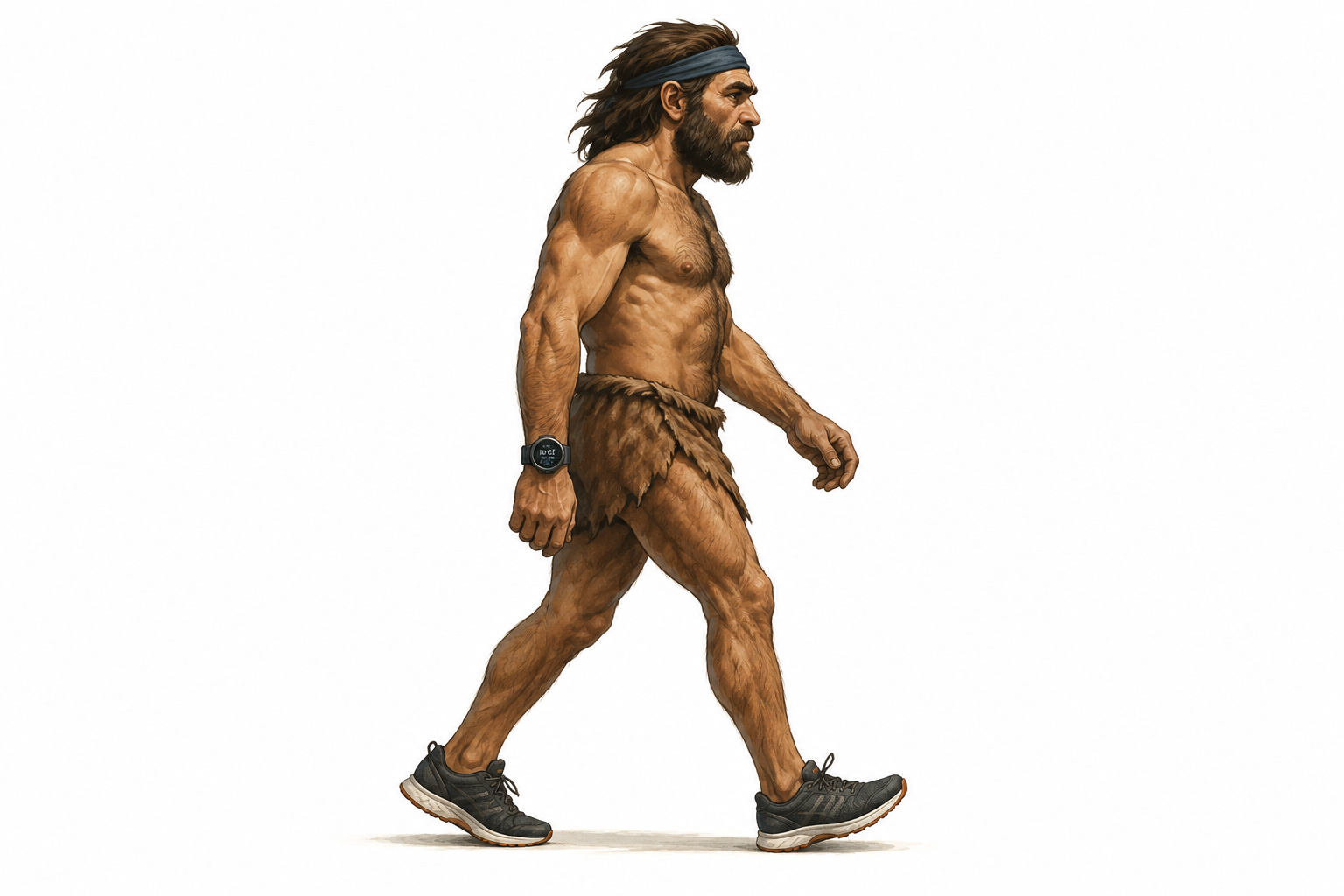
A few days ago, Max Lugavere posted that walking is “the most underrated form of cardio there is.”
I replied:
Walking is great, but at this point I’d argue that it’s massively overrated.
That one line kicked off a pretty lively discussion.
Some people thought I was saying walking is useless. I wasn’t, of course. But I also wasn’t being entirely insincere. So here’s the clearer version of what I actually meant, and why I think so.
Physical activity ≠ exercise
This is the distinction that keeps getting blurred, and it’s typically where people tend to talk past one another.
Physical activity is any bodily movement produced by skeletal muscle that results in energy expenditure (that’s the exercise physiologist’s definition). Walking qualifies. So does fidgeting, taking the stairs, or walking the dog while it drags you (which, for the record, is less exercise than purposeful walking).
Exercise is planned, structured, and repetitive physical activity done with the specific goal of improving or maintaining physical fitness. Intensity, duration, and progressive overload matter here. Most casual walking does not clear that bar for meaningful cardiorespiratory or metabolic adaptations in people who are already somewhat active!
Andrew Huberman later replied in the thread: “Necessary but not sufficient. 7000+ steps a day is not exercise, but given how little most people move, it’s a good staple on which to do all the other stuff.”
Walking (or daily movement in general) is a foundational piece of health for the average person. It is not, by itself, a high-quality training stimulus. By that I mean it’s insufficient to build or maintain adequate cardiovascular fitness across the lifespan (again, for the average person).
The opportunity cost of walking is real.
Here’s a practical point I made in the follow-up:
That’s not me being a running snob (okay, maybe a little). It’s dose-response physiology. Cardiac remodeling, stroke volume increases, mitochondrial biogenesis, and VO₂ max improvements respond more strongly to higher relative intensities. Zone 2 running, cycling, or even brisk incline walking that actually elevates heart rate and lactate will produce larger adaptations per unit of time than a conversational stroll will.
Of course, all walking is not created equal. A slow recovery walk is different from rucking, steep treadmill walking, or race-walking. When people defend “walking” by describing the latter, they’ve usually left the activity most people mean when they say they “went for a walk.” Professional race walker Evan Dunfee can walk 10 kilometers in 38 minutes—faster than most people can run it.
Steps are a terrible exercise metric
This whole discussion also highlighted something I’ve been saying for a while: steps are a terrible way to quantify exercise!
They can be a decent rough proxy for total daily movement and non-exercise activity thermogenesis (a.k.a NEAT). They are a poor proxy for training quality. A step number on your activity tracker does not tell me how those steps were obtained (a single 10,000-step walk is different than 10,000 steps accumulated while puttering around an office). This says nothing about the margin of error that most activity trackers have when they’re actually estimating your steps.
The most common pushback I got was some version of “But it’s way better than sitting on the couch!”
Yes. Obviously. I even posted the meme version of this:
That bar is so low it’s underground. Almost any movement clears it. The more interesting question is whether, for a given amount of available time and recovery capacity, walking is the highest-leverage use of that time for the outcomes most people say they care about. Because, after all, time is one of the biggest barriers people have for not exercising (or not exercising more).
Our fitness echo chamber also distorts this. People who run and lift regularly often forget how little the average person actually moves. So yes, the biggest return on investment is moving from 2,000 steps per day to 7,000 per day, but that doesn’t change the physiology (physiology doesn’t care about feelings).
Where walking actually earns its keep
I’m not anti-walking. I walk a lot myself—on recovery days, after hard sessions, while listening to podcasts, and just to get outside. It’s excellent for reducing sedentary time and the metabolic downsides that come with it, supporting recovery between higher-intensity sessions, lowering the barrier for people who currently do almost nothing, improving mental health, increasing outdoor time, and adding low-cost movement volume.
It is simply not the best primary tool if your goal is improving aerobic fitness, performance, or the higher-end adaptations that require more intensity… which is something most people would benefit from doing slightly more of.
Walking is great. It is also overrated as “exercise” and as cardio in the way many people use those words.
Do the walking. Get your daily movement in. Just don’t confuse background activity with the structured, progressive work that actually drives larger fitness adaptations. Both can (and should) exist in the same program.
With that said, here’s my general heuristic for thinking about steps (or walking more generally).
If you’re regularly active—doing 2–3 or more aerobic exercise training sessions per week and 2–3 or more resistance training sessions—~7,000 steps per day (as “background” activity) is the baseline.
If you’re somewhat active (doing purposeful exercise 2–3 days per week), 10–12,000 steps per day is the baseline.
If walking is the only form of cardiovascular exercise you do, 12–15,000+ steps per day is the baseline.
This isn’t just some opinion. There’s research showing that falling below 5–7,000 steps per day as background activity can actually blunt the benefits of aerobic training! And the dose-response studies on walking (in spite of their limitations) are pretty consistent in showing benefits up to 12,000 steps per day or more.
The formerly mentioned “inactivity” study (there are actually several) was incredibly influential in how I thought about walking in my overall daily movement spectrum. Not only does a low step count alter fuel use during exercise, but it also alters the transcriptomic/genetic response! You can do the same exercise after a low-step day and a high-step day, and the underlying physiology can be vastly different.

I don’t mean to be an exercist (a fun term coined by Dr. Daniel Lieberman in his book “Exercised”) or downplay the benefits of walking as a form of physical activity. It’s what humans evolved to do.
But that’s why we should think of it not as exercise per se, but as the base form of movement we get an adequate dose of every day. Then, we can layer our personal exercise goals on top of that—whether it be running a marathon, hitting a PR on the bench press, or preventing common age-related drops in aerobic fitness and muscle mass (they’re not inevitable!)
Running snobbery aside, I think it’s important to have an honest conversation about minimum effective doses and intensities of exercise. There’s public health relevance here—it’s not about downplaying one form of activity from a moral point of view.
Ambulatio sit norma (“let walking be the norm”).
~Brady~