What If the Plural of Anecdote Is Data?
Personal experience isn’t the strongest form of evidence. But sometimes, it's where science begins.
“The plural of anecdote is not data.”
You hear this constantly in science, medicine, nutrition, and increasingly, in the world of peptides and supplements.
Someone says that they tried a peptide and their shoulder stopped hurting. Or they started taking a supplement and their sleep improved.
The standard response from the “critics” is that none of this counts. Those are anecdotes, not data.
And I understand the argument. I’ve probably made it myself. But I’m no longer sure it’s entirely correct. What if the plural of anecdote actually is data? If that’s true, then what kind of data is it, and how much confidence should we place in it?
An anecdote is essentially a report of what happened to one person. I changed my fueling and my performance improved. I started taking this peptide and my long-lasting shoulder injury started healing.
These experiences can be completely genuine. The person may be reporting exactly what they felt and observed, but they aren’t running a randomized controlled trial against themselves. If you take a supplement for three weeks and feel better, you don’t get to simultaneously live through the counterfactual scenario in which you didn’t take it. You don’t know whether you would have improved anyway, whether something else changed, or whether your symptoms were simply fluctuating.
You also know that you took the supplement. That matters because if you expect something to help, that expectation can affect what you notice, how you interpret it, and sometimes even how you feel. I prefer the term expectancy effect here because it captures more than the usual idea that something is “just placebo.” We know that expectations can produce real changes in pain, mood, effort, and other subjective outcomes.
Anecdotes are also vulnerable to regression to the mean. We often try a new treatment when a problem is at its worst—when our knee hurts the most or our sleep is terrible or our training has stalled. The issue is that many of these things naturally improve with time. But because the improvement follows the intervention, we credit the intervention.
There’s also the issue of selection bias.
The people who experience a dramatic result are much more likely to talk about it than the people who noticed nothing (“I took this supplement for six weeks and absolutely nothing happened” isn’t a very compelling social media post).
So yes, anecdotes are noisy and shaped by our expectations, memory, natural variability, concurrent changes, and our deep human desire (flaw?) to connect cause with effect. That is precisely why controlled studies exist!
But what is a study made of?
Let’s consider the other side…
A randomized controlled trial might include 20, 50, or 500 people. At the end, the results are usually summarized as a group average. But averages can conceal what happened to the actual people in the study. One participant improved substantially. Another improved slightly. Someone else didn’t change. A few people may have gotten worse. The group result is just a mathematical summary of all those individual responses. In that sense, science is built from a collection of personal outcomes.
That doesn’t mean each participant in a trial is merely an anecdote in the usual sense. A measurement collected under a predefined protocol is different from a “story” remembered and reported after the fact. The researchers have tried to standardize the intervention, control for competing explanations, define the outcomes, and compare what happened with a counterfactual condition.
But the “raw material” is still individual experience. Studies aren’t conducted on an imaginary average human. They are conducted on people like you and me, and each person contributes an individual data point.
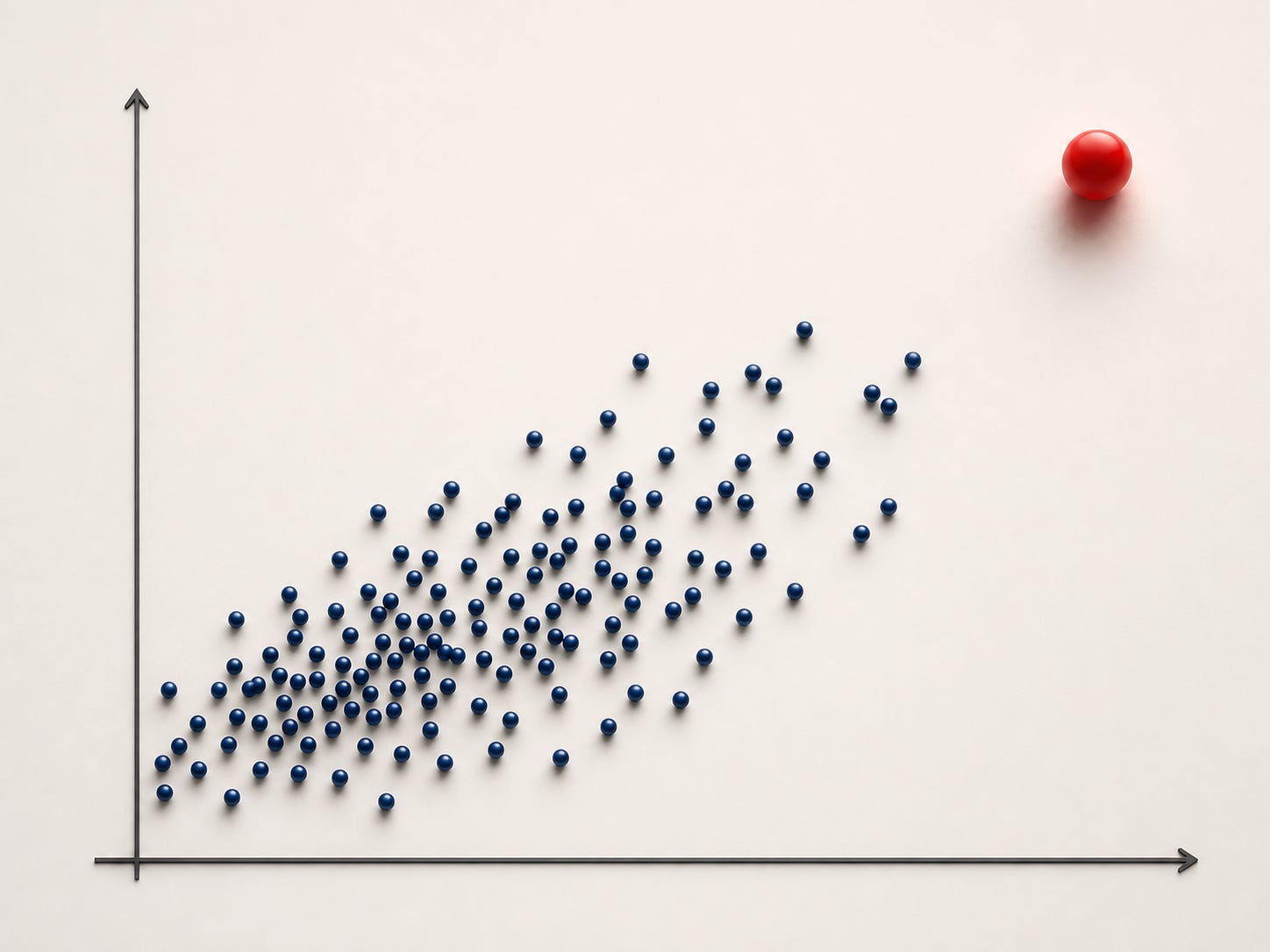
So perhaps the dividing line between anecdote and data isn’t as clean as we pretend. An anecdote is an observation. Data are observations that have been collected and organized in a way that allows us to compare them.
The plural of anecdote may therefore be data… it just isn’t necessarily good data.
I think this distinction becomes especially important when practice moves faster than research. That happens constantly in endurance sports. Perhaps the clearest current example is the movement toward very-high-carbohydrate fueling.
We have strong evidence that consuming carbohydrates during prolonged exercise improves performance. We also have a reasonably well-established scientific basis for consuming up to around 90 grams per hour. Once we move beyond 90 or 100 grams per hour, however, the evidence becomes much thinner. There are emerging studies showing that intakes around 120 grams per hour can increase the amount of ingested carbohydrate athletes burn, help preserve certain aspects of performance late in prolonged exercise, and potentially improve recovery. But we still don’t have a large, convincing body of randomized controlled trials showing that 120 grams per hour consistently produces better race performances or training outcomes than 90 grams per hour.
And yet, practice has already moved there. A growing number of elite athletes are consuming 100, 120, and sometimes even more grams of carbohydrate per hour. At the same time, athletes are running and riding faster than ever, breaking records, and reporting that these enormous carbohydrate intakes help them sustain higher outputs deeper into races.
One record-breaking performance fueled by 120 grams per hour proves almost nothing. That athlete also trained differently, raced under different conditions, wore different shoes, and probably changed dozens of other variables. But what about dozens of athletes? Or hundreds of races? What happens when coaches, nutritionists, and athletes repeatedly arrive at the same conclusion?
At some point, the accumulation of these anecdotes becomes difficult to ignore.
Yet still, these observations don’t establish that ultra-high carbohydrate intake caused the performances, nor do they tell us whether 120 grams is superior to 90. But they do create a strong real-world signal.
This is what it means for practice to be ahead of science. Athletes have made a collective bet based on physiology, experimentation, and accumulated experience. Science now has to catch up and determine whether the extra carbohydrate directly improves performance, who benefits, and under what circumstances.
Until then, the evidence is largely anecdata. Not randomized-controlled-trial-quality data. But data nonetheless.
Peptides may be one of the clearest modern examples outside of sports nutrition. We have an enormous number of people claiming benefits from compounds that haven’t been adequately studied for many of the purposes for which they are being used. Those reports should not be treated as proof of efficacy—and they certainly can’t establish safety. But they can still represent a signal. The mistake would be to conclude either that thousands of positive experiences prove something works or that, because those experiences aren’t randomized controlled trials, they tell us absolutely nothing.
There is also a more personal layer to this.
If I take something repeatedly and consistently experience the desired result, that matters to me. In some circumstances, it may matter more to me than the average result from some study.
A trial helps estimate the probability that something will work for someone like me. It cannot guarantee how I will respond. If a well-designed study finds that a supplement produces no meaningful benefit on average, but I repeatedly sleep better when I take it, I may reasonably decide to continue, assuming it is safe, affordable, and not preventing me from doing something more useful. My experience doesn’t invalidate the study, and the study doesn’t necessarily invalidate my experience.
Of course, I should still be skeptical of myself, but the more often I reproduce the result, the more informative my personal data become. That is still not the same as proving a biological mechanism or demonstrating that the intervention will work for anyone else. But for a personal decision, an informal n-of-1 experiment may be enough for most people.
The last point I’ll make is that not all evidence deserves equal weight. I think some people become so committed to the evidence hierarchy that they stop evaluating the evidence itself.
A randomized controlled trial is often called the gold standard. But after reading studies for more than a decade, I’m increasingly hesitant to treat those words as gospel.
There are good randomized controlled trials, there are bad randomized controlled trials, and there are truly terrible randomized controlled trials. A weak positive trial may not deserve more confidence than a large and remarkably consistent body of real-world experience merely because it has the letters “RCT” attached to it. Study design matters, but study quality matters more.
So how I think we should think about this is as a convergence of evidence. Is there a plausible biological mechanism? Do controlled studies show a meaningful and reasonably consistent signal? Are credible athletes, clinicians, coaches, or users reporting similar experiences? Does the effect appear when you try it—and can you reproduce it more than once?
Each of these layers has weaknesses. And personal experience can be almost comically easy to misinterpret. In the wise words of Richard Feynman: “The first principle is that you must not fool yourself, and you are the easiest person to fool.”
But when several independent layers point in the same direction, the case becomes stronger, and it gives us more reason to believe that the signal may in fact be real.
So I don’t think we should use anecdotes as proof. But we also shouldn’t use the phrase “the plural of anecdote is not data” as a way to dismiss personal experience.
Anecdotes are observations. They can generate hypotheses, identify unexpected effects, reveal individual variability, and point science toward questions worth testing.
When it comes down to it, sometimes they are all we have. And sometimes practice really is ahead of “the science.”
I think about this every time I write about a new study. I’m trying to point my readers toward something that might be worth testing, rather than a guaranteed result.
And for some people, that testing may lead to a powerful anecdote. One powerful data point.
Thanks for reading,
~Brady


