

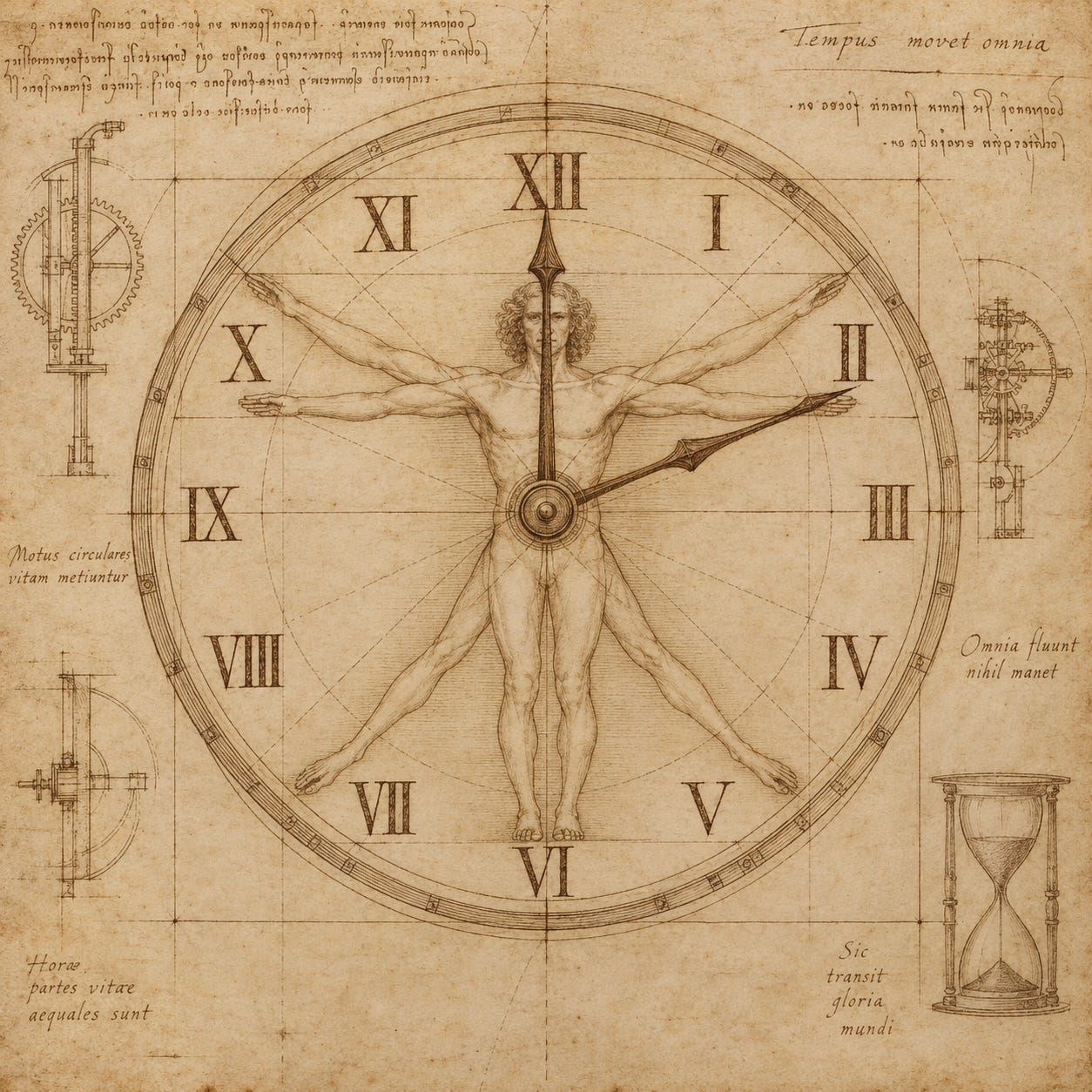
Timing is an aspect of health I’ve been thinking about for a while. And it’s probably the area of my life where I’ve “experimented” the most in regard to performance, sleep, and day-to-day productivity.
We spend a lot of time debating what to eat, how much to exercise, and how many hours to sleep. These are important questions. But the more I read and write about physiology, the more I find myself coming back to another one:
What about when?
I’m a morning exerciser who often feels stronger and more energetic in the afternoon. I’ve also written about the importance of darkness while staring at a bright computer screen at night (apparently, understanding the science doesn’t automatically make one great at following it).
I think those everyday contradictions are part of what makes this interesting. Our preferences, schedules, and biology don’t always agree. So how hard should we work at synchronizing them? And is it worth it?
As I’ve discussed in the art and science of exercise timing, our physiology is always “on the clock.”
Molecular clocks help coordinate daily changes in metabolism, alertness, hormone release, and physical performance. The body receiving a morning workout or evening meal isn’t operating in exactly the same state at every hour.
That idea connects several topics I’ve covered over the years: light, sleep, food, and movement. Here’s a little sample of that coverage.
Light
Light is easy to overlook because we don’t usually think of it as a health behavior. We track our workouts and count our protein, but rarely consider how much light we receive—or when we receive it. Part of this is probably because we have no way to truly measure or quantify our light exposure. And even if we could… it wouldn’t be that much fun.
Yet light is a major signal—the major signal—for our biological clocks. Bright daytime light helps reinforce our sleep–wake rhythm, while evening and nighttime light can delay melatonin release and shift that rhythm later. The same general input (light) sends a different biological message depending on when it arrives.
In my article on light exposure and health, I covered a study of 88,905 adults who wore wrist-mounted light sensors for seven days. Researchers then examined their mortality outcomes over approximately eight years. People in the highest nighttime-light exposure group had a 21–34% higher risk of all-cause mortality than those in the lower-exposure reference group. The pattern went the other way for daytime light: the highest daytime-exposure group had a 17–34% lower risk. So this wasn’t simply about getting more or less light. It was when the exposure happened.
The practical idea? Make daytime look more like daytime, and nighttime more like nighttime.
Sleep
Sleep conversations tend to revolve around the simplistic prescription of 7—9 hours of sleep per night. Sleep duration dominates the conversation.
But how consistently those hours occur also deserves attention!
In my article on inconsistent sleep patterns and heart health, I discussed research involving 1,992 adults, with an average age of 69. Researchers assessed sleep using wrist activity monitors, supplemented by an overnight sleep study, and followed participants for cardiovascular events over an average of about 5 years.
Greater night-to-night variability in both sleep duration and the time people fell asleep (known as sleep onset latency) was associated with higher cardiovascular risk. Each additional hour of variability in sleep duration—measured using the standard deviation across nights—was associated with a 36% higher risk of cardiovascular events. An additional hour of variability in sleep onset was associated with an 18% higher risk.
To be clear, that doesn’t mean going to bed an hour late tonight increases your heart-disease risk by 18%. But it suggests that simply asking “how much did you sleep?” is an incomplete question.
Do not treat this as a requirement to fall asleep at precisely the same minute every evening. Life happens. I do think a reasonably predictable bedtime and wake time belong in the conversation alongside sleep duration, though not as a substitute for insufficient sleep.
Food
Food timing is especially interesting because eating doesn’t happen in isolation.
Our glucose regulation changes throughout the day, and muscle contraction (e.g., exercise) increases glucose uptake through pathways that don’t depend entirely on insulin. A meal and a workout can interact in ways that wouldn’t be obvious from looking at calories or exercise minutes alone.
In a study I covered on exercise timing and blood glucose, 54 adults completed three conditions: no exercise, morning exercise, and evening exercise. The exercise was a 45-minute walk at a moderate intensity, performed at either 7 a.m. or 8 p.m. Dinner was standardized at 6 p.m., putting the evening walk two hours after the meal.
Among participants with obesity and impaired fasting glucose, both morning and evening exercise lowered overnight glucose compared with no exercise. Evening exercise also lowered post-dinner glucose in that group and in a normal-weight group of participants. But neither exercise schedule lowered fasting glucose the following morning.
The study illustrates why I’m interested in timing relative to an event, not just an hour on the clock. A walk after dinner is movement placed next to a meal, and it dramatically changes how that meal affects our body.
Of course, food-timing advice can become unnecessarily rigid when it doesn’t need to be.
In my article on evening carbohydrates and training adaptations, I covered a four-week trial in 42 physically active men. All followed evening training programs and diets matched for calories and macronutrients. One group of participants ate all their carbohydrates before training; the other groups included carbohydrates after training and before bed, using either lower- or higher-glycemic foods.
Across the groups, participants lost fat, gained lean mass, and improved their VO₂ max by about 9.6%. There were no statistically significant differences between the carbohydrate-timing groups. To me, this study was a counterweight to the idea that carbohydrates become inherently problematic after a particular hour, especially if you’re training intensely.
Timing deserves our attention, but so do adequate fuel, the demands of training, and the rest of one’s diet.
Exercise
This is probably the timing question I’ve spent the most time writing about (and thinking about in my own life).
When is the best time to exercise?
My first response is to ask: What are we trying to accomplish?
For acute performance, there’s good reason to take timing seriously. In my article on Olympic swimming, I discussed an analysis spanning the Athens, Beijing, London, and Rio Games. The estimated morning-to-evening performance difference was 0.37%, with better performances later in the day.
That sounds tiny. But it exceeded the difference between gold and silver in 40% of the finals studied. At that level, small differences aren’t small.
Does that mean everyone should move their workouts to the afternoon? Not necessarily.
Producing your best performance during one session isn’t the same as gaining the most fitness over months of training. A systematic review I covered on exercise timing and adaptations included 26 articles covering 713 participants and found little evidence that one training time consistently produced superior improvements across fitness, body composition, cardiovascular health, and metabolic outcomes. There was some evidence that matching training and testing times mattered for performance.
In other words, being stronger at 5 p.m. today doesn’t automatically mean that training at 5 p.m. will make you stronger than morning training over the next six months. Is it plausible, though? Sure.
Then there’s what happens after the workout.
In my article on strenuous evening exercise and sleep, I covered a study of 14,689 physically active adults, using more than four million nights of wearable data. The researchers considered both exercise timing and strain—a measure incorporating intensity and duration. Later exercise, particularly at higher strain, was associated with later sleep onset and shorter sleep. Crucially, timing was measured relative to each person’s habitual sleep onset.
Is evening exercise bad? No, that’s the wrong question. What also matters is how demanding the session is and how close it is to your usual bedtime.
No habit is an island
What interests me most is how these behaviors fit into an entire day. It’s what I like to call the “24-hour activity spectrum.”
An outdoor morning walk combines movement and light. An evening workout affects when dinner happens and how that dinner affects your blood glucose and sleep. A late night changes the following morning’s available time—and potentially whether your planned workout happens at all.
The studies discussed above don’t all point toward one perfect schedule. Some show meaningful timing differences. Others find that the fundamentals like consistency and progression matter much more. And several suggest that the answer even changes depending on the person, the outcome, and the surrounding behaviors.
So, no, timing isn’t literally everything. It doesn’t make up for an inadequate diet, replace insufficient sleep, or compensate for poor training prescription.
But it’s an aspect of health worth paying attention to so we can make the habits we already value work better together. That’s true optimization.
Thanks for reading,
Brady
So as someone who works night shifts, I'm basically cutting a lot of years off my life.