

Greetings!
Welcome to the Physiology Friday newsletter.
Details about the sponsors of this newsletter and deals on products I love, including Ketone-IQ, Create creatine, Equip Foods, and ProBio Nutrition can be found at the end of the post.
When we work out, we get fitter. And we have a pretty good idea of how this happens (at least I hope so… otherwise those 8+ years I spent studying exercise science were for naught).
Endurance training causes well-characterized increases in the number and quality of our mitochondria (the body’s energy factories), builds a denser network of blood vessels and capillaries, makes us better at burning fat and carbs as fuel, and even changes the physical structure of the heart, which grows in size and strength to not only accommodate a greater volume of blood, but deliver that blood more effectively and forcefully to the rest of the body.
Strength training has some overlapping but distinct effects on physiology, mainly increasing the size and number of muscle fibers (referred to as hypertrophy and hyperplasia, respectively) as well as their strength and force output capacity; the latter a result of improvements in our neuromuscular system’s ability to coordinate and recruit contracting muscle fibers.
These improvements are largely attributed to peripheral signals from the body, that is, metabolic and mechanical changes occurring in our legs, arms, and elsewhere. In other words, exercise science has generally taken a “bottom-up” approach to training adaptation.
Myokines (chemical messengers originating from contracting muscle) and metabolites (byproducts of glucose/fat breakdown, such as lactate) released during exercise activate a range of signaling cascades that allow the body to adapt to the training stimulus (to prepare for that marathon you’ve got coming up in 12 weeks).
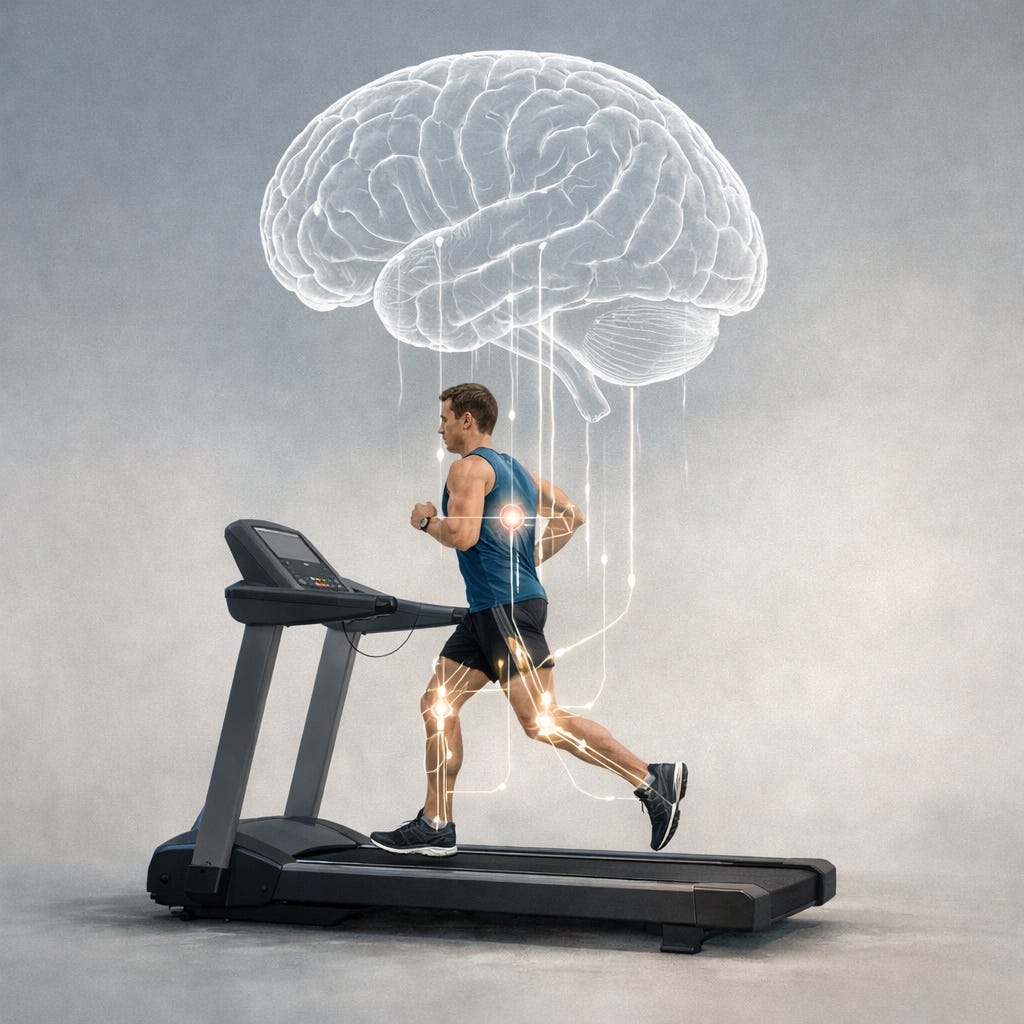
With all the focus on the body, we sometimes (ironically) forget about the brain, relegating it to the realm of psychologists and neuroscientists, not fitness experts. Of course, we know that exercise has brain health benefits in the short- and long-term. It’s probably one of the best things you can do to support healthy brain aging.
But what if the brain was actually responsible for the fitness we gain with exercise, perhaps getting stronger itself to facilitate endurance?
More intriguingly, could certain brain circuits be required for endurance adaptations?
According to a new study (it’s in the running for my favorite science finding of the year), the answer to both of those questions is yes. And even though the study was in mice, it might just change the way you think about your next workout.1
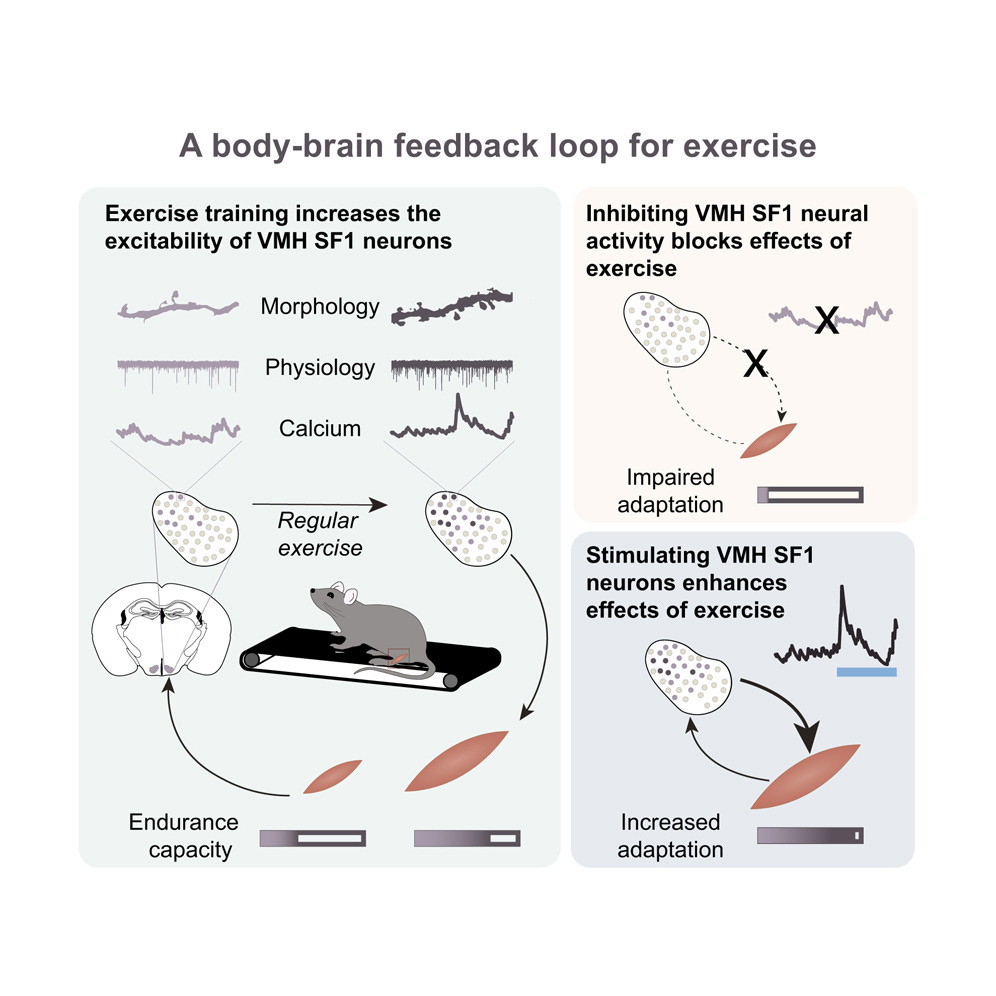
Researchers zeroed in on neurons in a region of the brain known as the ventromedial hypothalamus (VMH). Specifically, neurons in this region express a transcription factor known as steroidogenic factor-1 or SF1, and are considered to be a classic integrator hub for metabolic signals like glucose, insulin, and a hunger/satiety hormone called leptin in order to regulate energy expenditure.
In this paper, they referred to the VMH SF1 neurons as the candidate “exercise history encoder.”
They then built a tight and logically beautiful chain of evidence that goes like this:
Exercise activates these neurons in mice.
Training reshapes their post-run dynamics, and
The post-run activity of these neurons is required to get normal endurance adaptations.
Let’s take a closer look.
First, they asked, “Do these neurons even respond to exercise?”
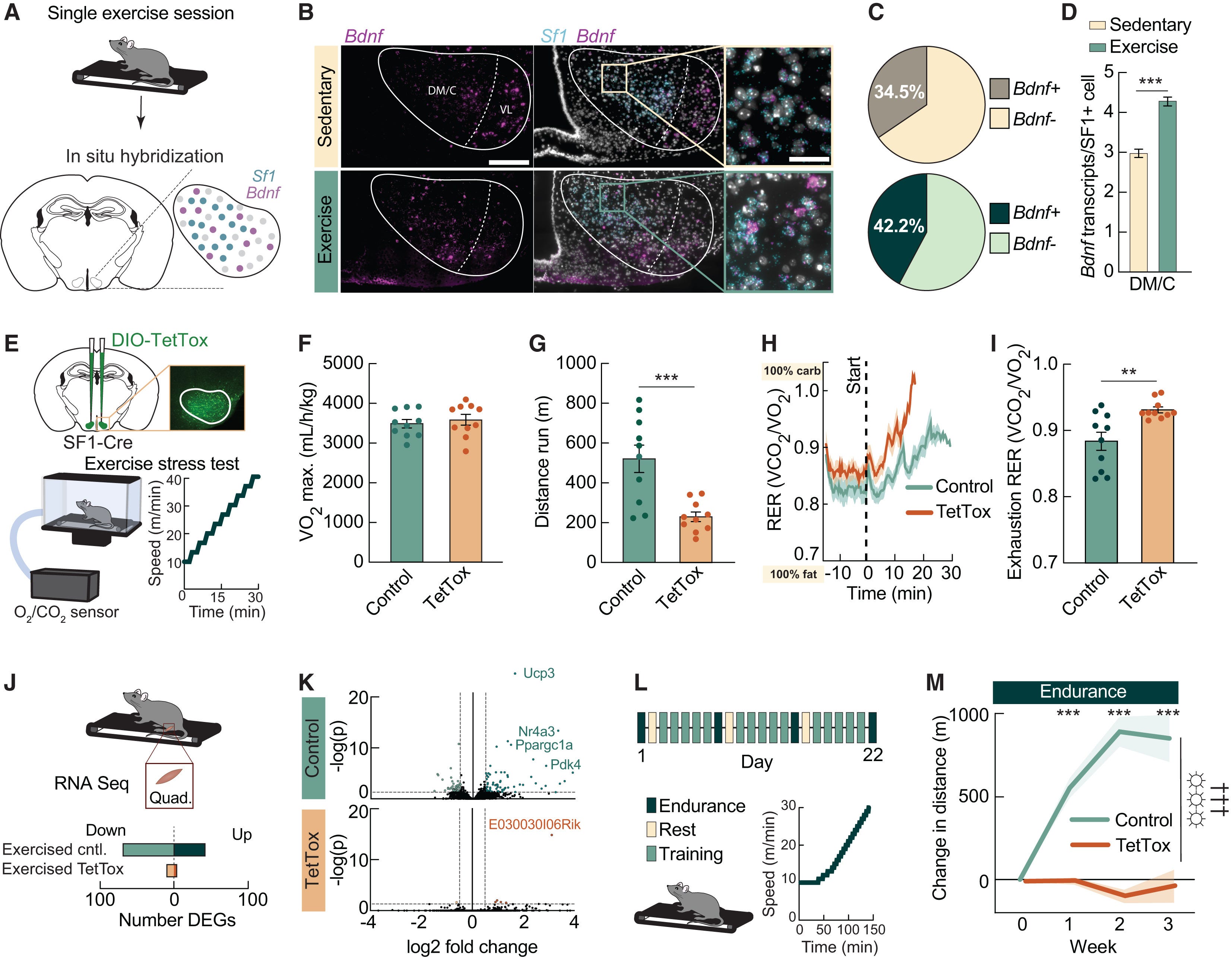
After a single bout of treadmill exercise, SF1 neurons showed higher expression of BDNF (brain-derived neurotrophic factor), a gene that tends to rise when neurons are activated. In one VMH subregion, the proportion of SF1 neurons expressing BDNF increased from 34.5% to 42.2% with exercise.
Next was “Are these neurons necessary for endurance and training adaptation?”
They used a genetic trick to block neurotransmitter release from SF1 neurons—essentially cutting their output lines—then ran mice through a treadmill “stress test” (basically a VO2 max test for mice) while measuring oxygen and CO₂ so they could infer fuel use. Importantly, VO₂max looked similar during the test, but endurance performance did not. The mice quit sooner and ran slower when SF1 neurons were blocked. Even more interesting, they shifted toward carbohydrate use earlier and at lower intensities, suggesting their fuel-selection strategy under stress was altered.
They also looked at muscle gene expression after training plus a run to exhaustion. In normal mice, exercise triggered lots of the expected transcriptional changes in muscle; in the SF1-silenced mice, those exercise-induced gene expression changes were “nearly abolished.” That’s a big deal, because those molecular shifts are part of how muscle becomes more oxidative and fatigue-resistant over time (i.e., how we build endurance).
Next question: “Does training change how these neurons fire?”
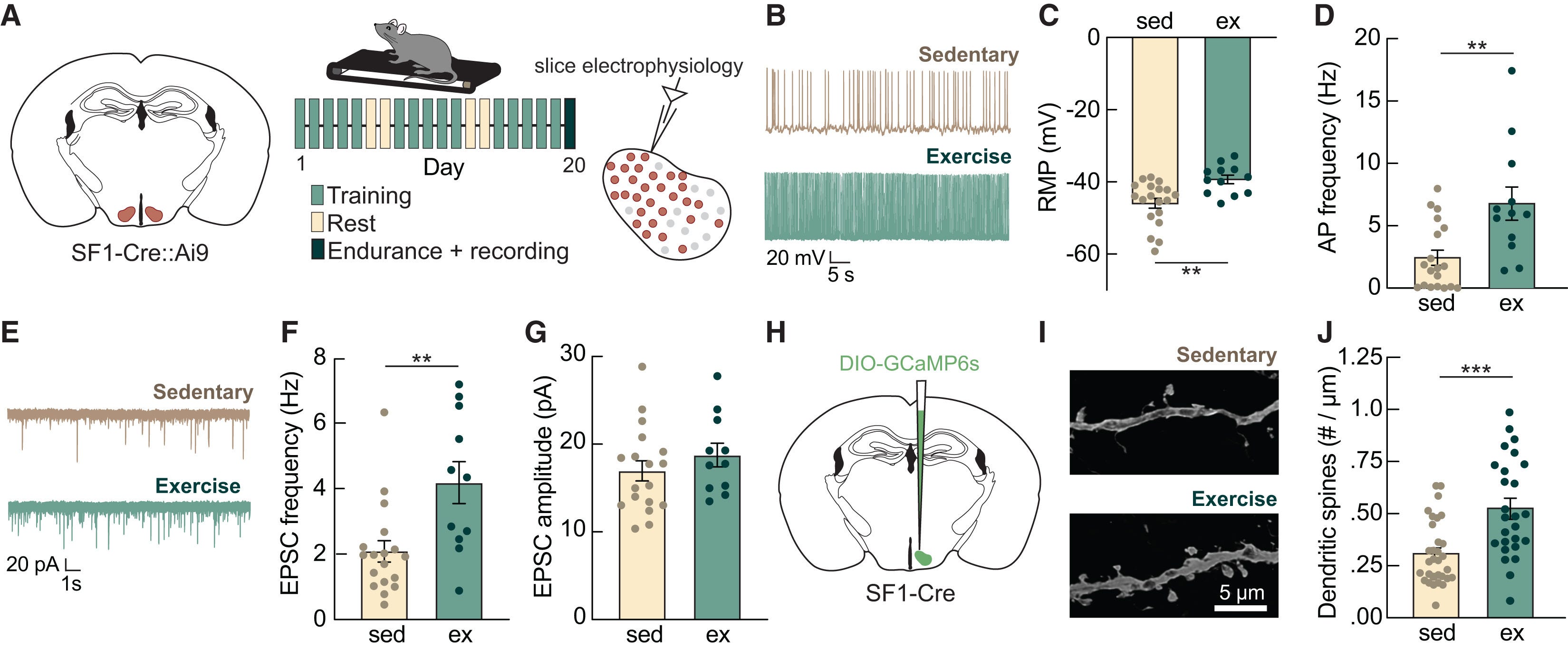
To answer this, they recorded SF1 neuron activity in living mice and found two main patterns: some SF1 neurons were suppressed right when the run ended (“post-run inhibited”), and others lit up when the run ended (“post-run activated”). After one week of treadmill training, the balance shifted strongly toward that post-run activation pattern. Roughly 31.8% of neurons were “post-run activated” on day 1 versus 53.2% on day 8 (with fewer neurons falling into the “inhibited” or “no change” buckets). Training made the brain respond more to the end of exercise, not less.
The final question is perhaps the most important one: “Is post-run activity of these neurons actually causing endurance gains?”
This is the part that makes the paper so fun. They used a technique called optogenetics to manipulate SF1 neurons after each training session—turning them off (inhibiting them) or turning them on (stimulating them).
When they inhibited SF1 neurons for 15 minutes after every workout, the normal gains in endurance were blunted. They also prevented the typical post-exercise rise in blood glucose (without changing body weight), hinting that part of the signal of endurance adaptation might be about restoring fuel availability for recovery.
When they stimulated SF1 neurons for 60 minutes after workouts, endurance improved beyond the usual plateau, and even stimulation alone (without training) nudged the mice’s metabolism toward higher carbohydrate use and higher overall energy expenditure/oxygen consumption. It had an “exercise mimicking” effect.
There was also evidence of training-related plasticity in this brain circuit. SF1 neurons became more excitable and appeared to receive stronger excitatory input after endurance training, which fits the idea that the brain is literally encoding exercise history.
This was one of those studies I simply couldn’t wait to read and write about. It doesn’t have a clean, actionable takeaway like some of the other physiology studies I share (I’ll try to give you some), but it’s freaking fascinating (to me, and hopefully to you).
It argues for a meaningful top-down component to exercise adaptation by telling us that, at least in mice, the brain is largely responsible for the downstream recovery and remodeling programs after exercise, especially in the window right after you stop. In fact, this paper strengthens the idea of a “narrow” post-exercise recovery window during which a training session is encoded, and future adaptations are hardwired into our body.
Does this mean we should start prioritizing “neurological recovery” techniques after our workouts as we do with nutrition and muscle-focused approaches? Perhaps. It tells me that maybe we shouldn’t finish a workout and then hop immediately into high-stress work or stimulating social media. Our brain and nervous system need time to do their job.
The obvious caveat here is translation. These are mice, on treadmills, with genetically/optogenetically manipulated neurons. That’s not the same as saying we’ve found the “endurance switch” in humans.
Ok, now bear with me while I get science-fictiony. Because what immediately came to mind after reading this study was two scenarios where these findings might apply: an “exercise pill” and neurodoping.
In the world this study hints at, the most powerful performance enhancer wouldn’t be something you take before a race; it would be something that quietly tweaks the 15–60 minutes after the workout, when the body is deciding what to rebuild, what to store, and what to upregulate for next time. You don’t need to run harder. You just need to convince the system that you did, and that it should adapt accordingly.
This is where the idea of “neurodoping” gets enticing (and a little creepy).
If endurance adaptation is partly gated by a brain circuit that can be turned up or down, it opens the possibility that neuromodulation could make training “count” more. Think recovery-enhancing brain stimulation, wearable brain tech, or a pill that amplifies the brain’s post-exercise learning signal. It’s also where the concept of “exercise in a pill” becomes increasingly possible.
In the past, most “exercise-mimicking drugs” (or the idea of them) have targeted a single pathway. But if we could design something to target the brain’s key endurance-enhancing command center, it might be able to integrate all relevant training signals to recapitulate the benefits of a workout without a drop of sweat lost. It could be a game-changer for people with diseases, older individuals with limitations to exercise, injuries, or those days when you just can’t find the time for the treadmill.
I’ll be a bit more convinced of these scenarios if the findings of this study can be replicated in humans. Until then, let’s just embrace the idea that there is potentially still a LOT to learn about how the body rewires itself to perform better.
And the next time you set a new personal best in a 5k or a marathon, thank your brain as much as you do your body for getting you to the finish line.
Thanks for reading. See you next Friday.
~Brady~
Ketone-IQ is high-performance energy in a bottle. I use it for post-exercise recovery along with enhancing focus, mood, and cognition. Take 30% off your order.

Create is the first “modern creatine” brand. They sell a wide range of creatine monohydrate gummies—and yeah, their gummies actually contain creatine, unlike some other brands. They’re giving my audience 20% off their order.

ProBio Nutrition—the all-in-one supplement that I use every single day—is offering 20% off. My preference is the tangy orange flavor, but they also sell an unflavored “smoothie booster” that’s great in a shake, smoothie, or juice.

Equip Foods makes some of the cleanest, best-tasting protein products around. I am absolutely obsessed with their Prime grass-fed protein bars (the peanut butter ones are to die for). Take 35% off a subscription.

What a discovery!! and gives a different perspective from what we already know! in this case coming directly from the brain! So, just to put it in different terms...would you agree we now need to say we need to train the brain instead of our legs? Endurance lies in the brain and not the body?
What jumped out to me was this comment "they shifted toward carbohydrate use earlier and at lower intensities, suggesting their fuel-selection strategy under stress was altered." This infers that the brain itself is active in regulating fuel selection strategy. This is not a 100% natural response to training and intensity. What happens if you trick your brain into thinking you are making a harder or easier effort than what the clock suggests. Ways to do this is to alter the feedback of time and distance. Thoughts?