


Greetings!
Welcome to the Physiology Friday newsletter.
Details about the sponsors of this newsletter and deals on products I love, including Ketone-IQ, Create creatine, Equip Foods, and ProBio Nutrition can be found at the end of the post.
I became interested in ketones (the exogenous type that you take as a “shot,” rather than the endogenous ones your body produces when you fast or eat a ketogenic diet) several years ago.
They were an up-and-coming supplement in the endurance sports world. Around that time, I also started writing some blog articles for H.V.M.N. (now Ketone IQ, one of the prominent companies in the exogenous ketones space) on the science of ketones, exercise performance, and other topics like fasting and cognition.
(Full disclosure: I sit on the Science Advisory Board of Ketone IQ, because it’s a company I believe in and a group of people I trust and admire.)
Back then, the hype around exogenous ketones centered on their potential as a performance-enhancing supplement, mainly as an alternative energy source (to carbs) during endurance exercise. A few studies at the time showed some modest benefits for time to exhaustion when participants took ketones before or during a prolonged endurance session, and there were even reports that Tour de France cycling teams were ordering ketones by the carton.
The performance fuel side is still one of the major selling points of ketone supplements, and there are definitely some interesting benefits shown in recent studies, like enhanced cognitive performance during ultramarathon running, for example.
But to be honest, I’m less enthused about the ergogenic effects of ketones.
Instead, my enthusiasm lately has been around ketones as a post-exercise recovery tool—a way to help the body adapt better to exercise training over time. The evidence here is incredibly robust (and growing). In fact, I published a review article over 7 years ago, when the first study came out showing that taking ketones during a chronic heavy endurance training block prevented symptoms of overtraining in cyclists.
That single study changed how I thought about (and used) ketones. When taken post-workout or during heavy periods of training, they may act like an “adaptation signal” for the body. Quicker recovery, and potentially fewer symptoms of “I feel like crap.”
But it turns out they may be doing even more than that. According to a recent study, ketones don’t just enhance recovery… they may actually enhance training adaptations, allowing already fit athletes to gain more aerobic fitness, performance, and mitochondrial gains when layered on top of training.1
The research positions post-exercise ketones as “a promising nutritional strategy to amplify mitochondrial remodeling and endurance performance.”
If you want to try ketones for yourself and experience what all the hype is about, I’d encourage you to try out my preferred ketone supplement, Ketone IQ. Visit ketone.com/BRADY for 30% OFF your subscription order plus receive a free gift with your second shipment—fun surprises like a free 6-pack, Ketone-IQ merch, and more (raspberry lemonade, caffeinated and non-caffeinated, is my favorite).

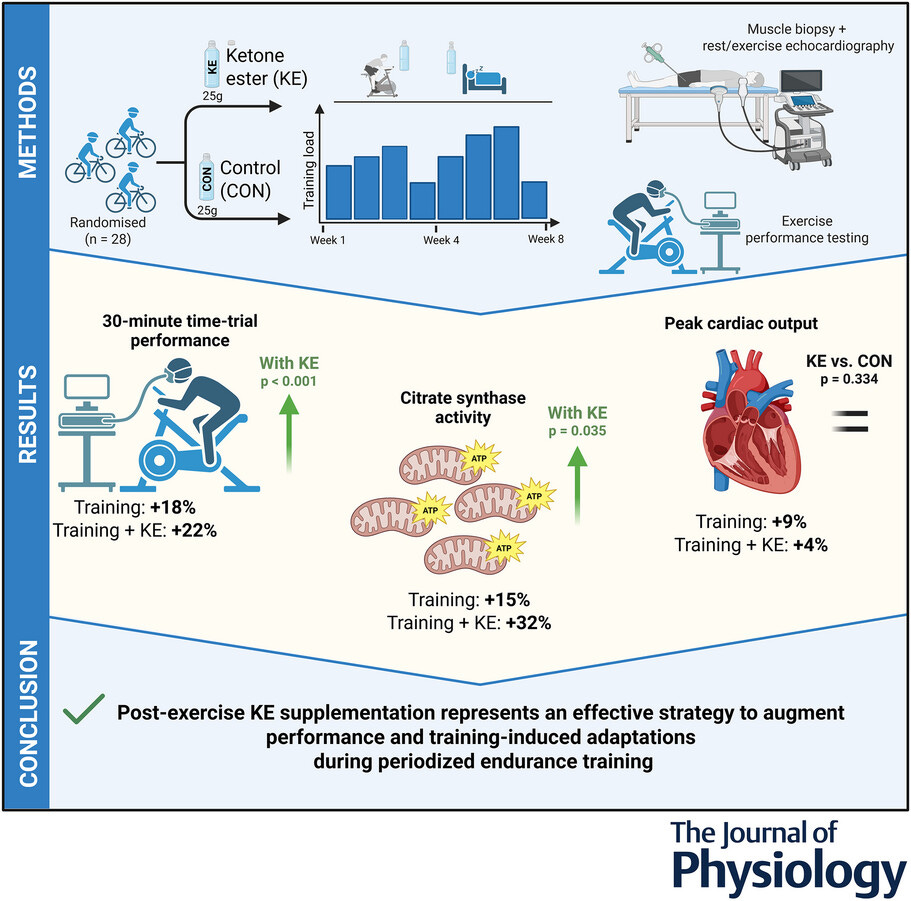
Twenty-eight trained male cyclists (average VO₂peak of ~50–55 ml/kg/min, so pretty fit) completed an 8-week endurance training intervention that comprised two 4-week blocks: 3 weeks of a progressive increase in training load followed by a 1-week “taper” (training load reduced by 40–50%), followed by another 3-week progression and then a final taper week. The participants trained 5 days per week, with 1–2 of those days including 2 training sessions, and they completed a variety of endurance and high-intensity workouts ranging from steady-state (“zone 2”) sessions to all-out 30-second sprints.
Here’s where the groups differed. After every training session and 30 minutes before sleep on training days, one group of participants consumed 25 grams of an exogenous ketone ester (i.e., 50 grams per day on training days). The other group (the control group) consumed a taste-matched placebo.
At baseline (before training), after week 3 of training, after week 7 of training, and at the end of the final taper week (week 8), the participants performed a 30-minute time trial test and a VO₂max test to assess average 30-minute power output, maximal oxygen consumption, and peak power output. Researchers also measured heart function and cardiac output, took muscle biopsies to assess markers of mitochondrial function, and even assessed the athletes’ subjective rest and recovery. It was one of the most comprehensive “performance workups” you could ask for from a study like this.
A few important notes before getting into the main results.
First, training load and diet were the same between the ketone and control groups throughout the study. That’s important because it means we can attribute any differences to the supplement, not to some nuance like the athletes in the ketone group training harder or fueling better (one potential flaw in the “overtraining study” I mentioned earlier was that the ketone group ended up eating more throughout the training intervention). Second, athletes who took the ketone supplement saw a rise in their blood ketone levels after exercise, with blood BHB reaching 2.6 mM. That’s relevant because it gives us a target range when we start to think about the potential applications of this study for our own training and recovery.
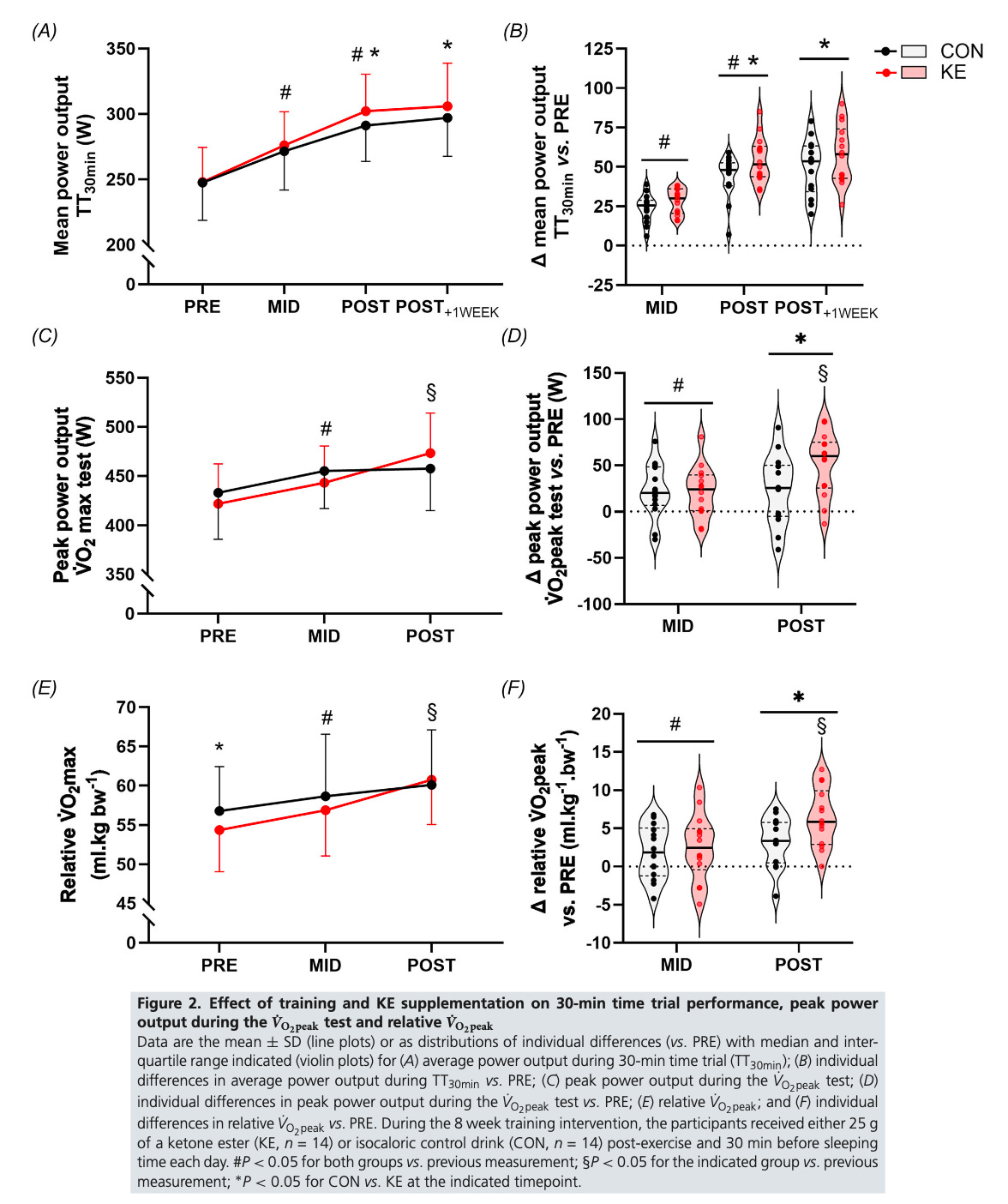
As a result of training, both groups improved their average power output during the 30-minute time trial by about 10% after 3 weeks (from 250 watts to 275 watts). But by week 7, the ketone group increased their average power output by 4% compared to the control group (for a final difference of 11 Watts; 302 watts versus 291 watts), a difference that persisted even after the final taper week (week 8 of the study).
Both groups also improved their peak power output by about 5% after 3 weeks of training. But while the control group didn’t further increase peak power output from week 3 to week 7 (they plateaued), the ketone group did, increasing it by an extra 7% from week 3 to week 7. Overall, the ketone group increased their peak power output by 52 watts during the 8-week study, compared to a 25-watt improvement in the control group.
The participants who took ketones also saw a greater improvement in VO₂peak, which increased by 6.4 ml/kg/min from pre- to post-training, compared to a 3.3 ml/kg/min increase in the control group.
So we have greater increases in cycling performance (time-trial power output), peak power output, and peak oxygen consumption in athletes who supplemented with ketones during training—an incredible result in its own right. But that might not even be the most interesting part of this study.
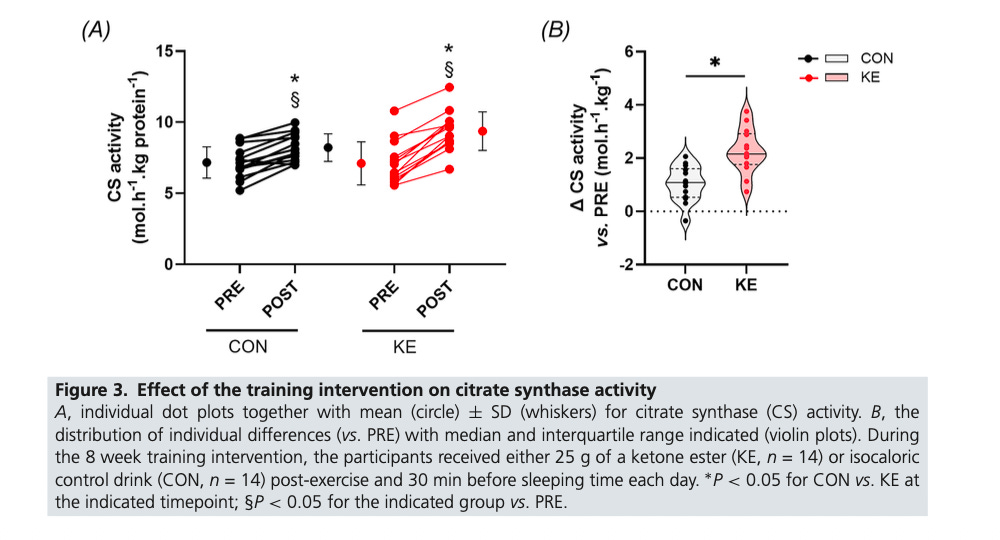
When the researchers looked at markers of muscle mitochondrial content, they observed that the ketone group had more than twice the increase in the activity of citrate synthase, an enzyme considered a marker of mitochondrial content (which rose by 15% in the control group and 32% in the ketone group). They had higher citrate synthase activity overall compared to the control group at the end of the study as well. There was also a 25% increase in the protein content of complex II of the electron transport chain (the energy-producing pathway in mitochondria) in the ketone group, but no change in the control group.
What about the heart? Improvements here didn’t show any between-group differences — athletes in both groups increased peak cardiac output and stroke volume, classic endurance training adaptations. But adding ketones to training didn’t appear to alter structural or functional cardiac adaptations over and above a placebo.
Lastly—and this was something I found surprising—ketones didn’t appear to provide any benefit for subjective stress and recovery scores. All athletes experienced a similar decline in their stress-recovery state throughout the training period (it got worse). I only say this was “surprising” on account of the older overtraining data. I expected the ketone group to at least feel slightly less “stressed” and a bit more recovered.
If you weren’t on the post-exercise ketones bandwagon already, you should be now.
That’s because this wasn’t a study in an untrained group, and it didn’t involve a brutal training intervention designed to drive athletes into the ground.
No—this was a reasonable endurance training intervention conducted in already well-trained cyclists. That’s key for a few reasons, the first of which is that trained athletes have typically squeezed out nearly every last bit of adaptation they can get through training, diet, sleep, or supplementation. Usually, adding a supplement or recovery protocol leads to marginal gains, if any, especially when athletes are already training intensely.
But in this study, adding ketones to an already optimized training plan allowed these athletes to eke out several percentage-point improvements on top of training alone. Usually, those types of gains are reserved for unfit, sedentary people, not fit athletes undergoing routine endurance training.
What’s really exciting about this study is the mechanism: ketones appear to be helping build more mitochondria during training, suggesting they’re driving muscular adaptations rather than central (cardiac) ones. This might seem surprising, but it’s well known that in addition to their role as “energy molecules,” ketones are also signaling molecules that induce a wide array of genetic and epigenetic changes throughout the body with relevance to health, longevity, and now, performance.
So what are the practical applications here? For the recreational amateur athlete like you and me (unless you’re one of the pros who reads my newsletter), I think they’re huge.
While increasing training volume is the clearest and most logical way to gain fitness, not everyone can just “train more.” So if you have a hard cap on your training volume, targeted ketone supplementation around training (post-exercise and pre-sleep) could be the ultimate biological lever—a way to artificially amplify your cellular “return on investment” from the time you spend training.
Ketones appear to be one (but not the only) way to maximize the process of recovery and adaptation to exercise. It’s similar to the benefits I see with post-exercise sauna or hot-water immersion. Not replacements for training, but effective adjuncts, a tool you can leverage alongside training.
That’s what makes them, in my mind, unique and exciting. Some of this research is honestly showing that post-exercise ketones might be the closest thing to a “biohack” we have in the world of endurance sports. Especially when you add this study to the literature that already exists on EPO production and hormonal signaling, which ketones also appear to influence.
Of course, you still have to do the work of sweating through the intervals. But when you’re done, ketones may be there to amplify the effort.
It’s still a growing area of research, and we’ve got a lot to learn and trials to run, including studies in less-fit and more-fit individuals, as well as women.
But I’m bullish on ketones. And if you’re serious about getting more out of your training, they might be something interesting to experiment with.
Thanks for reading. See you next Friday.
~Brady~
Thanks for the figure captions. I could finally understand the figures.
The subjects here are taking 50 mg of ketones every training day? Is that like 5 ketone-iq shots?
Well that was interesting! I'm not sure a $5 a day habit would be worth it. Hmmm, have to think about it. Thanks!