

Greetings!
Welcome to the Physiology Friday newsletter.
Details about the sponsors of this newsletter and deals on products I love, including Ketone-IQ, Create creatine, Equip Foods, and ProBio Nutrition can be found at the end of the post.
If you want to perform well in any endurance sport (whether you run, ride, swim, row, ski, hike, race triathlons… or simply train for health and longevity), you need a big aerobic engine, the ability to hold a high fraction of that engine, and the efficiency to turn oxygen into forward motion.
These are more commonly referred to as VO2 max, fractional utilization, and movement economy. And for a long time, they’ve made up the “holy trinity” of endurance sports.
But this classic endurance model isn’t perfect.
Two athletes can have similar lab values and look nearly identical early in a workout or race. Then, somewhere after an hour or so of hard effort, repeated surges, heat, hills, fueling mistakes, muscle damage, or plain old accumulated fatigue start to separate them. One athlete keeps rolling. The other starts fading (in physiology, morale, or both).
That difference is what sports scientists are increasingly trying to describe with a new set of terms: durability, fatigability, repeatability, and resilience.
They sound similar, but they’re not, and this week’s study by Benedikt Meixner, Michael Joyner, and Billy Sperlich does a great job at defining them and laying out what they mean for endurance sports (I’ll try to do the same as it applies to everyday athletes, too).1
It’s not a traditional experiment. It’s a viewpoint article, which means the authors are not testing a new training intervention or reporting a new dataset. Instead, they are trying to clean up the language around these emerging concepts. And honestly, it matters a lot. Because a lot of people are using words like durability, fatigue resistance, resilience, and repeatability almost interchangeably. Coaches use them. Researchers use them. Athletes use them. I’ve probably done it too. But these terms do not all mean the same thing. And if we want to measure them, train them, and actually apply them to performance, we need to be more precise.
That is the central idea of this paper. The classic endurance model is still foundational, but it may be incomplete unless we also account for how athletes respond when exercise gets long and unpredictable.
Durability
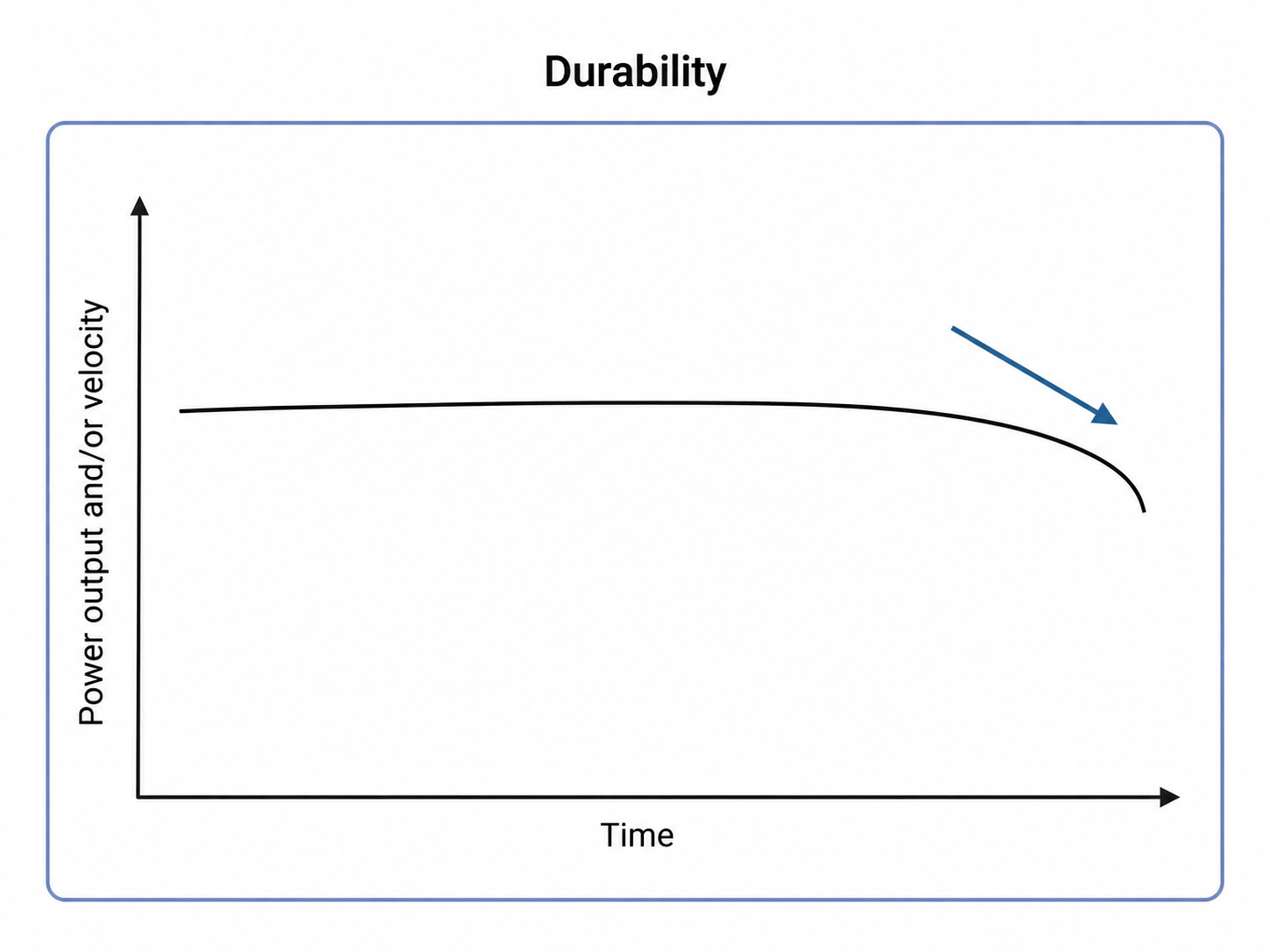
Durability is probably one of the most important concepts for anyone doing endurance exercise.
The authors define durability as the deterioration in physiological characteristics over time during prolonged exercise. That sounds a little academic, but the practical meaning is simple: durability is how well your physiology holds together as the work accumulates.
A durable athlete does not just have a good lactate threshold in the lab. They still have a strong threshold after 90 or 120 minutes of exercise, their heart rate does not drift wildly upward at the same pace or power, their mechanics do not collapse, and their fuel use does not become inefficient.
Durability captures the idea that your fitness on paper is not always the same as your fitness after you have already done a lot of work (it’s why I often recommend people give some extra thought to their “predicted marathon pace”).
The authors point to several mechanisms that may contribute to durability, including cardiovascular drift, neuromuscular fatigue, metabolic shifts, carbohydrate depletion, and changes in economy or critical power. They also note that durability can be assessed by looking at physiological drift during prolonged exercise or by testing performance markers before and after a long endurance effort.
I think durability is one of the missing links between being fit and being able to execute the event or workout you trained for.
Fatigability
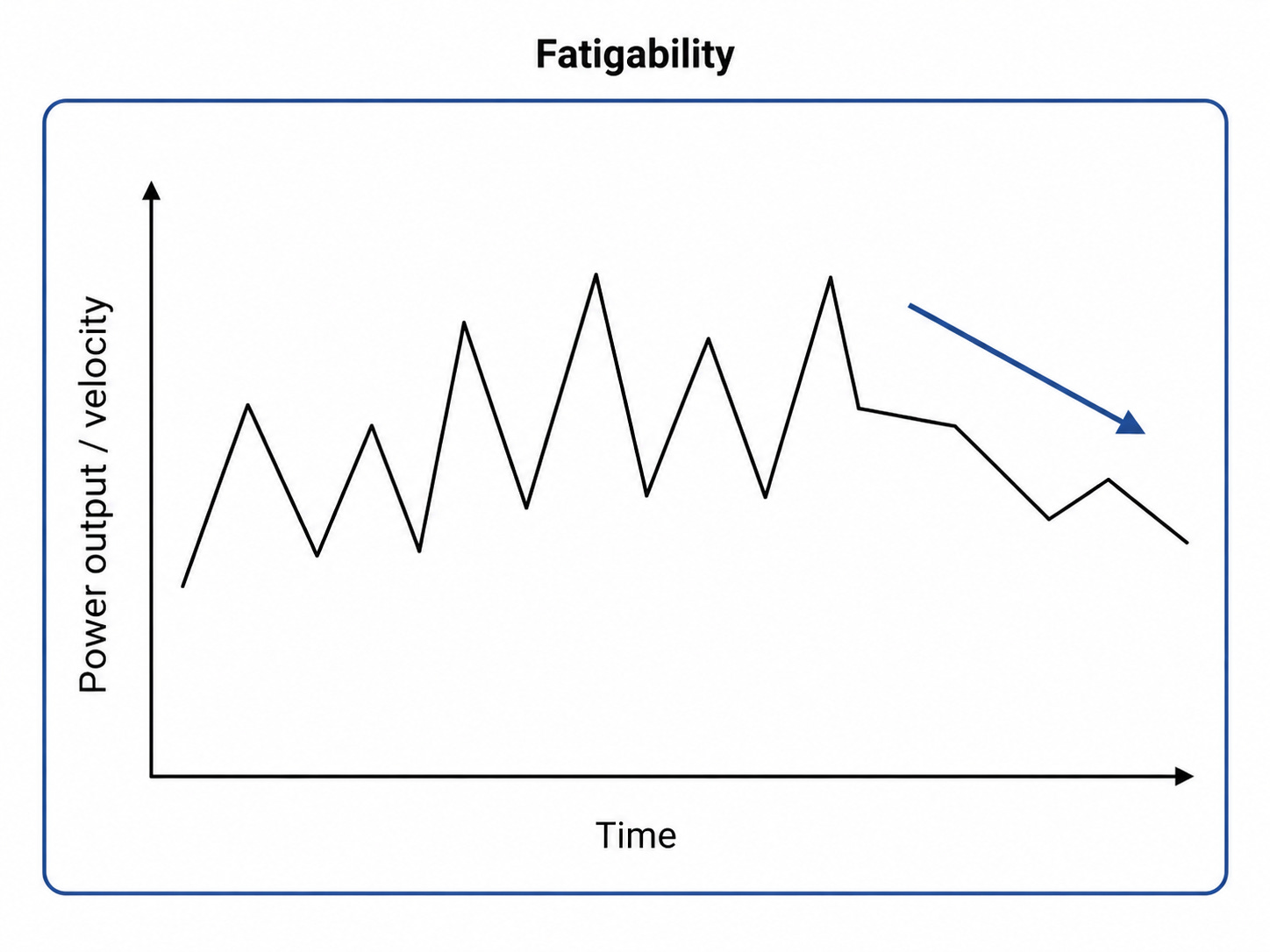
Fatigability is related to durability, but it is not the same.
Fatigability refers to the rate and magnitude of performance loss that develops during a continuous or repeated task when fatigue accumulates and recovery is limited or absent. It is about how quickly you decline under load.
This concept is especially obvious in cycling, where athletes may need to respond to surges, climbs, attacks, and stochastic power demands. But it applies across endurance sports too, and even Hyrox competition is probably a fantastic example where “fatigability” emerges as an important attribute.
An athlete with high fatigability might look great early but lose output rapidly as the session or race continues. Their power, pace, mechanics, coordination, or perceived effort starts to deteriorate quickly. An athlete with low fatigability can absorb the work and keep producing.
The key difference from durability is that fatigability often involves variable or repeated intensity while recovery is limited. Durability is more about preserving physiological function over prolonged steady or semi-steady exercise. Fatigability is more about how quickly someone cracks as the workload accumulates.
Repeatability
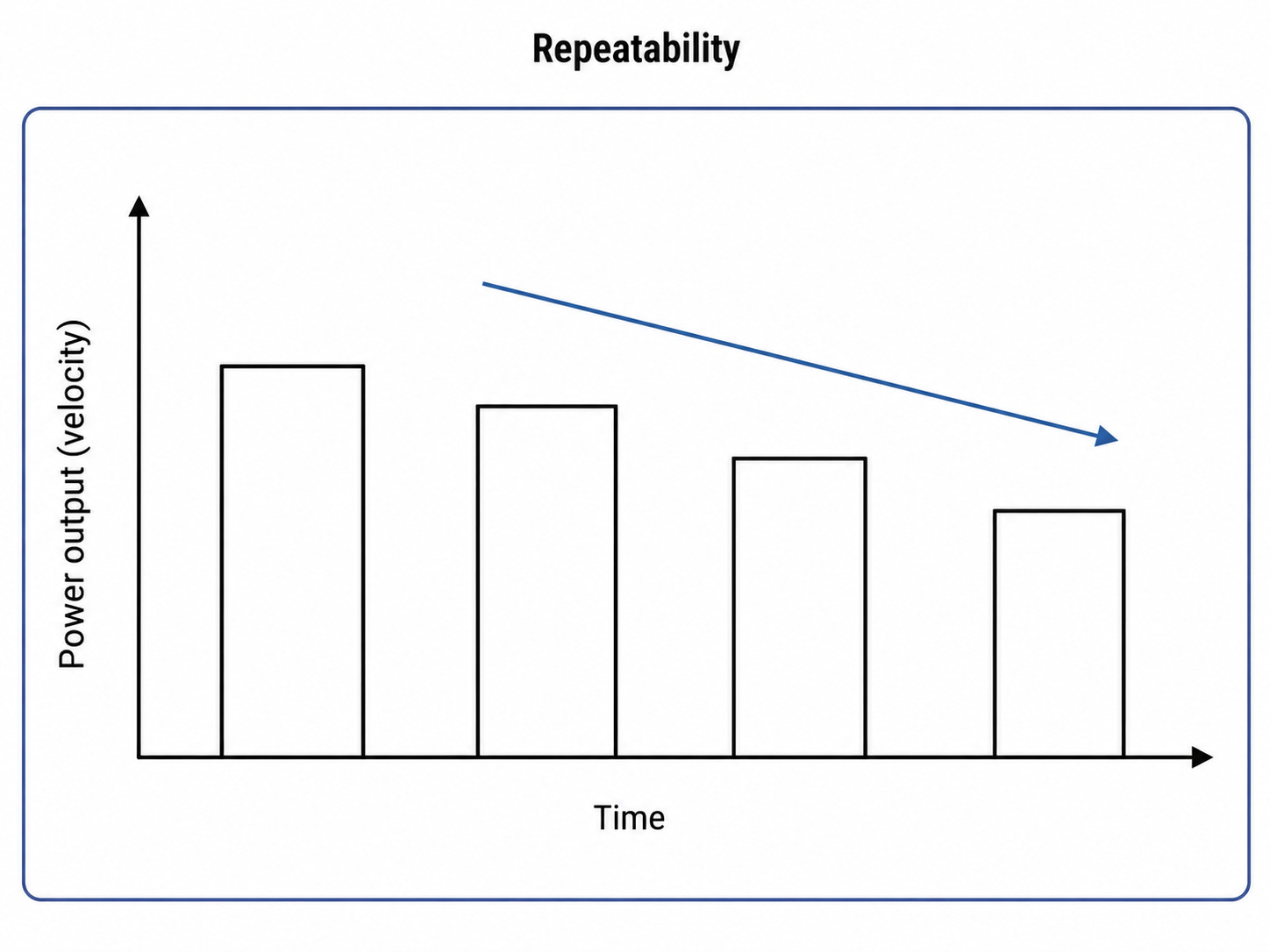
Repeatability is the ability to recover and reproduce high-intensity performance across multiple bouts, stages, heats, or efforts.
This is not the same as fatigability. Fatigability is about the decline under load when recovery is limited or absent. Repeatability is about what happens when there is some recovery and you have to go again (think a track interval session with equal rest in between repetitions).
An athlete can be durable but not very repeatable. They may grind well for a long, steady effort but struggle when asked to produce repeated surges or high-intensity bouts. Another athlete may have excellent repeatability in short efforts but lack the durability to hold performance deep into a long event.
Repeatability depends on recovery kinetics. That’s how quickly heart rate, lactate, neuromuscular function, metabolic processes, and fuel availability rebound between efforts. The paper notes that this trait appears trainable and may improve with maturation and accumulated training experience. Training consistently over time fixes everything. Well, not everything… but it fixes a lot.
Resilience
Resilience is the broadest and perhaps most slippery concept.
The authors describe resilience as the capacity to maintain or regain physiological and mechanical function under fatigue, environmental extremes, or other perturbations (heat, altitude, dehydration, mental fatigue, pain, sleep loss, terrain, psychological stress, and other real-world challenges). I’ll have to ask them if “small children at home” count.
A resilient athlete can adapt when the day gets ugly. They can manage heat, adjust pacing, fuel when the gut is unhappy, and absorb mental fatigue without a total performance collapse.
This trait matters for almost everyone who trains. A hot day, a missed water bottle, poor sleep, travel stress, a chaotic schedule, or an unusually demanding load at work or family life can expose whether fitness is robust or fragile.
This is not just a psychological trait either. Resilience has physiological roots, including our ability to regulate body temperature, hydration, sleep, cognition, and neuromuscular function.
That is important because I think many of us often moralize fatigue. When we fall apart, we assume we were weak or “soft.” Sometimes effort and mindset matter, of course. But often the body is dealing with a complex set of stressors that were not prepared for.
Resilience can be trained, but it requires specificity. Heat acclimation helps with heat. Long sessions help with prolonged fatigue. Fueling practice helps with gut tolerance. Strength training may help protect mechanics and muscular function. Sleep and recovery help preserve the systems that keep you adaptable.
Although I’d like to think there is some “cross-adaptation” that happens, too.
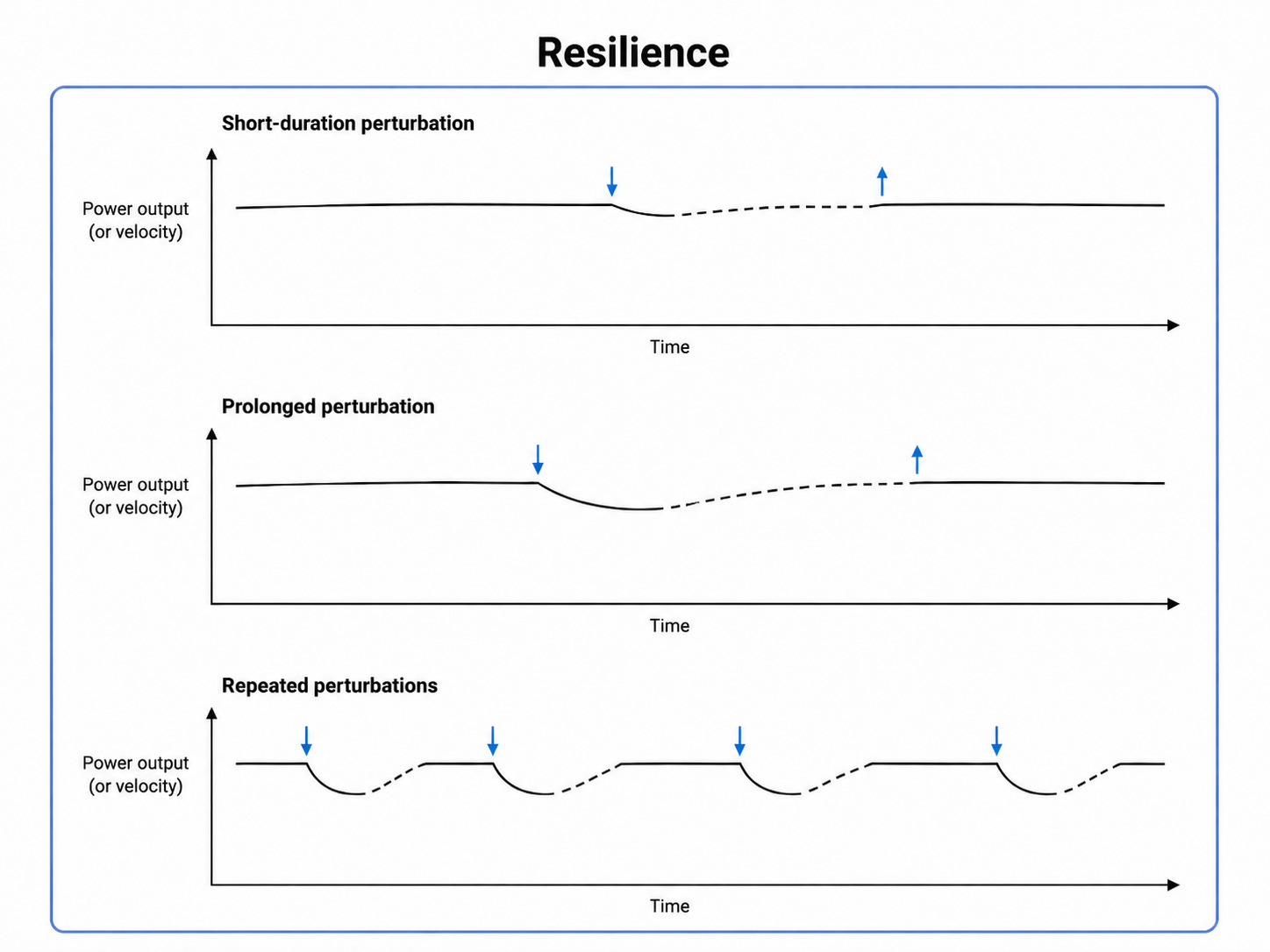
It’s important to note that the paper argues that these constructs should not be treated as interchangeable names for “good at not getting tired.” They are different capacities, with different mechanisms and different relevance depending on the event or goal.
That might be hard to see at first (I had to re-read these definitions several times), but physiologically speaking, the concepts become intuitive when you place them in the context of your own athletic domain. That exercise can also be useful for identifying your weaknesses (we all have one or two) and training them accordingly.
I’ll volunteer mine:
I am extremely durable. I can run forever. And if you tested me before and after a 2-hour run, I could likely produce similar values on a VO2 max or lactate threshold test. I’m also very repeatable—my efforts often get better as a workout goes on (if I get sufficient recovery), not worse.
But I am NOT resilient. Throw a wrench in my plans and introduce an unexpected variable, and I’m likely to psych myself out or crumble a bit under the unpredictability. So that’s something to work on…
None of this means we throw out VO2 max, lactate threshold, or economy. Those are still the foundation of a well-rounded performer.
But I think the next frontier in endurance performance may be understanding not just how high your ceiling is, but how much of that ceiling you can still access when the going gets tough.
That is what durability, fatigability, repeatability, and resilience are trying to describe.
The lesson for us all is simple: don’t just train to be strong when fresh. Train to remain yourself when tired. And that, I think, applies to much more than just athletics!
Thanks for reading. See you next Friday.
~Brady~
Ketone-IQ is high-performance energy in a bottle. I use it for post-exercise recovery along with enhancing focus, mood, and cognition. Take 30% off your order.

Create is the first “modern creatine” brand. They sell a wide range of creatine monohydrate gummies, and just launched a new creatine + electrolyte mix product plus travel-size packets of creatine gummies. They’re giving my audience 20% off their order.

ProBio Nutrition—the all-in-one supplement that I use every single day—is offering 20% off. My preference is the tangy orange flavor, but they also sell an unflavored “smoothie booster” that’s great in a shake, smoothie, or juice.

Equip Foods makes some of the cleanest, best-tasting protein products around. I am absolutely obsessed with their Prime grass-fed protein bars (the peanut butter ones are to die for, but they also just released a new chocolate peanut butter flavor).

Durability, fatigability, repeatability, and resilience in endurance sports: definitions, distinctions, and implications. Benedikt Johannes Meixner, Michael J. Joyner, and Billy Sperlich. Journal of Applied Physiology (2025). 139:6,1703-1709. 10.1152/japplphysiol.00343.2025.
Enjoyed this post. Great breakdown of why "not getting tired" isn't one thing. Durability, repeatability, resilience.
For some reason I can't seem to comment on your home gym over in the video thread. Bro, for 50 cents/ day you can get way better gear at planet fitness. It's ok to have weights and a bench and basic stuff like that but my experience with consumer grade home machines is that they break after a couple of years and are unrepairable. Also it's hot af where you are. Let PF do the a/c.