

Greetings!
Welcome to the Physiology Friday newsletter.
Details about the sponsors of this newsletter and deals on products I love, including Ketone-IQ, Create creatine, Equip Foods, and ProBio Nutrition can be found at the end of the post.
One of the few nearly indisputable principles of exercise physiology is that you get out what you put in.
It’s a cliché. But, physiologically speaking, it’s mostly true.
The harder you work (and the more consistently you do it), the more your body is forced to adapt. I suppose that’s as true in life as it is in exercise, but nowhere does it seem more obvious than with exercise intensity.
That helps explain the rise of high-intensity interval training over the past decade or so (although zone 2 is currently making a strong attempt to reclaim the crown). High-intensity training gained traction because research showed that it could produce meaningful benefits in far less time than traditional endurance exercise. And I mean FAR less. In some foundational studies, interval sessions lasting roughly 10–15 minutes produced improvements in aerobic fitness and cardiometabolic health comparable to 45–60 minutes of moderate, continuous exercise.
That’s pretty freaking remarkable.
Does this mean we should perform all our exercise at a high intensity? Of course not (that’s a discussion for another day).
But it does reinforce a broader idea that many of the benefits of exercise appear to be intensity dependent. And if that’s true, the obvious question is…why?
What happens inside the body during a few minutes of very hard exercise that makes it such a potent stimulus?
The usual explanations are that high-intensity exercise raises your heart rate more, burns more calories per minute, and places greater stress on your cardiovascular system. All of that is true. But, to me, those explanations are a little too surface-level. They describe how hard the body is working. They don’t fully explain the “biological message” that the workout sends. That message appears to be carried, at least partly, by molecules collectively called exerkines.
During exercise, skeletal muscle, the liver, fat tissue, immune cells, blood vessels, and other organs release proteins, metabolites, lipids, and hormones into the circulation. These molecules travel throughout the body and communicate with distant tissues. They are, essentially, the chemical messages through which one exercising organ talks to another.
The complete collection of factors secreted in response to exercise is broadly referred to as the exercise secretome (researchers in this field love their “omes”). Together, these contain thousands upon thousands of molecules that we’re only beginning to characterize.
So, if we want to understand why high-intensity exercise can produce outsized benefits relative to the time invested, it makes sense to study the secretome.
Does harder exercise simply release more signals? Does it release different signals? Do those molecules come from different organs, target different tissues, or relate differently to long-term health?
A new study attempted to answer all of those questions. And in doing so, they also raised another one: if we can identify exactly how high-intensity exercise reshapes this secretome—and which molecules produce which downstream effects—could we eventually, in effect, design “exercise in a pill?”
I won’t get too far ahead of myself. First, let’s look at what the researchers actually found.1
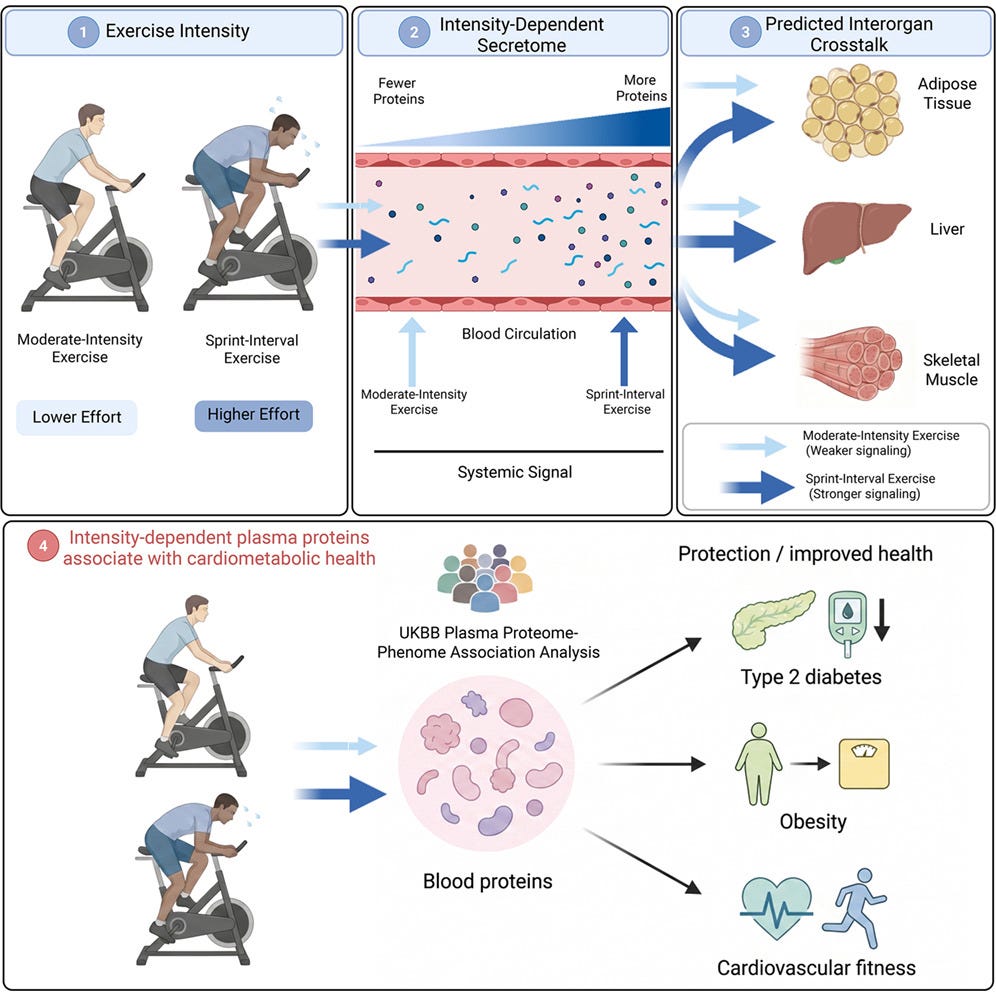
This was less a single experiment than a series of connected experiments designed to follow exercise signals from the bloodstream to their possible source, their potential target tissues, and, eventually, their relationship with long-term health. The latter aspect is perhaps the most applicable part of this whole study.
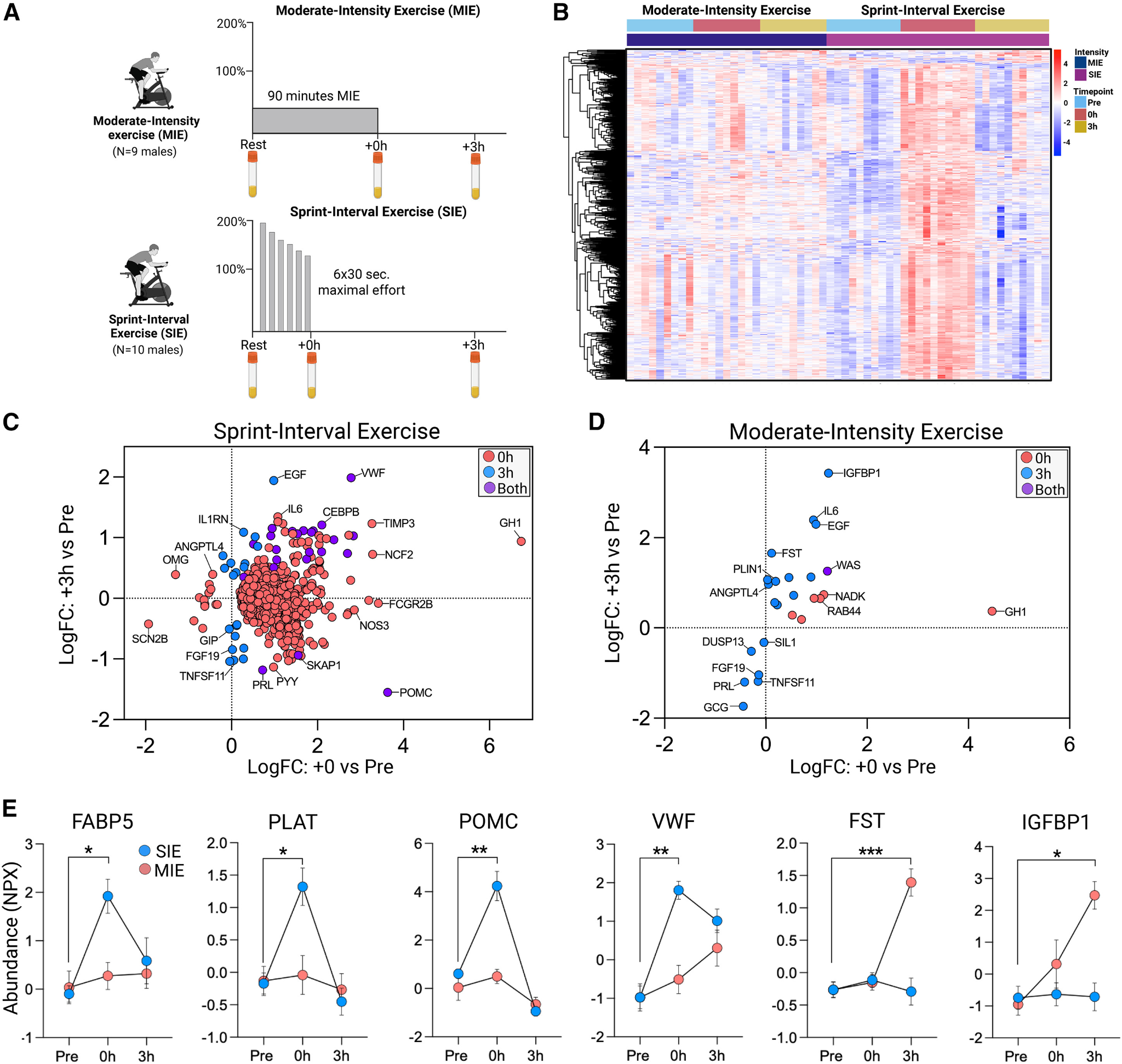
The primary experiment included 19 healthy, active men with an average age of 26. They were assigned to one of two cycling protocols:
Sprint-interval exercise (SIE) involved six 30-second all-out efforts against a resistance based on body mass, separated by four minutes of recovery. That’s only three minutes of maximal-effort exercise.
Moderate-intensity exercise (MIE) involved 90 minutes of continuous cycling at approximately 90–100% of the first lactate threshold—the point at which blood lactate begins rising above resting levels.
Blood was collected before exercise, immediately afterward, and again three hours later. A subset of the participants then completed eight weeks of either sprint-interval training or moderate-intensity training, with three to four sessions per week. The researchers repeated the same acute exercise and blood-sampling protocol after the training period to determine whether the molecular response was unique to the pre-training state or persisted after participants became better trained.
Immediately after the sprint session, 714 proteins changed significantly. That was nearly one-quarter of all the proteins the researchers detected, and more than 98% increased. These included proteins involved in vascular function, inflammation, fuel metabolism, and hormonal signaling. Three hours later, however, the number of altered proteins had fallen nearly 20-fold. The sprint session created a very large but very short-lived spike in circulating proteins.
The moderate-intensity session produced almost the opposite pattern. Only seven proteins changed immediately after 90 minutes of cycling, but that number increased to 19 three hours later.
When the researchers directly compared the responses to the two protocols, 280 proteins differed immediately after exercise. Three hours later, only two differed: follistatin and insulin-like growth factor-binding protein 1 (both of which were higher after moderate exercise).
The eight-week training period did not eliminate these responses! The same general pattern remained when the acute exercise tests were repeated: an immediate increase after sprint exercise and a delayed increase after moderate exercise. Several individual proteins also responded similarly before and after training, which suggests that sprint response wasn’t just a shock produced by giving untrained participants an unfamiliar workload. At least some of these intensity-dependent signals remained after repeated training.
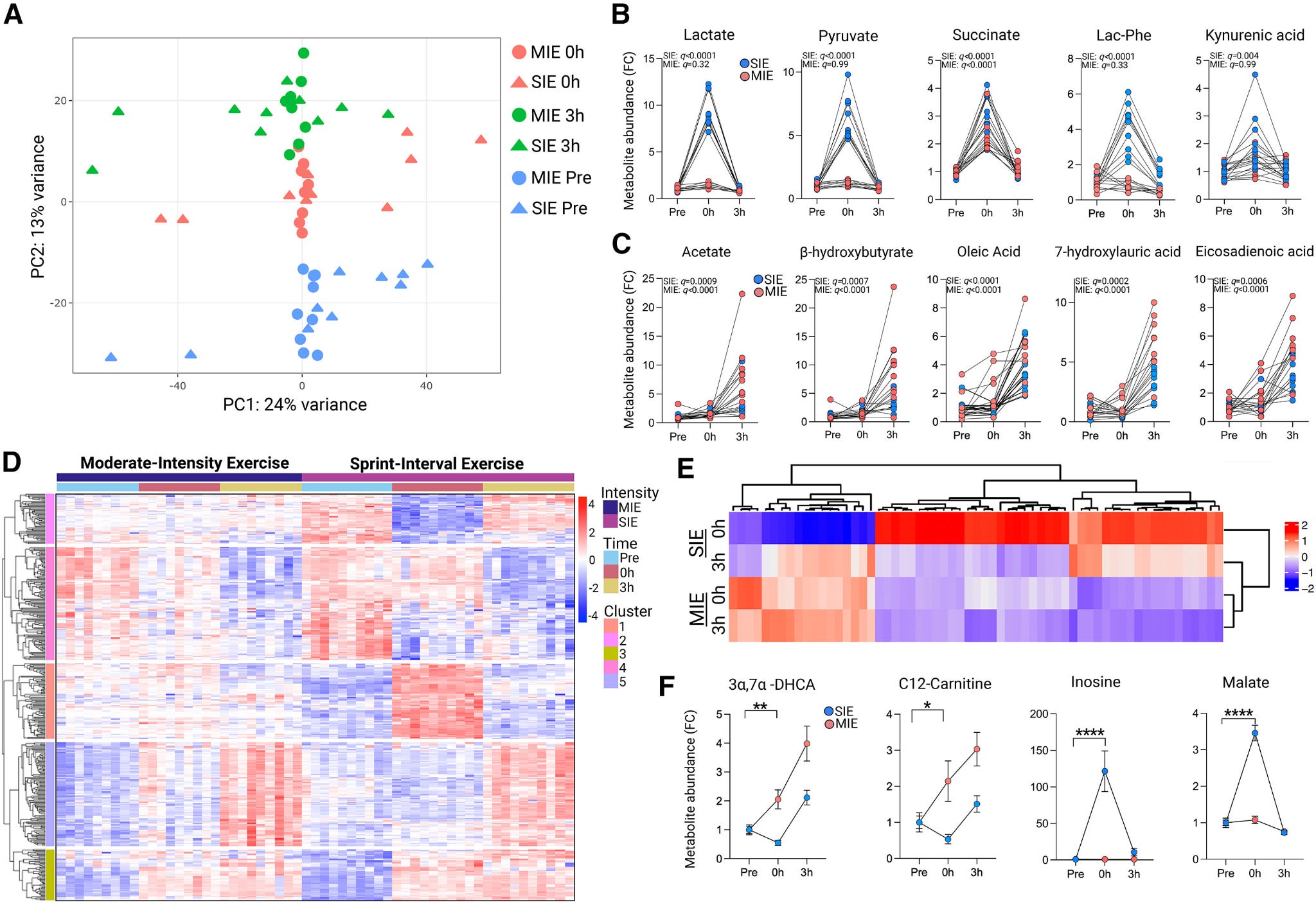
The metabolites behaved similarly.
Sprint exercise changed 203 metabolites immediately after exercise. These included lactate, pyruvate, succinate, and malate—molecules that reflect rapid glucose breakdown, mitochondrial energy production, and accelerated ATP turnover (all of which are increased during exercise in an intensity-dependent manner). Three hours after the sprint session, 199 metabolites remained altered, but the profile had shifted. Rather than being dominated by products of rapid carbohydrate metabolism, it now included several circulating fatty acids.
Moderate exercise again produced the more delayed response. Only 31 metabolites changed immediately after cycling, compared with 203 after sprinting. Three hours later, however, 183 metabolites had changed. Most were fatty acids or other molecules associated with lipid metabolism. So, once again, sprint exercise produced the large immediate signal, while moderate exercise generated a slower metabolic one. Several of these metabolite responses also persisted after the eight-week training intervention.
Where were these signals coming from?
The predicted sources included immune cells, skeletal muscle, adipose tissue, the liver, pancreas, pituitary, intestine, brain, and several other organs—not just working skeletal muscle.
Next question. Where were they going?
To find out, the researchers performed what was essentially a plasma-swap experiment. Human fat cells were exposed for three hours to blood collected either before or immediately after exercise. Blood collected after sprint exercise increased the expression of 1,128 genes and decreased the expression of another 549. Plasma collected after moderate exercise produced a much smaller response: only 14 genes increased, and 11 decreased.
This is a wild finding, because the cells were not contracting, producing force, or experiencing the exercise session themselves. They were simply exposed to blood collected from someone who had just exercised! Something about the post-sprint environment dramatically altered the genetic program in fat cells.
You might be asking yourself—so what? Who cares about the “secretome” unless it’s having a relevant impact on some health or performance outcome?
That leads to the final aspect of the study.
Did these proteins relate to long-term health?
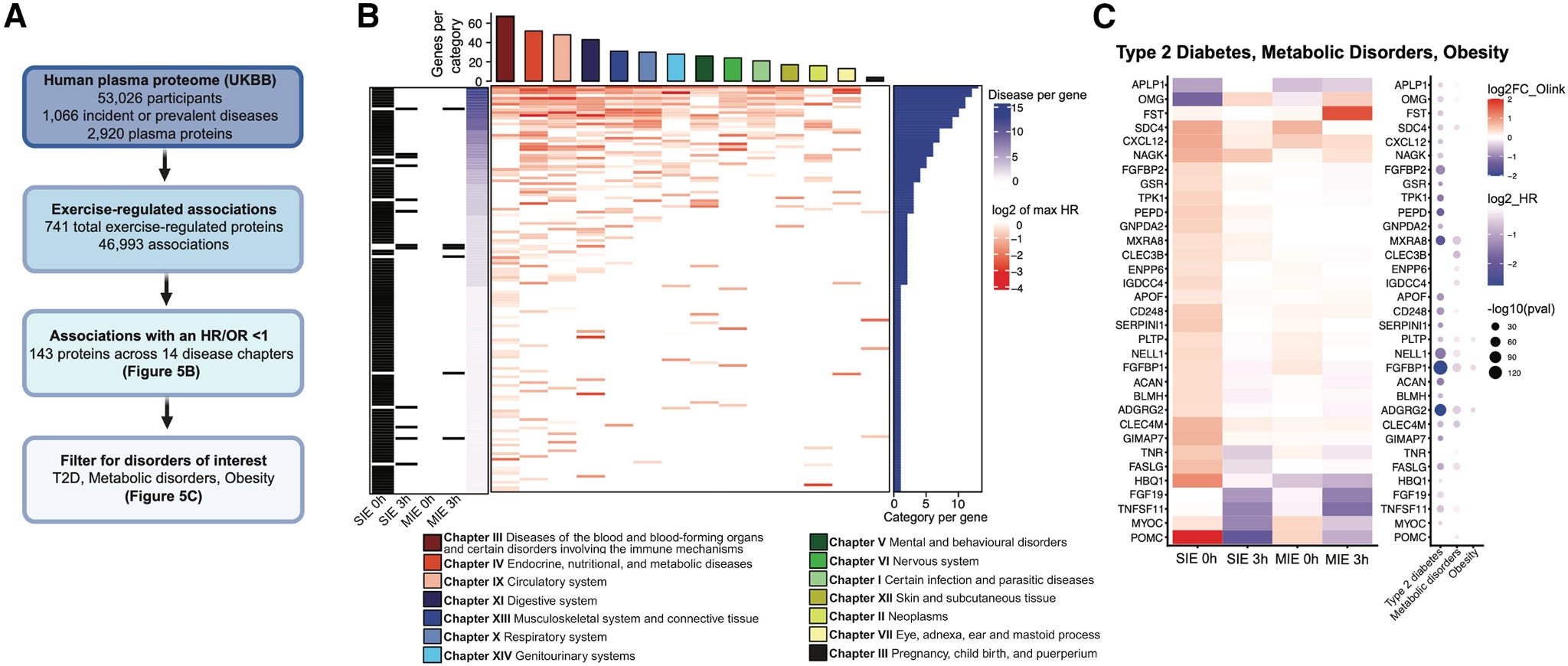
The researchers used a UK Biobank resource containing plasma-protein measurements from 53,026 people and data covering 1,066 diseases. They searched for health associations involving the 741 proteins altered by either sprint or moderate exercise.
Across those proteins, they identified 46,993 protein-disease associations. Counterintuitively, most were associated with higher rather than lower disease risk, which may reflect the fact that acute exercise temporarily activates inflammatory and cellular stress signals (protein rising briefly after a workout can be part of a beneficial adaptive response even if chronically elevated levels are associated with disease).
So the authors then narrowed their analysis to proteins associated with lower disease risk. This left 143 proteins spanning 14 broad disease categories, most of which had been altered exclusively by sprint exercise. When they focused specifically on obesity, type 2 diabetes, and other metabolic disorders, they identified 33 exercise-responsive proteins associated with lower risk. Thirty-two of the 33 were altered after sprint exercise, while only three were altered after moderate exercise. And more than one-quarter of these 33 proteins were also inversely associated with chronological age (higher levels were associated with a lower, or younger, chronological age).
The tl;dr: sprint exercise acutely altered a larger number of circulating proteins, and many of those same proteins were associated with better cardiometabolic outcomes in a large observational dataset. What we can’t say is that any one of these proteins (or sprint/moderate-intensity exercise itself) causes better health outcomes. Although there’s plenty of other strong evidence to suggest that’s true.
Do these findings solve the “zone 2 versus high-intensity” debate? Of course not. There is no solution (or correct answer as to which one is “better”).
But they are a strong… and I mean very strong… argument in support of the idea that high(er) intensity exercise is a more potent, and therefore a more beneficial, stimulus. It sends the body a stronger signal, and that signal (probably) shapes long-term health outcomes. If we look at the epidemiological data linking vigorous exercise (performed in short bouts or even “randomly” throughout the day) to disease risk, the argument becomes even stronger.
To wrap up, I want to return to a radical idea I surfaced at the beginning of this email.
The idea of “exercise in a pill” is usually dismissed outright, occupying the same sci-fi realm as the fountain of youth. I’m the first one to admit that the idea of replicating the full spectrum of benefits exercise gives us seems insane. So bear with me for a moment.
This study was able to identify the entire suite of proteins, metabolites, and signaling molecules released during a single session of exercise. We are now able to characterize precisely what happens—and to what magnitude it happens—when we break a sweat. Knowing this, it doesn’t seem too far-fetched that some pill (or more likely injection) could simulate this response in someone without them even stepping foot in a gym.
But to simplify exercise into its component parts is insulting. It disregards the social aspects of exercise, the physical movement going on during exercise, and the psychological benefits that come along with it.
We can (probably) replicate the exercise secretome, but we (almost certainly) can’t replicate the social, physical, and psychological landscape in which exercise is performed.
And truly, who would want to?
Thanks for reading. See you next Friday.
~Brady~
Ketone-IQ is high-performance energy in a bottle. I use it for post-exercise recovery along with enhancing focus, mood, and cognition. Take 30% off your order.

Create is the first “modern creatine” brand. They sell a wide range of creatine monohydrate gummies, and just launched a new creatine + electrolyte mix product plus travel-size packets of creatine gummies. They’re giving my audience 20% off their order.

ProBio Nutrition—the all-in-one supplement that I use every single day—is offering 20% off. My preference is the tangy orange flavor, but they also sell an unflavored “smoothie booster” that’s great in a shake, smoothie, or juice.

Equip Foods makes some of the cleanest, best-tasting protein products around. I am absolutely obsessed with their Prime grass-fed protein bars (the peanut butter ones are to die for, but they also just released a new chocolate peanut butter flavor).

Brad, fascinating read, and the more we learn, the less we know 🤓 it’s crazy isn’t it?
I think a lot of folks would want an "exercise in a pill"! 😄
I, for one, never felt good/better after exercise (especially high intensity), to the point where i almost stopped doing it completely, as it required completely clearing my schedule after the session (I guess looks like suffering from PEM?). If I could reap the benefits of exercise without the crash I'd pay a solid pile of cash for this pill.